How Much Does Digital Product Design Cost in 2026 for Startups and B2B?

8minutes read
product design cost

One of the first questions founders ask is, "How much does it cost to design a product?" It’s a valid concern, but successful companies view this budget differently: not as an expense, but as risk mitigation. It is far cheaper to fix a logic error in a prototype than to rewrite code after a failed launch. The data confirm this: design-centered companies experience 32% faster revenue growth than their peers. 

At Gapsy Studio, we’ve guided over 200 startups and enterprises through this financial planning, so we know where budgets are well-spent and where they are wasted. In this guide, we break down the real 2026 product design cost estimates for apps and SaaS products, analyze the factors driving these prices, and share proven strategies for product design cost reduction to help you build smarter.
Product Design Cost: Your Short Answer

If you need a reliable starting point for budgeting your project, here’s what the 2026 market looks like.

Drawing from our cross-industry experience, the investment in product design for digital platforms typically falls into three well-defined tiers. These ranges reflect the complete design process: strategic discovery, UX research, information architecture, high-fidelity UI, interactive prototyping, and a structured developer handoff. 

It’s important to note that these estimates apply strictly to the design phase; engineering and implementation costs are calculated separately.

Project maturity

Typical budget range

What this usually covers

Startup MVP

$10,000 – $25,000

Speed to market. Core feature set, one platform (Mobile or Web), essential branding, and a clickable prototype for investor validation.

Mid-sized product (SaaS)

$30,000 – $60,000

Market fit and scale. Web + Mobile adaptive, custom dashboard, user role management, design system creation, and basic user testing.

Enterprise ecosystem

$75,000+

Complexity and security. Multi-platform systems (e.g., Fintech/Healthcare), rigorous compliance flows, advanced data visualization, and comprehensive documentation.

The reason for the price difference is that complexity drives cost.

A basic app is straightforward, but once you add real-time data or deep logic, the design effort grows fast. Think of it this way: a simple to-do list and a live trading dashboard are both "apps," but they are worlds apart to build. Usually, what’s happening under the hood dictates how hard the interface is to design.

To get it right, you need a team that understands the tech just as well as the visuals. If you’re trying to figure out where your project fits, let’s chat. We’d love to help you find the right approach for your goals.

Cost of Product Design by Project Stage

To accurately estimate the cost of product design, you have to look beyond the pixels. It’s easy to assume the budget pays mostly for polished screens, but that’s only half the story.

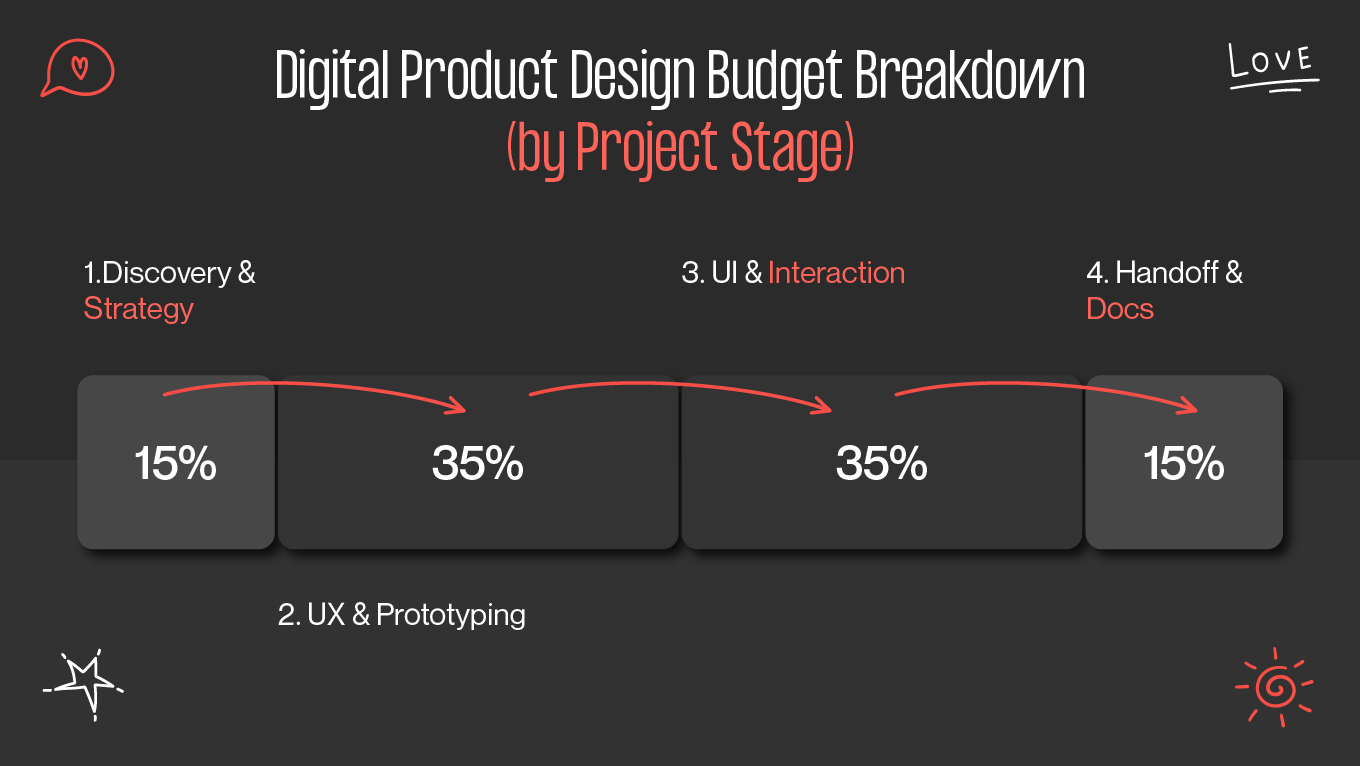
In reality, a huge part of the investment goes into the work you can’t see (strategy, logic, and testing). We spend nearly half our time on this foundational work because it’s the only way to ensure the final product doesn't just look good, but actually succeeds.

Digital product design budget breakdown

Here is how a typical budget is distributed across the lifecycle of a successful product, based on our experience: 

Discovery and Strategy 

You wouldn’t build a house without checking the soil first, so we don’t build software without checking the market. Discovery and strategy creation is the blueprint phase, where strategic groundwork determines whether a product scales or stalls. 

  • What you pay for: In-depth competitor and category analysis; creation of high-accuracy user personas; multi-stakeholder workshops to align business and technical expectations; a clear definition of functional and technical requirements. 

  • The ROI: This stage protects teams from the single most expensive mistake in software — investing in features users don’t need or won’t adopt. Industry data shows that 85% of successful design projects begin with deep research, because it dramatically reduces the risk of costly mid-development pivots, unclear scope, and misaligned expectations. In practice, every hour spent here saves dozens downstream.

UX Design and Prototyping

This is where your product develops its structural backbone: the logic, user flows, and information architecture. It determines how intuitively and efficiently people will interact with it. 

At Gapsy, we treat this phase as the strategic foundation that shapes every downstream design and development decision. This is also where our UI/UX design approach comes into play, aligning user behavior, product logic, and interface structure before any visual layer is finalized.

  • What you pay for: Wireframes, screen architecture, user journey mapping, sitemaps, and interactive low-fidelity prototypes that allow teams to test the product’s thinking long before visual design enters the picture.

  • The ROI: You uncover friction, logic gaps, and unnecessary complexity (precisely when they’re cheapest to fix).  A UX adjustment in a wireframe takes a few hours; the same adjustment in fully developed code can take two weeks and involve multiple teams. Robust UX architecture dramatically reduces design debt, prevents costly redevelopment, and ensures that when moving into UI and engineering, you’re building on a stable, validated foundation rather than iterating in the dark.

This foundation is also critical for a healthy product adoption process, where users can understand value quickly and build habits without friction.

UI and Interaction Design

While UX makes it work, the UI creates the connection. It’s what tells users your product is credible and worth their time. That’s why we treat interface design as an extension of your branding system, so every interaction feels consistent, intentional, and unmistakably yours.

  • What you pay for: High-fidelity screens, custom iconography, visual hierarchy systems, interaction patterns, motion design, and accessibility-compliant color and contrast standards that make the product usable for a wider range of users.

  • The ROI: Good design dictates behavior. A clear, intuitive layout removes hesitation and turns casual browsing into actual action. Research proves this, as well-optimized product interfaces can boost conversion rates by up to 400%. 

Handoff and Documentation

Design isn't finished when the visuals are approved. It's finished when developers can build it without guessing.

Our team treats handoff as a critical bridge, where we make sure every detail is engineering-ready, so the product you launch looks exactly like the one we designed.

  • What you pay for: A fully structured Design System, reusable component libraries, spacing and typography tokens, interaction rules, motion guidelines, redlines, and implementation-ready specs formatted for the development stack (Figma → React, Flutter, SwiftUI, etc.). Every component includes usage rules that help teams know when and how to apply it.

The ROI: A clean, robust handoff drastically reduces development time, rework, and engineering costs. When developers don’t need to guess, interpret, or reverse-engineer UI decisions, they deliver faster and with far fewer errors.

How Much Do Product Design Services Cost? Comparison of Different Cooperation Options

When you ask, "How much do product design services cost?", the answer depends entirely on who does the work.

You generally have three options: hiring a solo freelancer, building an in-house team, or partnering with a dedicated agency providing experienced talents. Each comes with a different price tag and risk profile. The "sticker price" is often misleading, as hiring a full-time employee involves significant overhead (taxes, hardware, benefits) that isn't reflected in their salary.

Hiring Option

Estimated Cost 

Best For

The Risk Factor

Freelancer

$50–$120 / hour

Small tasks, quick fixes, or very early-stage prototypes.

Reliability. If they get sick or ghost you, your project stops. You are also limited to one person's skillset (e.g., they might do UI well but fail at UX logic).

In-House Senior Designer

$120,000- $160,000/year


(Salary + Benefits + Overhead)

Mature companies that need long-term product maintenance.

Burn Rate. You pay them their full salary even during downtime. Plus, the hiring process takes 3-6 months.

Digital Product Agency

Project-Based/ Retainer


($10k - $50k+ depending on scope)

Startups and SMEs are developing a new product or undergoing a major redesign.

Higher Hourly Rate. You pay a premium per hour compared to a junior freelancer, but you pay for zero downtime.

Why the Agency Route Often Makes More Financial Sense

So why do seasoned founders and high-growth startups increasingly choose the agency model, even when the hourly rate looks higher on paper? One word: scalability. This is precisely why product design outsourcing has become the preferred model for startups and B2B teams that need senior expertise without long-term overhead.

When you hire a full-time Senior Product Designer for ~$130k/year, you get one specialist with a single discipline focus. But modern digital products rarely succeed on design alone; they require research, systems thinking, micro-interactions, testing loops, and ongoing alignment with technical constraints. That level of breadth is impossible to achieve with one hire.

When you partner with a product design agency like Gapsy for a similar annual budget, you gain access to an entire cross-functional ecosystem:

  • A UX Researcher to validate your idea (runs user interviews, tests assumptions, prevents costly misalignment before design begins).
  • A UX/UI Designer to make it eye-catching and functional (creates structure, layouts, flows, and visual language that drive clarity and conversion).
  • A Motion Designer to add interaction (builds animations, micro-interactions, and transitions that improve usability and perceived quality).
  • A Project Manager to keep it on track (coordinates timelines, removes blockers, ensures smooth communication, and protects your budget and scope).

You get the expertise of five people for the cost of one, and you can pause the contract the moment the design phase is done. That is financial efficiency.

If you’re on the fence about hiring vs. partnering, let’s just have a chat about your roadmap. We can look at what you need to build and see which model makes the most sense for your runway.

Want to create a product design?

See Gapsy's hourly rate further in the article. Press the button and we will contact you.

Factors That Influence Your Product Design Cost Estimate

If you request quotes from three different design agencies, you’ll almost always receive three very different numbers. That discrepancy stems from how each team interprets the scope, the product vision, and the level of depth required to deliver a high-quality outcome.

To get a precise and reliable product design estimate, you should first define the variables that truly drive complexity. In our experience, three core factors have the biggest impact on whether a project sits at the low, mid, or high end of the pricing spectrum:

Platform Coverage

The platforms you choose to support have a direct and measurable impact on your total product design cost. A lightweight web app and a multi-platform ecosystem require fundamentally different levels of effort, expertise, and design architecture.

Web Only — Baseline investment.

Ideal for early validation or products with desktop-first usage. The structure is straightforward, and design patterns remain consistent.

Web + Mobile Responsive — Moderate increase (~15–20%).

Adapting layouts across breakpoints requires rethinking hierarchy, scaling interaction patterns, and ensuring that the experience remains intuitive on smaller screens. This is where many products fail. Nonetheless, responsive behavior is one of Gapsy’s strongest areas of expertise, especially for SaaS and fintech interfaces where clarity under constraints is critical.

Native iOS + Android — Significant increase (~50–80%).

Designing native experiences is not simply “resizing screens.” Each ecosystem has its own rules, gestures, navigation patterns, and interaction logic. iOS follows Apple’s Human Interface Guidelines, while Android aligns with Material Design principles, which means every component, motion pattern, and user expectation must be tailored accordingly.

Functional Complexity

Functional complexity is one of the most significant drivers of product design cost. Two solutions may look similar on the surface, but the underlying logic can require vastly different levels of design effort.

  • Standard features.  Elements like login flows, profile pages, settings, and basic dashboards rely on established UX patterns. Because our team at Gapsy has designed these core components across dozens of products — from fintech platforms to SaaS tools and marketplaces — they’re fast and cost-efficient to deliver. These features rarely increase scope; they provide a stable foundation that keeps budgets under control.
  • Novel Complexity.  Costs rise when a product introduces behavior that can’t rely on familiar patterns. This includes AI-driven interfaces, real-time data visualization, multi-state dashboards, AR/VR interactions, or products that are based on detailed 3D modeling to explain complex objects, environments, or spatial behavior. We see this constantly in our work with live trading platforms and secure payment flows. When you’re building an interaction that doesn’t have a standard playbook yet, it requires more research and testing, as well as tighter collaboration with engineers to make sure it works.

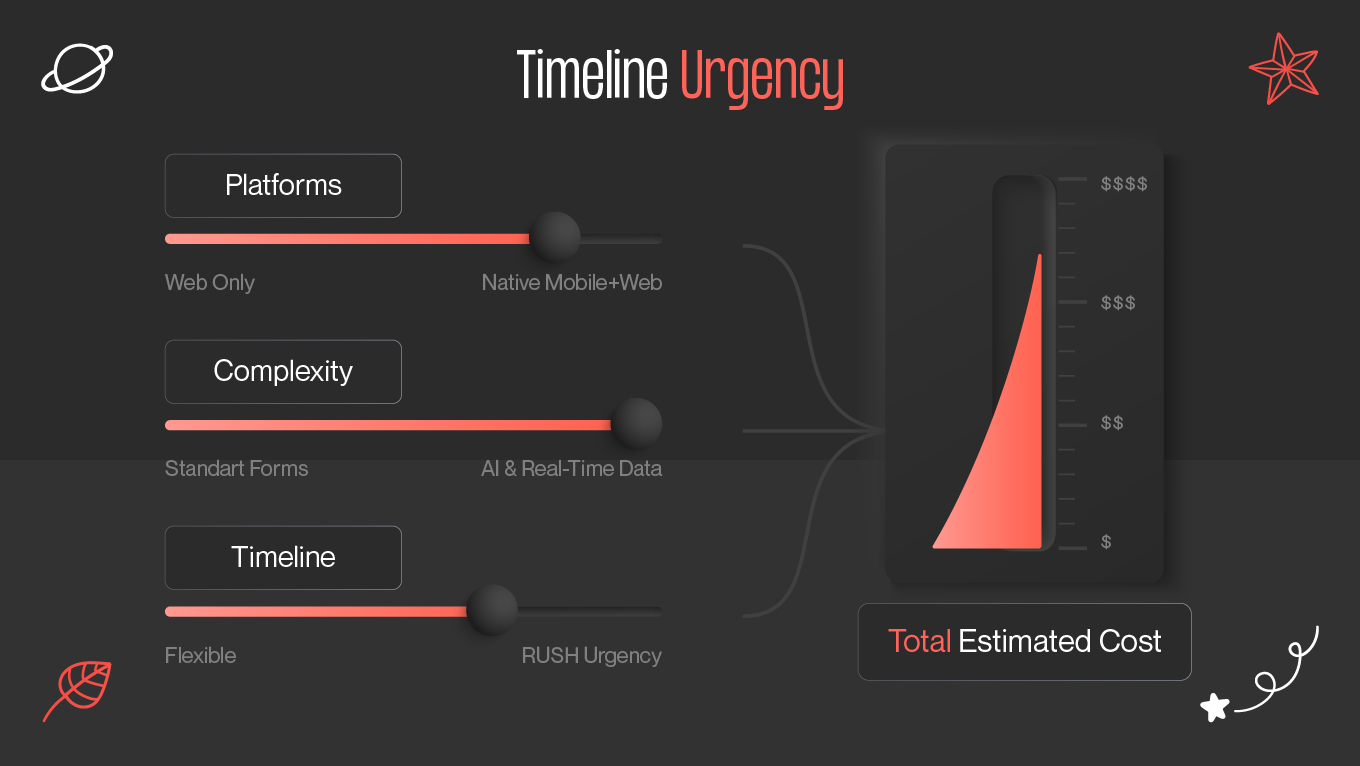
Timeline Urgency

In product design, speed, quality, and cost form a fixed triangle. You can usually optimize for two, but never all three at once.

  • Standard timeline (3–4 months). This timeframe allows space for proper discovery, UX validation, iteration, and stakeholder alignment. It’s where design decisions are tested rather than assumed, risks are addressed early, and scope stays predictable. From a cost perspective, this is the most efficient option: fewer revisions, cleaner handoffs, and better long-term outcomes.

Accelerated timeline (4–6 weeks).  When a launch is tied to an investor demo, market window, or regulatory deadline, timelines compress. To maintain quality under these conditions, we typically allocate senior designers, reduce iteration cycles, and run parallel workflows. This intensity increases delivery speed but also raises cost (usually by 20–30%), reflecting overtime, priority resourcing, and reduced scheduling flexibility.

Timeline Urgency
Timeline Urgency

5 Strategies for Product Design Cost Reduction

Founders often think a tight budget means hiring cheaper talent. It doesn’t.

It means you need to be smarter about what you build.

True product design savings come from cutting waste. Here are five practical ways to bring the cost down without hurting the final product.

Spending on discovery may feel counterintuitive when budgets are tight. Nonetheless, it’s the most effective way to control total cost in practice. Discovery clarifies what not to build before committing resources.

Example: A focused $5,000 discovery sprint that validates demand, user flows, and constraints is dramatically cheaper than investing $50,000+ into a product that solves the wrong problem. 

The quickest way to burn a budget is designing for a future that hasn’t happened yet. The thing isn’t in lack of features; most products fail because they’re bloated.

Focus only on the core features that solve the primary user problem. Launch the "skateboard" first, get user feedback, and then build the "car." By narrowing the initial scope, you significantly cut design and development hours.

Unless your product’s competitive edge depends on a completely novel interface, designing every component from scratch is rarely justified at early stages.

Established systems like Material Design or Ant Design already solve accessibility, consistency, and usability at scale. An experienced partner can adapt these foundations to your brand while avoiding hundreds of hours of redundant UI work. For MVPs, this approach dramatically lowers cost without compromising quality or future scalability.

Design changes become exponentially more expensive as fidelity increases. Adjusting a wireframe is fast; revising a polished UI cascades across layouts, components, and states.

Before moving into high-fidelity UI, all stakeholders should align on user flows, information architecture, and feature scope. Late-stage ripple through the entire system, consuming budget and delaying delivery. Clear sign-off at low fidelity is one of the simplest ways to protect timelines and costs.

Unstructured feedback is a hidden budget killer. Multiple reviewers sending fragmented comments create constant context switching, slow progress, and inflate design hours without adding value.

High-performing teams consolidate feedback into a single, prioritized review per iteration. This allows designers to address issues holistically instead of reacting to micro-adjustments. Structured review cycles lead to faster decisions, cleaner outcomes, and significantly lower iteration costs.

How to Get an Accurate Quote for Your Idea

Ultimately, the only reliable way to understand how much product design will cost for your specific idea is to evaluate real inputs instead of the averages. Market ranges are useful for orientation, but in practice, pricing is shaped by product maturity, uncertainty level, and the depth of decision-making required. Two products with the same feature list can differ dramatically in cost depending on logic complexity, user roles, and validation needs.

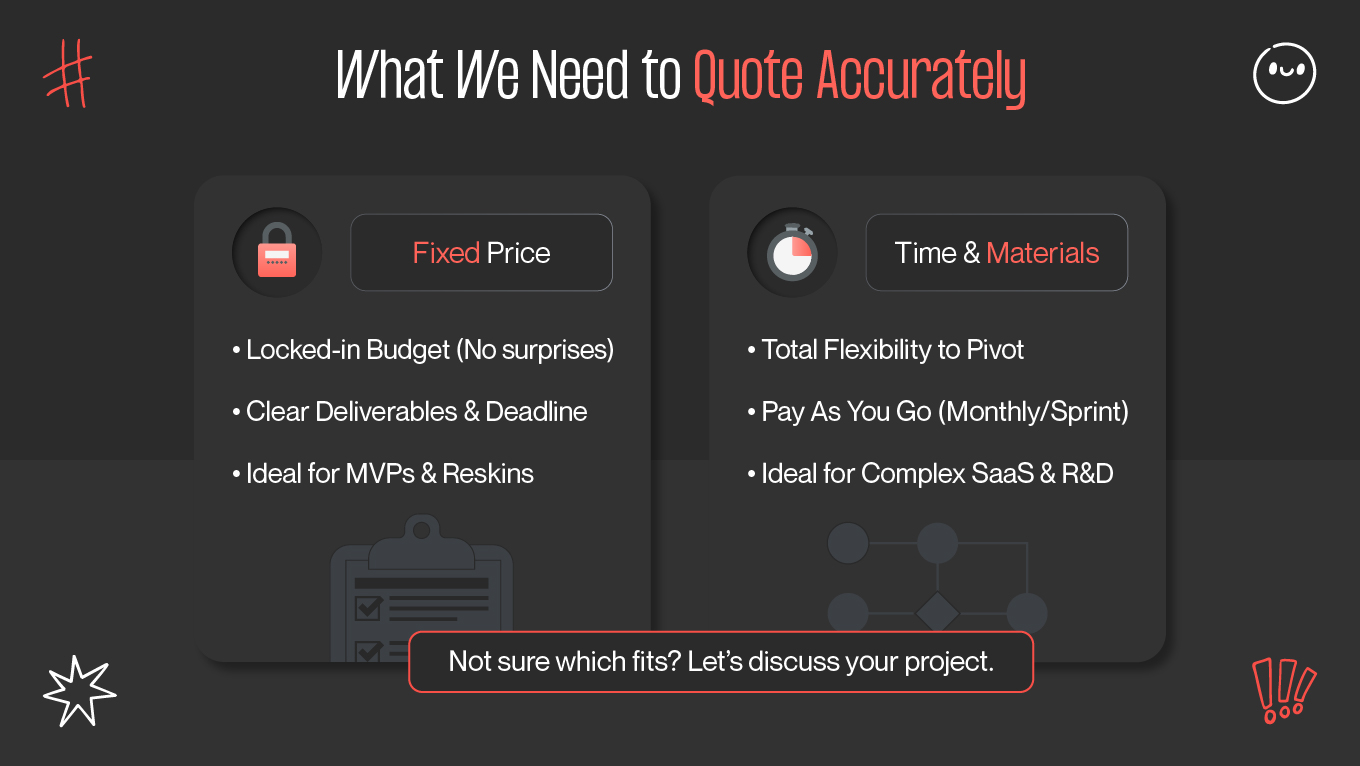
We believe in cost transparency and in explaining why a number exists — not hiding it behind vague ranges. Depending on how defined your project is and how much flexibility it requires, we typically work with two pricing models.

Fixed Price Model (Best for Defined Scopes)

If your product has clear requirements, a finalized feature set, and a fixed deadline, we can offer a single, locked-in price covering the entire design scope.

Why choose it: You know exactly what you’re paying for — down to deliverables, milestones, and timeline. This model minimizes financial uncertainty and works best when decision-making is aligned upfront.

Best for:

  • MVPs with validated assumptions
  • Landing pages and marketing websites
  • Focused UX/UI redesigns
  • Projects where the scope is intentionally “frozen” to avoid rework
  • This model performs best when the goal is execution efficiency rather than exploration.

Time & Materials (Best for Innovation)

If you’re building a complex or exploratory product (especially one driven by AI, data-heavy logic, or emerging user behaviors), requirements often evolve as insights emerge. In this case, we bill based on actual time spent.

Why choose it: You gain full strategic flexibility. The team can adapt flows, refine features, or pivot direction based on user testing, stakeholder input, or market feedback without renegotiating contracts every time the scope shifts.

Best for:

  • Long-term SaaS platforms
  • AI-driven or data-intensive products
  • Early-stage startups seeking product–market fit
  • Ongoing product design and optimization cycles

This model supports learning, iteration, and informed decision-making.

What We Need from You to Provide an Accurate Quote

We can usually turn around a realistic estimate within 24 hours. And don't worry—you don't need a massive requirements document to get started. 

To get the scope right, we usually just need three things:

  • A brief description of the product (What problem does it solve?).
  • A feature list (What does the user need to do? Login, pay, chat?).
  • References (Examples of other apps or styles you like).
What We Need from You to Provide an Accurate Quote

What We Need from You to Provide an Accurate Quote

Why Gapsy Studio? Because You Need ROI, Not Just Pretty Pixels

If you’ve read this far, you understand that digital product design is a significant investment. The market is flooded with agencies that can make screens "look nice." But if your goal is a successful launch and sustainable growth, aesthetics are only 20% of the job.

Since 2014, Gapsy Studio has operated on a simple premise: Good design must make business sense. That’s why we approach design not as isolated screens, but as a holistic customer experience design process that directly impacts conversion, retention, and long-term product value.

Across 200+ successful product launches, we've helped startups secure funding and enterprises streamline complex operations — experience that places us alongside other best product design companies working on high-impact solutions. 

  • Our team doesn't design on vibes. We design for numbers. Everything done is rooted in research, aiming for real impact, like the 25–35% jumps in conversion and retention we’ve secured for past clients.

  • We love the heavy lifting. Generic agencies stumble when things get technical. We thrive there. Fintech, Healthcare, AI—our agency specializes in the complex, high-stakes fields where accuracy is just as important as aesthetics.

  • We speak developer. A pretty Figma file is useless if it breaks the code. Our designers understand technical constraints from day one. That means no impossible layouts and no expensive delays. 

When partnering with us, you're hiring product strategists committed to ensuring your investment yields a return.

Whether you’re building a new MVP or fixing an existing platform, you don’t have to figure it out alone. Drop us a line. We’ll help you look at the roadmap, spot the risks, and see if we’re the right team to help you build it.

Conclusion: Stop Guessing and Start Building

The question "How much does product design cost?" doesn't have a single, universal answer. And that’s a good thing. It means your budget is flexible based on your specific goals, timeline, and feature set.

Remember: professional design isn't cheap, but bad design costs a lot more. A confusing product will burn through your runway faster than any agency invoice ever could. The smartest founders know this. They aren't hunting for the lowest bidder. Instead, they're looking for a partner who ensures they don't have to build the same thing twice.

Uncertainty kills momentum. If you’re stuck trying to figure out if the numbers work, just contact us. We’ll help you scope it out and give you a plan you can take to your stakeholders.

Rate this article

40 ratings
Average: 4.9 out of 5

If you like what we write, we recommend subscribing to our mailing list to always be aware of new publications.

Do you have any questions? We tried to answer most of them!