
Telemedicine Website Design in 2026: Tips, Best Practices, and Examples

13minutes read
telehealth web design

A patient’s trust is won in the three minutes they spend navigating your interface. Since 70% of users expect healthcare to be as intuitive as a banking app, a clunky intake flow directly causes appointment abandonment.

In telemedicine, design isn't surface. Scheduling, consent, authentication, and HIPAA compliance either work together as one coherent system or they don't work at all. When they don't, the damage is abandoned bookings, compliance exposure, and patients who chose someone else.

Our guide is built on a decade of Gapsy’s experience of healthcare platform design. It's a practical framework for founders who understand that the right decisions here improve the experience and determine whether the business scales.
Key Takeaways

  • Thoughtful telemedicine design reduces friction in patient onboarding, increasing booking completion and trust.

  • Platforms built with structural control handle multi-specialty workflows, regulatory requirements, and growth more efficiently.

  • Clear dashboards, smart scheduling, and progressive intake flows improve provider utilization and reduce no-shows.

  • Embedding analytics, consent logging, and workflow monitoring from the start allows leadership to make strategic, risk-informed decisions.

  • Performance, mobile accessibility, and AI-enhanced guidance directly influence patient satisfaction, retention, and long-term revenue.

Case Study of Building a Trust-Driven Healthcare Website

We teamed up with Dentalux to turn their clinical credibility into a digital experience that fosters patient trust and supports long-term growth.

Dentalux is a modern dental clinic that combines effective treatment technologies, skilled practitioners, and personalized care. In healthcare, the way people perceive a service plays a key role in converting leads and building long-term brand loyalty. Their goal was not just to update their image but to create a digital foundation that communicates safety, competence, and accessibility, all while promoting measurable business success.

The Challenge Our Client Faced

The main issue was not branding but rather risk perception.

Many dental websites inadvertently heighten anxiety. Our research showed that clinical visuals, scattered service pages, unclear pricing, and hard-to-find booking options create obstacles. In healthcare, these obstacles lead to hesitation, which results in fewer bookings. Fewer bookings slow down revenue growth.

From a business perspective, Dentalux needed to:

  • Strengthen first-impression trust

  • Increase qualified online appointment requests

  • Show advanced technology without making patients feel overwhelmed

  • Create a flexible digital structure that can accommodate future services

The redesign involved restructuring how the clinic conveys credibility, compliance, and care through its product architecture.

Our Approach to Web Design and Branding

We viewed the website as operational infrastructure rather than a marketing tool. The structure prioritized clarity, intuitive navigation, and strong service presentation.

Key design decisions included:

  • A clean layout that reduces cognitive overload. Instead of overwhelming users with technical terminology, treatments were grouped by patient intent (e.g., preventive care, aesthetic improvements, restorative solutions).

  • Warm, human-centered photography to counter clinical intimidation. This helped maintain medical credibility while reducing the subconscious stress often associated with dental visits.

  • Structured service descriptions to communicate expertise clearly. Instead of a generic “Contact Us” form, we created booking pathways with specific calls to action on service pages.

  • Visual branding that balances medical credibility with approachability. The website flow builds authority without overwhelming the user.

Every design element was designed to help patients feel confident before they even step into the clinic.

How Design was Aligned with Business Outcomes

Every structural choice is linked back to operational impacts:

  • Clear navigation reduces support questions about services.

  • Organized booking flows lead to higher appointment completion rates.

  • Transparent explanations of services reduce pre-visit uncertainty and minimize no-shows.

  • A scalable content framework allows the clinic to add new specialties without overhauling the entire platform.

In short, the design supports both immediate revenue goals and long-term growth.

Results for Dentalux

The revamped platform positions Dentalux as technologically forward, professionally credible, and emotionally accessible, all at once.

More importantly, the website now acts as:

  • A trust-building tool at the first point of contact

  • A structured system that guides patients toward booking

  • A flexible framework that supports service and marketing expansion

For Dentalux, digital design serves as a stable, compliant, and growth-oriented product layer that strengthens their reputation while meeting measurable business goals.

The updated platform reflects what modern healthcare leaders increasingly recognize: in competitive medical markets, trust is built methodically, and scalability must be planned.

Not sure if your telemedicine website design needs an upgrade? Gapsy is here to help you assess the platform — contact us to collaborate.

What Makes Telemedicine Web Design Different

Telemedicine web design faces more scrutiny than other digital products because each interaction has clinical, legal, financial, and emotional consequences. Here, a missed validation rule is not a minor UX design flaw; it can result in a failed consultation. An unclear consent step poses a regulatory risk and poorly structured intake leads to lost revenue and increased workload for providers.

Telemedicine platforms should earn trust quickly, protect sensitive data rigorously, and work effectively with clinical workflows. When done right, it results in higher booking completion rates, smoother operations for providers, and a compliant system that can grow.

Design for Medical Trust is Vital

In telemedicine, usability alone isn't enough. Patients have to share their medical history, symptoms, identification documents, and payment details. The design must convey legitimacy before they fill out any fields.

Showing verified provider credentials, licensing details, and specialties prominently helps reduce decision-making uncertainty. When credentials are hidden or scattered across pages, patients may hesitate.

A well-structured provider profile should include:

  • License numbers (where applicable)

  • Years of experience

  • Specialization areas

  • Professional affiliations

  • Clear profile photos

These elements create immediate credibility, boosting appointment initiation rates. Patients feel reassured before they provide personal information. Trust must be built into the structure.

Intake design affects revenue performance

Intake forms are often where telemedicine platforms lose patients. When all medical history fields appear at once, drop-off rates increase. Patients perceive the process as time-consuming or intrusive.

We address this through:

  • Progressive disclosure (step-by-step intake sequencing)

  • Smart conditional logic (showing only relevant questions based on prior answers)

  • Real-time validation to prevent submission errors

For example, restructuring a 20-field static intake into a multi-step flow with conditional branching can reduce abandonment and increase booking completion rates. At the same time, validation logic reduces support requests related to failed submissions or missing data.

Regulatory Constraints Shape UX Decisions

In telemedicine, consent is essential. Regulatory frameworks, such as HIPAA in the U.S. and GDPR in the EU, dictate how consent is collected, timestamped, and stored. Consent cannot just be a pre-checked box at the bottom of a form: its sequencing matters.

Effective telemedicine platforms should:

  • Separate medical consent from marketing consent

  • Require active acknowledgment

  • Log timestamps and IP metadata

  • Store consent records in structured formats that can be queried

When consent is built into the onboarding process rather than added at the end, platforms reduce legal risks and audit difficulties. Retrofitting consent features after launch often requires changes to the database and workflow redesign. Incorporating them during the design phase avoids costly technical issues.

Regulatory requirements shape technical architecture

Compliance influences how databases are structured, how authentication works, and how data flows. Data minimization principles affect how patient records are organized. Instead of gathering excessive free-text information, platforms should:

  • Use structured fields for identifiable symptoms

  • Separate personal data from medical notes whenever possible

  • Control access permissions based on roles (admin, clinician, support)

Authentication logic

Multi-factor authentication, session timeouts, and role-based access are necessities in healthcare. Authentication processes must balance security and usability, especially for older or less tech-savvy patients.

Poorly designed authentication can lead to more login failures and support requests. Effective design lowers the risk of unauthorized access while keeping the process user-friendly.

Accessibility requirements

Accessibility standards influence contrast ratios, labeling, keyboard navigation, and compatibility with screen readers. In telemedicine, accessibility is not just about inclusion; it helps mitigate risks. Patients must clearly understand consent, pricing, and treatment descriptions.

Balancing Patient Simplicity with Clinical Complexity

Patients want clarity and speed. Providers need organized, clinically relevant information. Therefore, the platform must address these needs without overwhelming either party.

We design intake systems to guide users step by step:

  • Clear explanations before medical questions

  • Visual progress indicators

  • Conditional flows based on symptom selection

This approach makes the process seem less complex while still capturing essential medical data.

For clinicians, dashboards should highlight:

  • Primary complaint

  • Relevant flags in the medical history

  • Uploaded documents

  • Appointment context

When providers have to scroll through unstructured notes, consultation time increases, and follow-up questions multiply.

Well-organized dashboards based on clinical workflows lead to more efficient consultations, resulting in shorter appointment times, fewer post-consultation messages, and improved provider satisfaction.

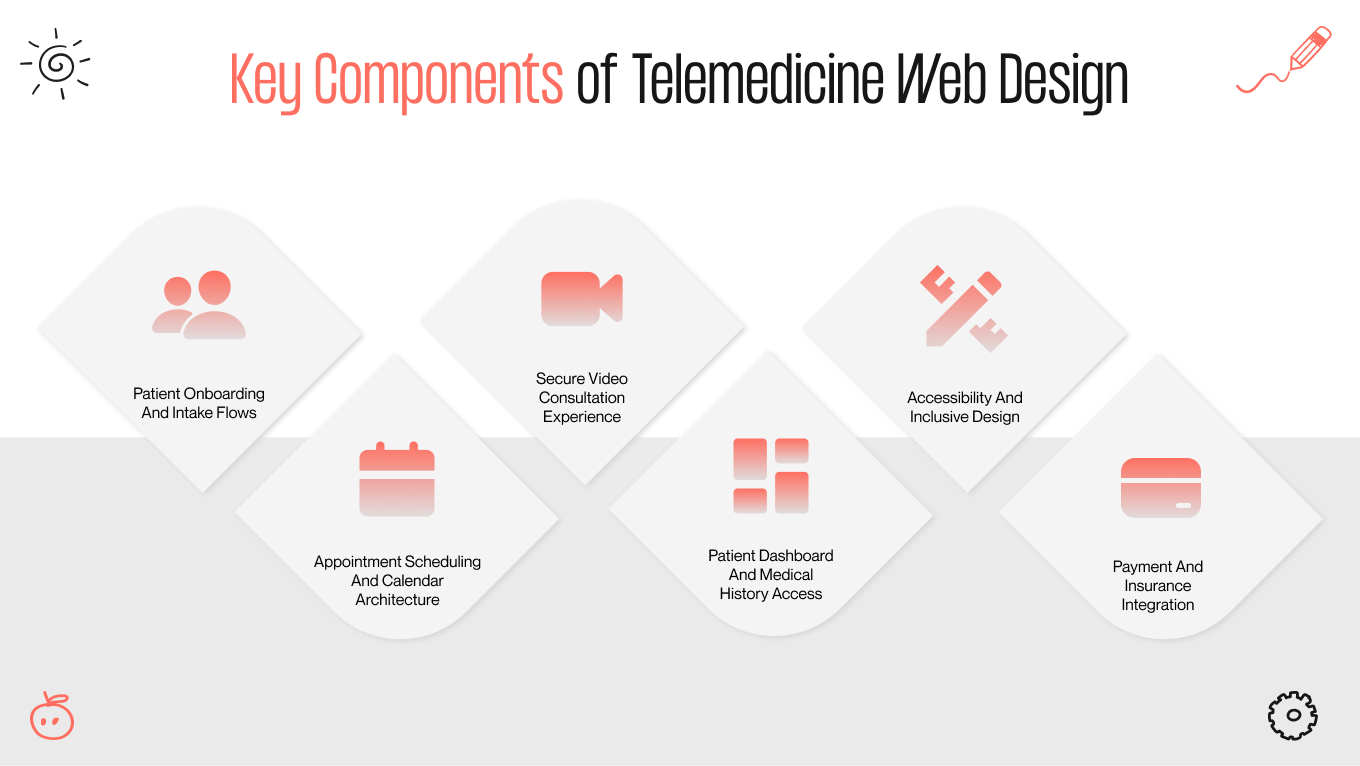
Core Components of High-Performing Telemedicine Web Design

High-performing telemedicine website design is defined by how well the system works under real patient and provider pressure. We have seen platforms with strong branding fail because core workflows were fragile. In telemedicine, friction compounds quickly: 

  • Unclear intake form affects booking rates

  • Weak scheduling logic disrupts provider utilization

  • Poor dashboard clarity increases support tickets

When you deliberately design these components, outcomes improve across the board. You reduce abandonment, increase completed consultations, and create operational stability that supports scale.

Patient Onboarding and Intake Flows

Patient intake is where you lose the most people. Many clinics make a critical mistake: they force a stressed patient to fill out a single, long form packed with confusing medical terms. Overwhelmed patients freeze, skip important questions, and give up. This leaves doctors with missing details and creates extra work for the staff.

Instead of treating intake like a test, make it feel like a helpful chat. Break forms into small steps and show patients their progress. Behind the scenes, the system should only ask questions that match the patient's symptoms. It should also catch mistakes instantly before the patient clicks submit.

Appointment Scheduling and Calendar Architecture

Clinic scheduling gets messy fast. You have to juggle different doctors, shifting hours, time zones, and insurance rules. If your system guesses when clinicians are free instead of checking their real-time schedules, you set yourself up to fail. When two patients book the exact same time, your staff has to step in, patients get upset, and you lose time.

To fix this, your calendar should lock time slots the second a patient selects them. It also needs to detect time zones automatically and match patients with the right doctor instantly. When your system checks insurance rules before booking, scheduling becomes a solid promise. 

Secure Video Consultation Experience

The video call is where your tech turns into medical care. If the video drops during a busy hour, or if the app doesn't explain what went wrong, patients will doubt your service.

To protect the patient's peace of mind and the doctor's time, your video tool must remain stable. When it comes to compliance, it’s necessary to secure and encrypt the video calls. Also, you should require safe logins before anyone enters the room. Keep the connection status visible. Most importantly, if the video drops, give the patient a clear, easy button to reconnect right away.

Patient Dashboard and Medical History Access

A patient's worry doesn't disappear when they hang up. What happens next determines if they will return. Too often, apps just dump a confusing PDF onto a screen. Patients have to hunt for their prescriptions or next steps, which drives them to call your support desk.

A good dashboard puts the most important details first. The system should clearly label prescriptions, lab results, and action items. When you organize this data well and control who can see it, you give patients the power to easily manage their health.

Accessibility and Inclusive Design

Telemedicine must serve everyone, including older patients and those who struggle with technology. Hard-to-read text, confusing menus, and legal jargon are bad for business. They also create legal risks because patients might agree to things they cannot read.

Good design includes everyone. Use high-contrast colors, clear menus, and simple words. Make sure the app works with keyboards and screen readers. When you do this, your platform becomes a lifeline for everyone instead of a locked door.

Payment and Insurance Integration

Hidden costs and surprise insurance problems destroy the trust you just built. If your staff manually checks insurance after a patient books a slot, you create a massive roadblock. If the insurance denies the claim, you have to cancel the visit.

You can fix this by automatically checking insurance when the patient books. Show them what they will pay before confirming. Guiding patients through insurance steps turns a stressful billing dispute into a simple payment.

Build a trustworthy and scalable telemedicine platform with Gapsy — reach out and let’s discuss your project.

Custom Telemedicine Web Design vs Template-Based Solutions

One of the first important decisions telemedicine founders and healthcare leaders must make is whether to start with a template-based solution or invest in custom telemedicine web design. This choice impacts more than just speed or budget. It affects long-term growth, compliance, efficiency, and technical issues.

We have helped organizations on both paths. The difference is not usually clear at launch but shows up as patient numbers rise, specialties grow, integrations increase, and regulations tighten.

Templates speed up getting to market, while custom solutions offer more control over structure. It's a mistake to view this only as a visual or budgetary choice rather than a long-term infrastructure decision.

When Templates Work

Template-based telemedicine web design can work well under specific conditions. If the aim is to quickly validate a narrow use case, structured templates offer a controlled, cost-effective way to enter the market.

Choose templates when

  • Launching an MVP with limited financial risk

  • Offering one or two standard specialties

  • Using predictable intake and consultation processes

  • Needing a few third-party integrations

  • Operating under manageable regulations supported by existing compliance modules

However, templates sacrifice flexibility for speed. Database structures, intake processes, scheduling rules, and authentication flows are set in advance. As long as your care model stays within these limits, operational efficiency remains stable.

Financial risk arises when growth complicates things. If intake variations, provider routing, or compliance needs go beyond what templates can handle, organizations often resort to workarounds. These workarounds lead to technical debt, which raises maintenance costs, slows feature updates, and increases migration risks later on.

When Custom Telemedicine Web Design Becomes Necessary

As telemedicine platforms grow, operational challenges arise. Expanding to multiple specialties creates unique clinical pathways. Enterprise clients need EHR and CRM integrations. Insurance requirements differ by region, and regulations vary across locations.

At this point, templates often start to restrict scalability.

Custom telemedicine web design tackles these issues at the architecture level. Instead of forcing processes into set modules, intake logic, scheduling rules, authentication systems, and integration layers are developed around the actual care model and future growth plan.

You should choose a custom telemedicine web design when

  • Managing multiple specialties with different clinical pathways

  • Integrating with external EHR, CRM, billing, or insurance systems

  • Operating in regions with different compliance needs

  • Implementing complex scheduling logic and provider routing

  • Creating a unique, trustworthy patient experience

The advantages of custom designs show up in operational metrics:

  • Higher provider usage due to better routing logic

  • Lower cancellation rates from precise scheduling

  • Less administrative work through automation

  • Better readiness for scaling in new markets

Most importantly, custom systems lower long-term migration risks. Redesigning infrastructure under pressure from growth costs much more than planning it carefully from the start.

Comparison: Custom telemedicine web design vs template-based solutions

Templates offer a fast, budget-friendly starting line, but they force your clinic to work the way the software wants. Custom design takes more time and money upfront, but it builds software that fits your patients and doctors.

Here is how the two approaches compare across the areas that matter most.

Criteria

Template-Based Solutions

Custom Telemedicine Web Design

Time to launch

Fast deployment

Longer initial build

Upfront cost

Lower

Higher initial investment

Flexibility

Limited to predefined features

Fully adaptable to business logic

Integration capability

Basic or restricted

Deep integration with EHR, billing, and CRM

Compliance adaptability

Constrained by the platform

Tailored to regulatory requirements

Brand differentiation

Limited customization

Fully aligned with brand and positioning

Scalability

May require migration later

Built for long-term growth


Telemedicine Website Design Examples that Work

Under the stress of a busy clinic, not all telemedicine apps survive. The best platforms do not just look pretty; they build deep trust and handle heavy daily use without breaking.

Here are a few telemedicine website design examples that show how smart, intentional choices solve patient problems and drive business success.

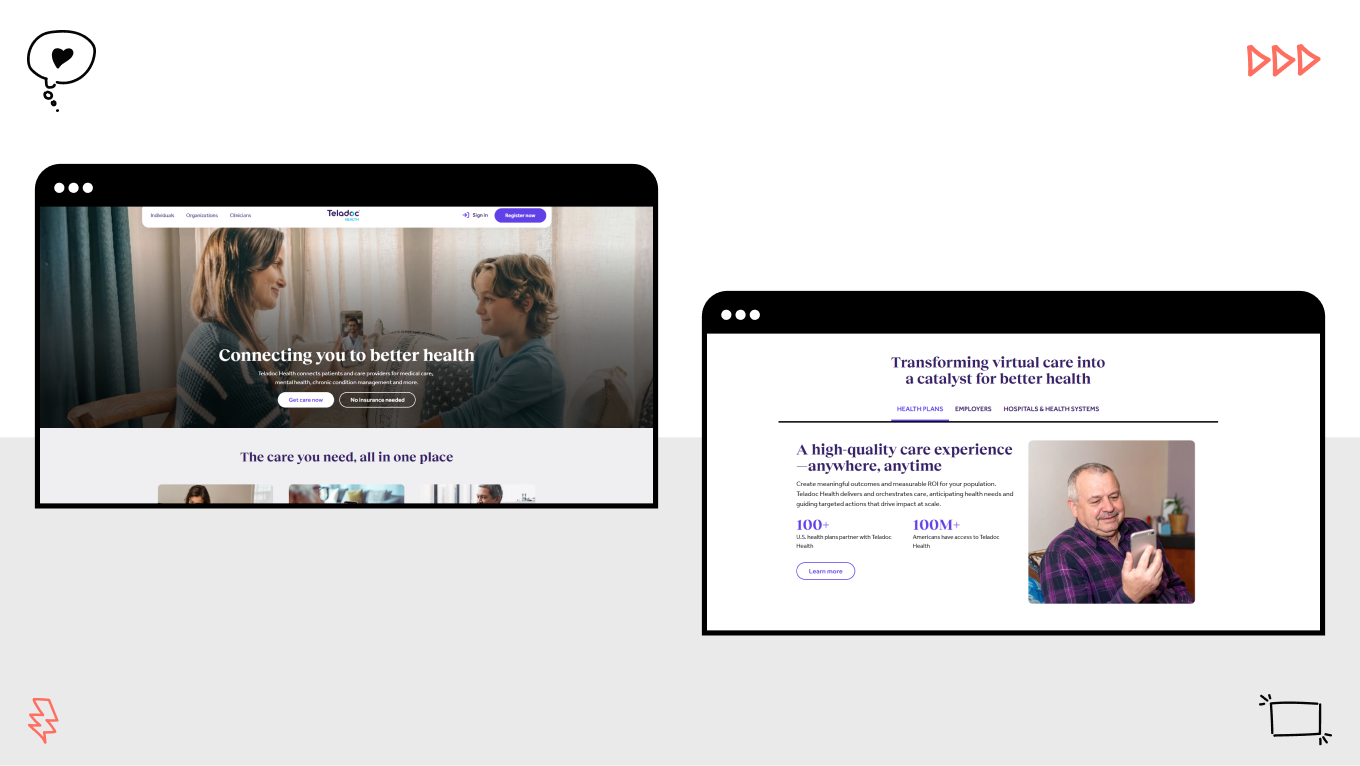
Teladoc Health

Teladoc’s platform is a large-scale telemedicine system that can manage a large number of patients across multiple specialties and areas. Its design makes it easy for new users to get started with clear service categories and step-by-step booking processes. The backend handles complicated provider routing, multi-state licensing rules, and scheduling for many appointments.

What works structurally

  • Clear service categorization by condition and care type

  • Guided intake that routes patients to appropriate providers

  • Early account creation to support long-term retention

  • Consistent scheduling logic across regions

Business alignment

  • Supports high-volume operations

  • Reduces provider mismatch and rebooking

  • Enables scalable, repeat usage

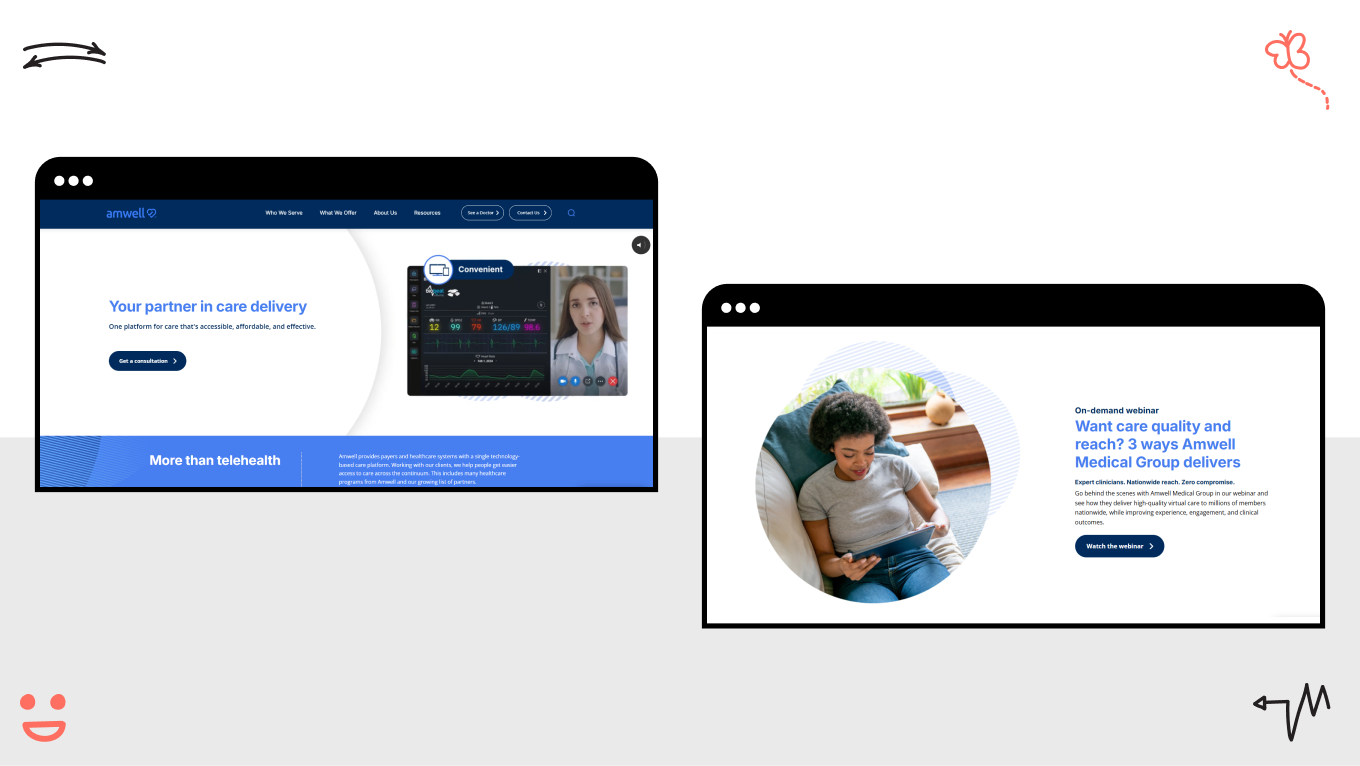
Amwell

Amwell combines insurance validation, employer partnerships, and direct-to-consumer access into a single, integrated system. One of its best decisions is to clarify eligibility and coverage early in the process, before patients invest time in a detailed medical intake.

What works structurally

  • Entry pathways based on coverage type

  • Clear eligibility verification steps

  • Structured consultation preparation

  • Transparent cost communication

Business alignment

  • Reduces billing disputes

  • Supports B2B2C enterprise partnerships

  • Reinforces predictable reimbursement workflows

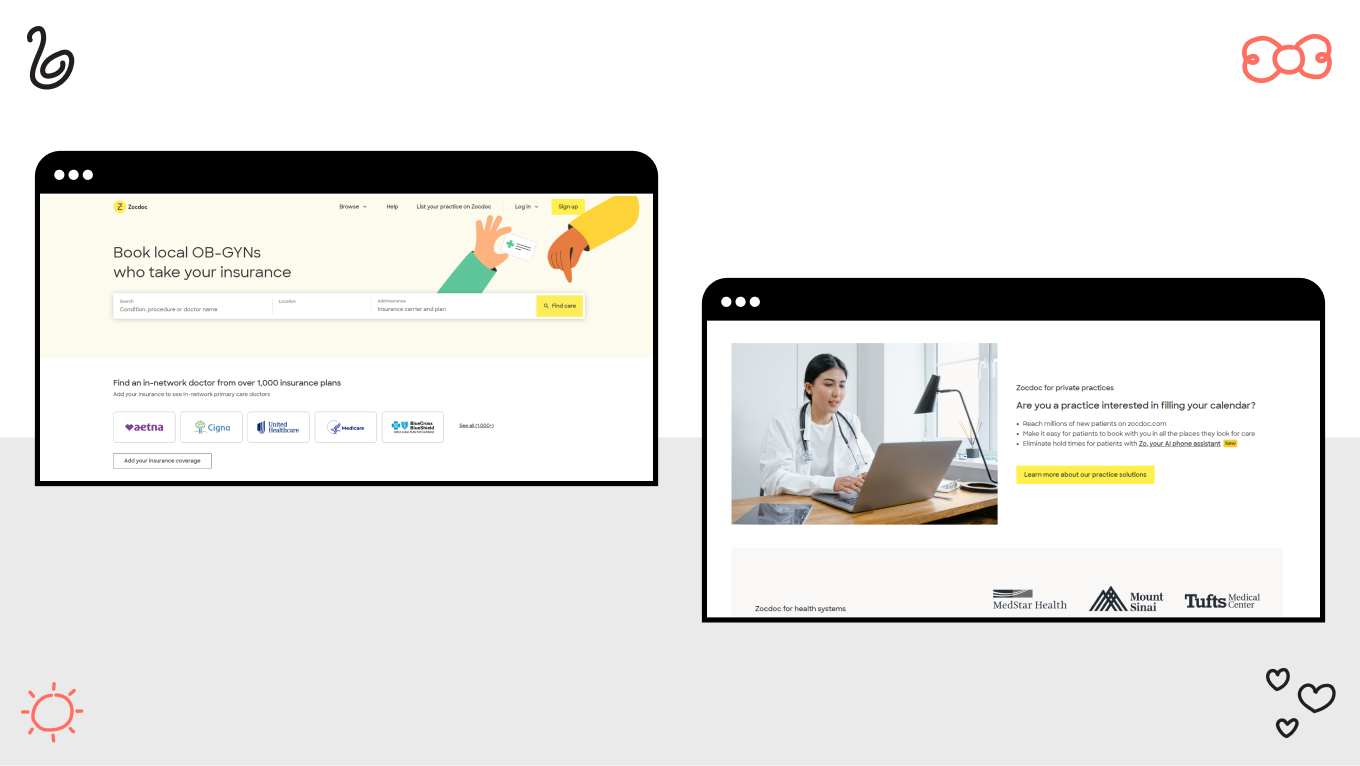
Zocdoc

Zocdoc uses marketplace infrastructure for telemedicine. It focuses on helping users find providers, sorting options, and showing real-time availability. Insurance compatibility and available time slots are presented to users when they make decisions, not after they start booking.

What works structurally

  • Advanced filtering by specialty and coverage

  • Visible real-time availability

  • Transparent provider reviews

  • Simple booking confirmation flow

Business alignment

  • Accelerates patient acquisition

  • Increases provider utilization

  • Supports competitive urban healthcare markets

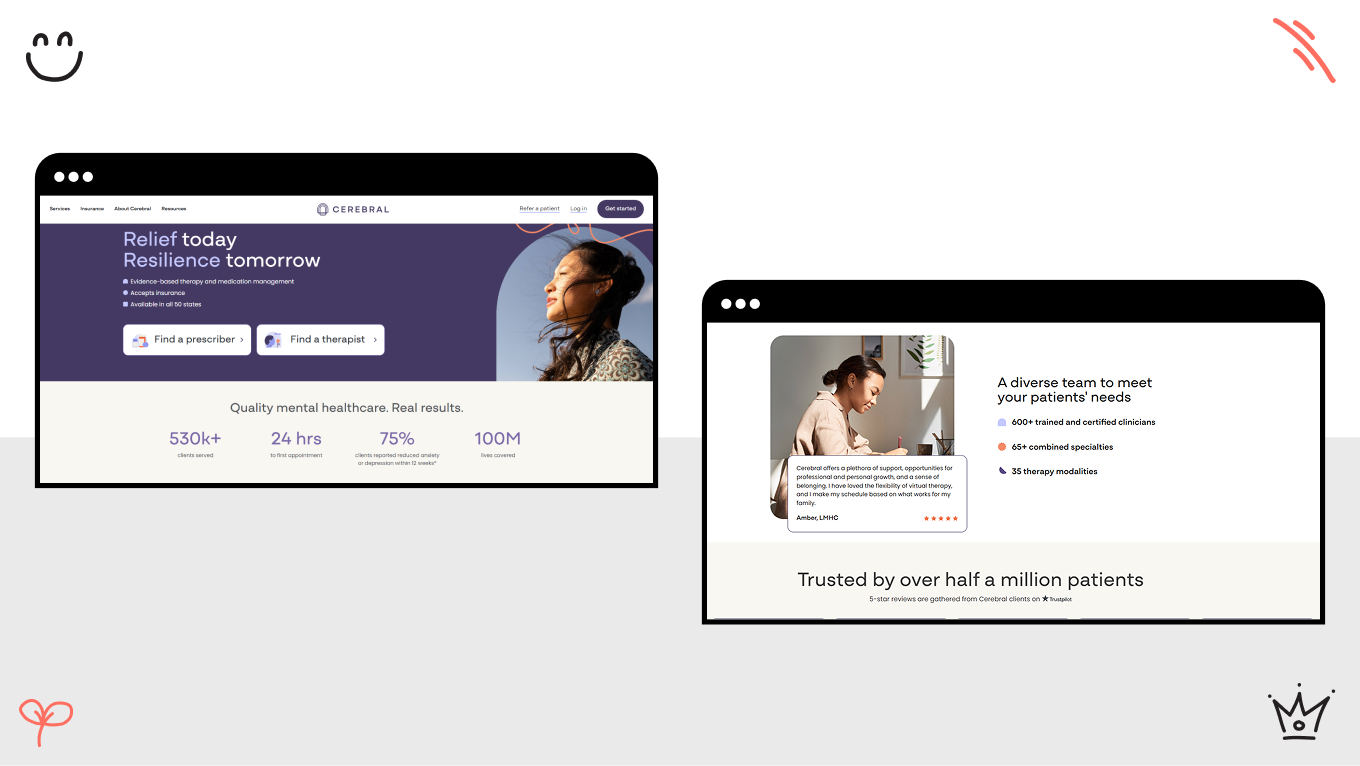
Cerebral

Cerebral shows how telemedicine design can connect with a subscription-based mental health model. Its intake flow links assessment responses to treatment options and related subscription tiers. This creates a well-integrated system for care and payment.

What works structurally

  • Condition-focused onboarding

  • Structured mental health assessments

  • Dashboard built for ongoing engagement

  • Clear subscription framing during intake

Business alignment

  • Encourages recurring revenue

  • Strengthens long-term retention

  • Aligns UX with continuity-of-care model

How to Measure Success in Telemedicine Web Design

A visually pleasing telemedicine website design means nothing if it doesn't help patients and doctors. Many clinics focus too much on picking brand colors, hitting launch deadlines, or counting site visitors. They forget to measure the things that keep the business alive.

When you don't track the right numbers, you hide real problems. A confusing button or a clunky form annoys a patient and creates extra phone calls for your staff, risking legal trouble. This is what eventually costs you money.

You should build tracking into your platform from the very beginning. When your system monitors how people use it, your team stops guessing. You can see how a single design choice impacts your bottom line, saves your doctors' time, keeps patients coming back, and protects patient privacy.

Conversion Metrics

Conversion is the first financial sign that your telemedicine design is working well. Traffic without completed actions does not bring in revenue.

We typically measure:

  • Visitor-to-account registration rate

  • Registration-to-booked appointment rate

  • Intake form completion rate

  • Payment completion rate

If there is strong traffic but low bookings, friction likely exists in the onboarding flow, credential visibility, consent ordering, or pricing clarity. Small user experience changes can lead to significant revenue increases by increasing the number of users who reach billable consultations.

Financial impact: Improved conversion raises revenue without increasing acquisition costs.

Operational impact: Cleaner intake data reduces the time required for provider clarification.

Compliance impact: Organized tracking ensures required disclosures are completed before payment.

Operational Metrics

Telemedicine platforms must work reliably under clinical pressures. Operational instability lowers provider efficiency and limits growth.

We evaluate:

  • Consultation completion rates

  • Average time per consultation

  • Provider utilization rates

  • No-show and cancellation rates

When scheduling validation, intake structure, and dashboard setup are correctly designed, providers can spend less time solving problems and more time delivering care. Better utilization directly raises revenue per provider and minimizes idle time.

For instance, high no-show rates may indicate weak reminder systems or unclear booking confirmations. Long consultation times might suggest incomplete intake data or poorly designed provider dashboards.

Financial impact: Higher provider utilization and fewer cancellations lead to steadier revenue.

Operational impact: Less workflow friction enhances growth potential.

Compliance impact: Structured logging of appointment flows aids in audit readiness.

Experience Metrics

Telemedicine relies on relationships. The digital experience is often the main point of contact for patients. Confusion or instability can directly harm retention and lifetime value.

We track:

  • Patient satisfaction scores

  • Repeat booking rates

  • Net Promoter Score (NPS)

  • Frequency of support tickets related to usability

Experience metrics often highlight issues that conversion data cannot catch. Bookings may occur, but unclear dashboards or poor post-visit summaries can reduce repeat usage.

Patterns in support tickets are especially telling. If many tickets concern finding prescriptions or understanding next steps, the dashboard layout likely needs improvement.

Financial impact: Better retention boosts lifetime value and reduces dependence on new acquisitions.

Operational impact: Fewer usability-related tickets lessen administrative burdens.

Compliance impact: Clearer communication cuts down on misunderstandings that lead to disputes.

Risk Metrics

Telemedicine operates under strict regulatory oversight. Design flaws can lead to compliance violations, financial penalties, and reputational harm.

You should monitor:

  • Security incidents or breach attempts

  • Authentication failure rates

  • Consent logging accuracy

  • Compliance gaps found during audits

Weak authentication can lead to more unauthorized access attempts. Incomplete consent logging opens up legal risks. These are real financial concerns, not just technical issues.

Risk measurement must be integrated at the design level. Consent timestamps, authentication events, and data access logs should be systematically recorded and easily audited. Without this monitoring in place, exposure stays hidden until a regulatory review happens.

Financial impact: Reduced risk of penalties, lawsuits, or the need for costly system rebuilds.

Operational impact: Enhanced system stability when under audit pressure.

Compliance impact: Reliable documentation and audit trails are essential.

Telemedicine Web Design Metrics Overview

Metric Category

What It Measures

Business Impact

Conversion Metrics

Booking flow performance and form completion

Revenue growth and acquisition efficiency

Operational Metrics

Consultation stability and provider workflow efficiency

Scalability and cost control

Experience Metrics

Patient trust, satisfaction, and retention

Lifetime value and brand strength

Risk Metrics

Security posture and regulatory alignment

Legal protection and reputational stability


Why You Can Entrust Your Telemedicine Website Design to Us

We see telemedicine design as the digital version of a doctor’s bedside manner. It builds trust, reduces obstacles, and ensures reliability. Our 12 years of experience in healthcare show that combining user-friendly design with essential features creates platforms that feel personal, work well, and can grow easily. Key elements include:

  • HIPAA-compliant data handling and consent logging

  • Smart scheduling and provider routing

  • Clear, user-friendly intake and dashboard workflows

  • Strong authentication and secure session management

These design choices together provide patient confidence, improve provider efficiency, and support long-term stability in operations and regulations.

Create a Healthcare Web Design with Gapsy!

Transform your platform with our expert UX design services tailored to your unique needs.

Final Thoughts

Building a telemedicine platform requires a solid digital foundation. If your app doesn't win a patient's trust the moment they log in, keep their data safe, and make your doctors' lives easier, your clinic will struggle to survive.

Healthcare leaders should treat their software as a critical business investment. After all, smart, intentional design protects your income, handles more patients without breaking, and keeps you out of legal trouble. When custom telemedicine web design handles future growth from the very start, you avoid the nightmare of tearing it down and rebuilding it when patient volume spikes.

Gapsy Studio is ready to help you transform your telemedicine platform — book a call and let’s discuss all the details.

Rate this article

20 ratings
Average: 4.9 out of 5

If you like what we write, we recommend subscribing to our mailing list to always be aware of new publications.

Do you have any questions? We tried to answer most of them!