Best Product Design Companies Worth Partnering With in 2026

13minutes read
best product design companies

The statistics are uncomfortable but essential to acknowledge. New Product Development (NPD) failure rates range from 35% to 49% across industries, skyrocketing to 90% for startups.

This attrition is rarely due to poor coding; it is frequently linked to a lack of user-centric design validation. Launching without this foundation is a fast track to burned capital and wasted engineering cycles. To stay out of that 90% bracket, you need more than just a UI provider; you need a digital product design and development agency who grounds creative decisions in market data.

To help you mitigate this risk, we have curated a list of the best product design agencies for 2026. In this guide, we’ll cover:

  • The top-rated agencies for both B2B and consumer software products.

  • The most significant criteria to consider when choosing a partner aligned with your business objectives.

  • Practical guidance on finding a design team that can drive a strong product–market fit.
Why Work With a Product Design Company?

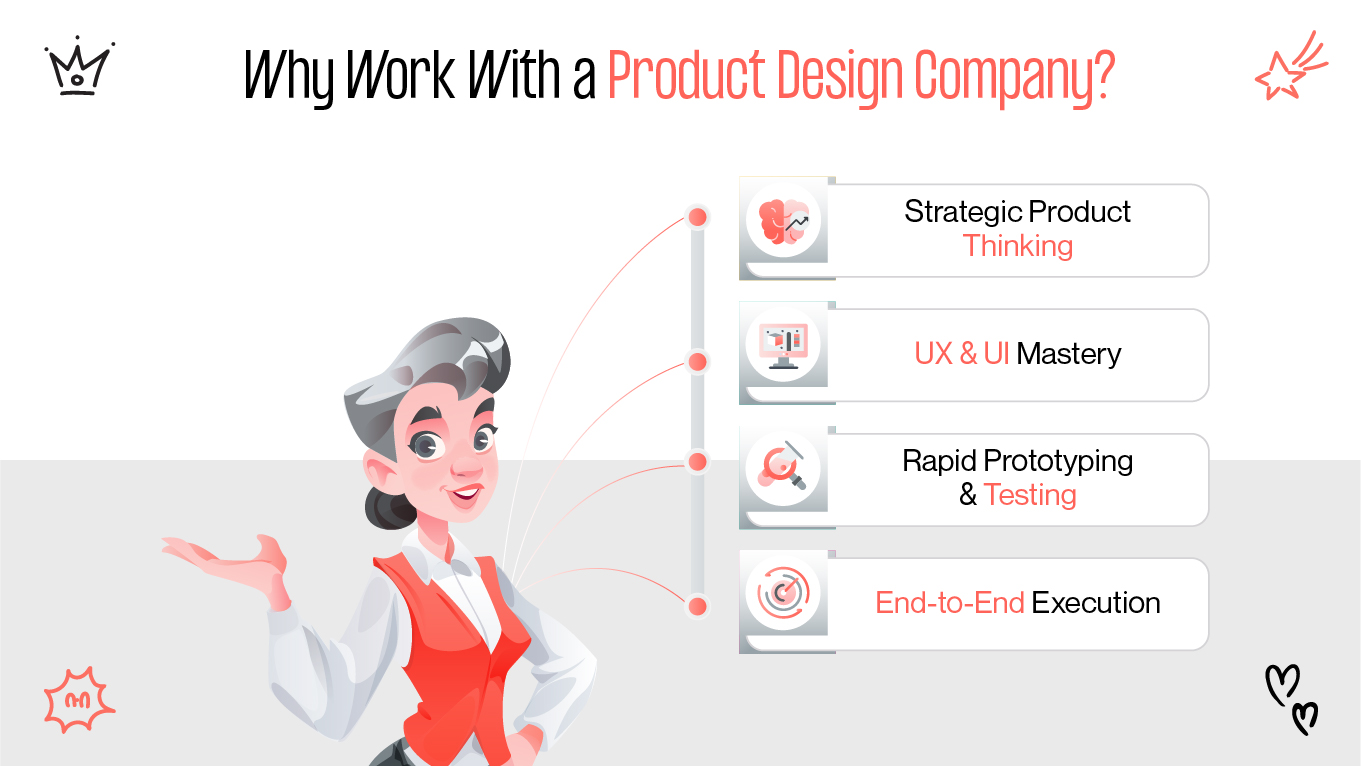
Turning the idea into a functioning, beautiful, and scalable product requires expertise in design, strategy, usability, and cross-functional execution. What product design firms can bring to the table are the following:

  • Strategic product thinking. They evaluate market needs, competition, and trends and align your product with business goals for redesigning or creating a product from scratch.

  • UX and UI mastery. From wireframes to interaction design, they engineer seamless user flows. 

  • Rapid prototyping and testing. Time is of the essence. The best agency swiftly moves from concept to testable solutions.

  • End-to-end execution. Best-of-class design agencies offer branding and development support as well as marketing-ready assets.
working with product design company
product design company advantages

How a Product Design Agency Works

Building a product is a constant conversation between what a business needs, what code allows, and how people actually behave. A product designer helps lead this dialogue, ensuring that technical constraints and strategy don't lose sight of the human experience. Partnering with a new product design agency brings fresh eyes to this process, helping translate complex goals into something that feels natural to use. Here is how they guide that journey:

  • Discovery and research. They begin by learning everything about your users, market, and objectives.

  • Concept development. Ideas are formed based on validated insights, rather than speculation. This step involves designing product architecture, mapping features, and creating preliminary sketches.

  • Prototyping and UX design. Interactive prototypes enable real-time testing and feedback, vital for early confirmation.

  • UI Design and branding integration. Visual design takes center stage with a cohesive, engaging appearance that accurately represents your brand.

  • Handoff and support. With clean documentation and assets, the product is now ready for developers and marketing teams to execute.

Why Branding and UX Are Inseparable

A brilliant product with inconsistent branding risks being forgotten, while a stunning brand with poor UX loses trust instantly. When branding and product design are synchronized:

  • Users instinctively trust the interface.

  • Every interaction reinforces your unique brand voice.

  • The product clearly and consistently communicates its value proposition.

Great product designers think in brand terms, like voice, tone, motion, and visual hierarchy. In 2026, users expect a seamless integration of brand identity and digital experience.

Top Product Design Agencies to Watch in 2026

Searching for a product design agency often feels like a second job. Between the identical-looking portfolios and the constant sales calls, it’s easy to feel drained before the work even begins. We’ve already spent the time digging into how these teams operate, so you can skip the noise and find a partner  that fits your needs.

Below, we have highlighted the top product design agencies that are worth your time. These are teams that combine creative innovation with the engineering discipline required for modern software.

Gapsy Studio: Best Product Design Agency for Data-Driven Growth

Best for: Startups and B2B enterprises seeking measurable business results and data-driven UX.

Since its founding in 2014, Gapsy Studio has established itself as a high-performance digital product design agency that prioritizes ROI over simple aesthetics. With a portfolio of over 260 successful projects, the studio specializes in translating complex technical requirements into intuitive user experiences, particularly in demanding industries such as Fintech, Healthcare, and AI.

A 14-person expert team combines the speed and flexibility of a boutique creative studio with the structured processes of enterprise agencies, becoming a fully product packaging design agency. Rather than following short-lived design trends, Gapsy’s work is grounded in in-depth user research and behavioral analysis. This approach has produced tangible outcomes, including up to 25% higher conversion rates and 35% longer session durations. These consistent results are seen in a 5.0/5.0 Clutch rating, backed by over 50 verified client reviews.

Key points

  • Proven track record of lowering bounce rates (by up to 20%) and increasing user retention.

  • Top-rated on Clutch with extensive experience serving global markets from the US to Europe.

  • Covers everything from rapid prototyping and motion design to post-launch optimization.

Ustwo: Leading Product Design Studio for Emotional Experiences

Best for: Large enterprises and consumer brands seeking immersive, emotionally resonant experiences.

Ustwo is a global digital product studio that needs little introduction, primarily due to its fame as the creator of the hit game Monument Valley. Founded in 2004, the London-based agency has grown into a massive operation with over 200 employees across Tokyo, New York, and Lisbon. As a certified B Corp and employee-owned company, they place a heavy emphasis on ethical design and internal culture.

At the core of their work is “Play Thinking,” a design philosophy that borrows from game mechanics to build emotionally engaging digital experiences. This approach is efficient for consumer products, lifestyle apps, and automotive interfaces, where immersion is a key differentiator. However, their premium model is built for scale: with hourly rates typically between $150–$199 and project budgets often exceeding $200,000, they are geared primarily toward global brands like Google, Peloton, and BMW that need "delight" at massive scale.

Key points

  • Unmatched expertise in gamification and immersive UX, leveraging their background in award-winning gaming.

  • A large, multi-studio structure best suited for multinational corporations.

  • A strong commitment to inclusive and socially responsible design as a B Corp.

Brash Inc.: Bold Product Design Studio for Market-Ready Concepts

Best for: Companies with innovative and out-of-the-box ideas that are willing to invest in high-quality visualization.

Brash Inc. is known for its bold product designs, focusing on brands and blending industrial, digital, and technological elements in a creative way to produce eye-catching concepts that are also market-ready. The company was established in 2017, and in many cases, it operates at the intersection of product and brand to create a product that makes a statement rather than following trends.

For pricing considerations, Brash falls within the mid-range, with estimated hourly rates of $100- $149 and minimum project costs of $25,000- $50,000. While they offer a feasible package to companies willing to spend on distinct design, this company leans heavily towards design differences and less towards the performance aspects of user experience.

Key points

  • Mid‑tier pricing with strong visual and product design execution.

  • Effective for standout branding and demo‑ready products.

  • Less emphasis on iterative UX optimization and data‑driven performance.

Duck Design: Design Studio for Rapid Creative Delivery

Best for: Startups and scale teams that require efficient, affordable design execution with well-defined costs.

Duck Design is a subscription-driven design studio that has resonated well with startups and scaleups seeking speed, agility, and predictable costs. Instead of hiring the studio on a project- or time-and-materials basis (which is how most creative services are currently consumed), Duck Design offers a monthly subscription plan to position itself as the fast-execution partner rather than a strategic consultancy.

Duck is an excellent starting point for startups that require a steady flow of UI work, market assets, or rapid product development, as most designs are completed with minimal upfront cost or effort. However, Duck is limited by its subscription scheme, as work is often centered on delivery rather than discovery, lacking research, testing, and performance analysis.

Key points

  • Subscription pricing: $2k–$15k+ per month.

  • Strong emphasis on speed, communication, and execution.

  • Less contributions to user experience research, strategy, and maximizing ROI.

Blaster: Boutique UX/UI Studio for Early-Stage Products

Best for: Companies that seek creative, initial product ideas rather than enterprise-level delivery capabilities. 

Blaster is a product design boutique renowned for its nuanced approach to solving intricate challenges in digital product design. It merges aesthetic design with the fundamentals of UX and helps products differentiate themselves from the start by focusing on users and details. 

As the smaller agency, Blaster usually charges on a project basis or by the hour. Their project budgets would start at $25,000+. Although the studio is known for producing excellent conceptual design and well-refined interfaces, there is only so much larger-scale work it can take on given its boutique nature. 

Key points

  • Value‑oriented pricing with quality UI/UX for smaller scopes.

  • Best for early‑stage design needs or MVP‑level work.

  • Not an appropriate choice for long‑term UX research or optimization pipelines.

IDEO: Global Innovation for Human-Centered Transformation

Best for: Enterprises and organizations needing transformative, human-centered design and innovation to reshape strategy, culture, or services.

IDEO is a highly influential design consultancy firm worldwide, with its reputation established through human-centred design and the concept of innovative thinking. Established in 1991, this firm is known for having multidisciplinary groups and research-focused approaches that enable clients to reinterpret issues and explore possibilities.

In engagements, IDEO's approach is generally high investment and strategic (usually ranging from $50,000 to $500,000+), given the level of exploration required. In terms of strategy, it is definitely a high benefit for organizations, but not necessarily scalable for product development cycles, UX performance, and optimization, as smaller product-oriented agencies have stressed.

Key points

  • Deep knowledge of research, innovation, and strategy.

  • Very high investment level, indicating enterprise transformation effort.

  • Less emphasis on optimal conversion metrics and product optimization.

Frog Design: Strategic Experience for Complex Enterprises

Best for: Large organizations and complex product ecosystems that require holistic experience design and strategic consultancy across multiple touchpoints.

Frog Design has been a global design and strategy firm for many decades, with expertise in experience design, brand, innovation, and more. Their projects include the intersection of brand story and multi-platform experience for various enterprises.

Typically, estimated pricing for standard design consulting ranges from $100–$149+ per hour, though specific enterprise-level strategic projects will likely be higher priced. Their pricing point will tend to impact iteration cycles, making it less ideal in product development teams who require rapid UX testing, performance metrics, and conversion-centric strategic moves.

Key points

  • International recognition and extensive design experience.

  • Enterprise-level costs and cycle time.

  • Less focus on iterative UX performance optimization.

Ramotion: Polished UI/UX & Brand Design Studio

Best for: Tech scale-ups and enterprises wanting polished, execution-focused UI/UX and brand identity for web and mobile products.

Ramotion is a design agency focused on the online environments, specializing in creating refined UI/UX designs and a strong visual identity, primarily for startups and big companies such as Opera, Netflix, and Adobe. Design services pertain to interface, branding, and usability in web and mobile technology.

The estimated market rate for Ramotion is in the middle tier ($150- $199 per hour), with costs for individual projects proportional to the outcomes. The visual handling and consistency of results are good. Execution-driven is the focus of Ramotion projects, which address interface and visual design. Still, the work is less comprehensive in user experience and experimentation for product teams.

Key points

  • Mid-tier pricing with excellent visual and UI/UX design.

  • Very good for well-designed interfaces and brands.

  • Less focus on data-driven UX strategy or long-term growth performance.

Clay: Digital Design Studio for Visual Storytelling & Motion

Best for: Brands and products that prioritize high-end visual design, motion, and storytelling to create striking, immersive digital experiences.

Clay is a design and development studio that combines complex visual design, typography, and motion elements to produce modern digital experiences. Their projects range from improving brand presence and consumer appeal to creating high-impact and aesthetically refined interfaces, collaborating with Google, Uber, and Slack.

Clay’s pricing structure tends to be in the upper mid to top range ($150-$199/hr) and reflects the investment in visual storytelling. From UI point of view, Clay’s quality is top-notch, with trade-offs in investment in engagements related to longitudinal UX metrics/iteration and conversion strategy optimization that could be made available.

Key points

  • Premium visual design and motion experience.

  • Related to aesthetically driven pricing.

  • Less focused on performance-centric UX pipeline optimizations.

Fantasy: Visionary Product Design for High-Impact Brand Experiences

Best for: Brands and enterprises seeking visionary, high-visibility digital experiences and conceptual design that stands out in the market.

Fantasy is a 25-year-old world‑famous design consultancy agency known for its creative vision in digital experience and its projects undertaken for elite clientele. Their projects involve creative, experimental interfaces that break boundaries on a conceptual platform.

Fantasy work is generally priced in the high-end, custom segment, reflecting the project budgets influenced by the scope of the work. Although the work undertaken by the Fantasy category attracts a lot of attention and admiration, the level of investment makes it more appropriate for high-profile brand launches than for lean products.

Key points

  • Premium pricing.

  • Strong in visionary and impactful experience.

  • Less focus on continuous UX performance improvement for small companies.

Lazarev: Clean UX for SaaS and Tech Products

Best for: SaaS and tech products needing clean, user-centered UX and interface design executed effectively within mid-tier budgets.

Lazarev is a B2B product design agency specializing in clean, contemporary customer experience and interface design, particularly for tech-related projects. The projects handled by Lazarev center on using usability, cleanliness, and a strong visual hierarchy.

With estimated rates between $100-149 per hour and project budgets that can range up to $50,000, Lazarev's price range would be classified in the middle tier. They may offer strong execution and user interfaces, but their projects generally focus on the surface and interaction levels rather than the broader realm of user experience research.

Key points

  • Mid-tier pricing with great UX execution.

  • Valid for Saas and tech product development.

  • More focus on other areas rather than on performance optimization.

Superside: High-Volume Solutions for Scalable Enterprise Workflows

Best for: Enterprises or teams that require high-volume, subscription-based design support for operational design tasks, marketing assets, and UI updates.

Superside operates on a subscription model to deliver large-scale design work to enterprise clients. Rather than the usual project- or hourly-based pricing model, the company operates on a retainer pricing model, where clients pay monthly subscriptions.

While it brings predictability and scalability to marketing operations, it is not well-suited to intensive product research or performance optimization in these areas. Superside subscription services are more geared towards continuous design output than towards product innovation.

Key points

  • Subscription pricing for ongoing design output.

  • Ideal for high‑volume, operational design needs.

  • Not a product strategy or UX research‑oriented partner.

Compare the Top Product Design Agencies 2026: Quick View

Selecting a partner comes down to fit: budget, timeline, and industry focus. Whether you need a lean team for a startup MVP or a global partner for a branding overhaul, use this side-by-side comparison to identify the right match for your business goals.

Agency

Best For

Key Strength

Pricing Tier

Gapsy

Startups & B2B Growth

Data-Driven UX & ROI, measurable product outcomes

$$

Ustwo

Consumer Brands & Gaming

Gamification & immersive UX

$$$$

Brash Inc.

Bold Product Concepts

Striking visual & industrial design

$$

Duck Design

Startups & Small Teams

Fast, subscription-based design output

$

Blaster

Early-Stage Products

Quality UI/UX for smaller scopes

$

IDEO

Enterprises & Strategic Innovation

Human-centered design & organizational transformation

$$$$

Frog Design

Large Organizations & Complex Products

Holistic experience design & strategy

$$$

Ramotion

Tech Startups & Scale-Ups

Polished UI/UX & brand identity

$$

Clay

Brand-Focused Digital Products

High-end visuals, motion & storytelling

$$$

Fantasy

Global Brands & Enterprise

Visionary, high-impact digital experiences

$$$$

Lazarev

SaaS & Tech Products

Clean, user-centered UX & interfaces

$$

Superside

Enterprises with High-Volume Design Needs

Subscription-based, operational design

$$


What to Look for in a Product Design Agency

A polished portfolio can hide a lot of flaws. While aesthetics matter, the real value of a product design agency is found in their reasoning: how they use data to back up their creative choices. You need product designers who treat your business goals as a set of problems to solve. To find a partner that impacts your bottom line, look for these specific qualities:

Experience in Product Design and Development

Experience is about breadth, depth, and adaptability. When reviewing an agency’s portfolio, ask yourself:

  • Did they undertake comparable-sized or more complex projects?

  • Are they fluent in product development cycles and stakeholder needs?

  • Can they collaborate with developers and product managers?

A seasoned agency for product design and development knows how to navigate technical constraints and guide you through the "unknowns" that inevitably pop up during the build.

Track Record in Innovation and Branding

Products that simply "function" are no longer enough to win the market. You need a solution that engages users and drives retention. 

Look for an agency that:

  • Push creative boundaries

  • Are award winners or known within UX/UI or innovation

  • Show case studies with clear business outcomes

  • Offer branding within their product design practice

Check if they have helped brands pivot or scale. Real innovation isn't just about flashy visuals—it’s about creating sustainable differentiation that survives market shifts.

Create a Product Design with Gapsy Studio!

We'll help you reimagine your product — just drop a line.

Final Thoughts

As selecting a digital product design agency is a strategic investment, the right partner wouldn’t just deliver mockups; they will bring clarity to your chaos, technical empathy to your code, and strategy to your business model.

Here is how to make the final decision with confidence:

  • Define the outcome: Are you building a speedy MVP for validation or scaling an enterprise ecosystem? Match the agency’s strength to your stage.

  • Assess fit: Do they simply nod at your requirements, or do they challenge you to make the product better?

  • Start small: Trust is earned. Consider starting with a UX audit or a design sprint to test the workflow before committing to a full build.

  • Value chemistry: Tools change, but communication remains constant. Pick a team you actually enjoy solving problems with.

2026 promises to be the year of data-driven creativity and AI integration. To capitalize on these trends, you need a partner who understands product design and development as a unified force.

Design is your competitive advantage. Gapsy Studio is ready to help you seize it. Let’s turn your complex ideas into a market-ready reality. Contact us to start the conversation.

Rate this article

20 ratings
Average: 4.9 out of 5

If you like what we write, we recommend subscribing to our mailing list to always be aware of new publications.

Do you have any questions? We tried to answer most of them!