

Conversational UX Design: How Structured Interaction Drives Conversion, Retention, and Operational Efficiency

13minutes read
conversational ux

Companies that respond to leads within five minutes are 21 times more likely to qualify them than those that wait longer. Speed and clarity in interaction directly influence revenue outcomes. Conversational UX design creates structured, immediate engagement that captures intent before it fades.

In most digital journeys, hesitation appears long before a sales conversation begins. Users abandon complex forms, postpone decisions, or leave when the path forward feels unclear. Structured conversational interaction reduces that hesitation by guiding users step by step, turning passive interest into active progression.

In this article, we break down what conversational UX means in practical business terms and how it differs from simple chat interfaces. You will see the structural components that make conversational systems reliable, measurable, and aligned with revenue goals.
Key Takeaways

  • Conversational UX design restructures how users qualify, buy, onboard, and resolve issues, directly impacting conversion, retention, and support costs.

  • The real value of conversational UX lies in structured intent mapping, guided dialog flows, and measurable alignment with business KPIs.

  • When tied to revenue goals, conversational UX improves lead quality, accelerates activation, and reduces operational friction.

  • Poor governance, unclear ownership, or lack of compliance controls can turn conversational systems into operational risk instead of growth leverage.

  • High-impact use cases include sales qualification, customer support optimization, onboarding acceleration, and internal workflow efficiency.

  • Sustainable ROI requires disciplined measurement, continuous optimization, and a clear link between conversational performance and financial outcomes.

What Is Conversational UX?

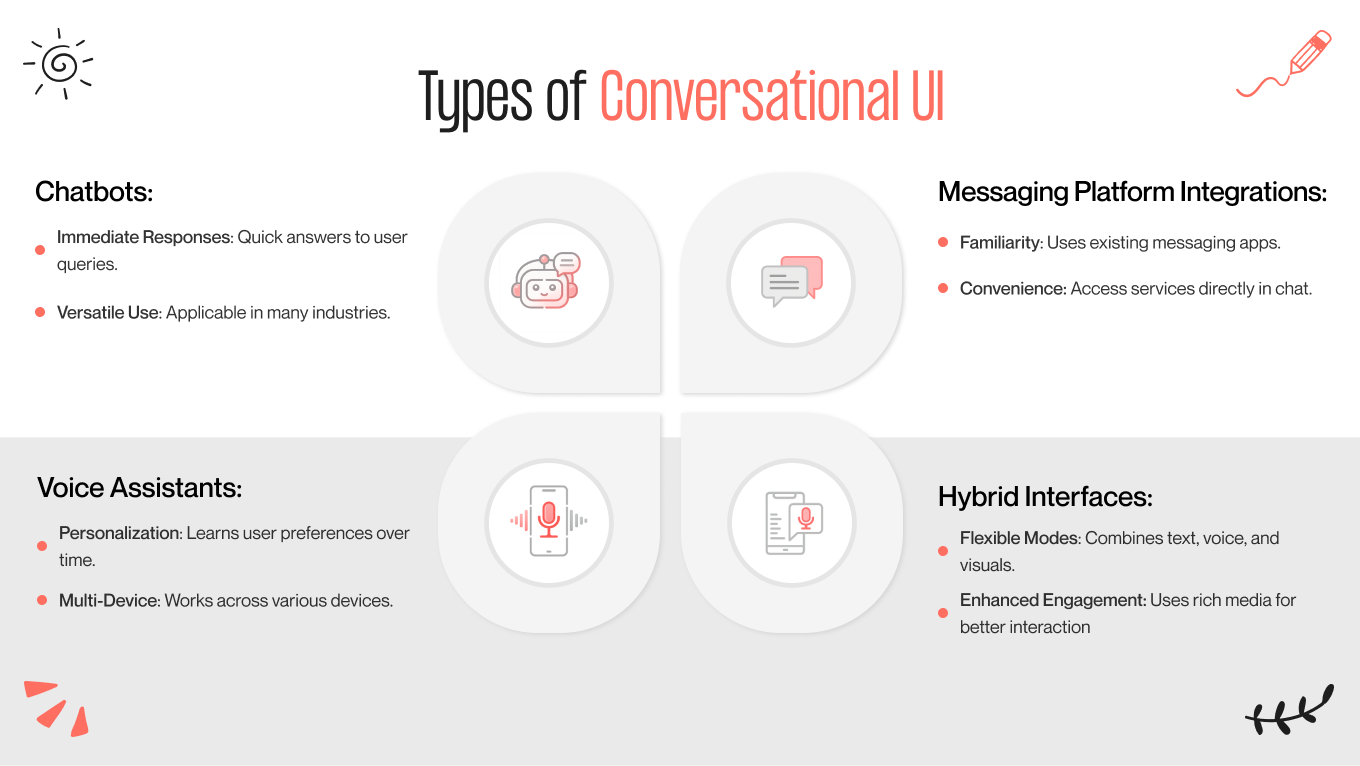
UX conversational design creates interfaces that facilitate natural and intuitive dialogues between users and digital systems. This field focuses on developing experiences that mimic human conversation, using technologies like chatbots, voice assistants, and conversational agents. The goal is to create seamless, engaging, and efficient interactions, making it easier for users to accomplish tasks or obtain information through conversation-like exchanges.

For example, instead of navigating through complex drop-down menus to return a product, a user can text an e-commerce chatbot, "I need to return my last order," and the system understands the context and generates a shipping label.

Why Conversational UX Design is Important

Conversational UX design is critical in modern user experience for several reasons:

  • Enhanced Accessibility. Conversational interfaces make technology more accessible to a broader audience, including those with disabilities or limited technical skills. Users can interact with systems using natural language, reducing the learning curve and making digital services more inclusive.

  • Efficiency and Convenience. Conversational UX enables users to accomplish tasks quickly and efficiently without navigating complex menus or interfaces. This is especially valuable in contexts where speed and ease of use are critical, such as customer service or mobile app design interactions.

  • Real-Time Interaction. Unlike traditional interfaces that may require asynchronous communication (like emails or forms), conversational UX allows for real-time interaction, leading to quicker resolutions and a more dynamic user experience.

  • Personalisation and Context Awareness. Modern conversational systems can tailor responses based on user history and preferences, creating a more personalized experience. This contextual awareness helps deliver relevant information and services, improving user satisfaction.

  • Integration with Emerging Technologies. Conversational UX is integral to the functionality of emerging technologies such as smart home devices, wearable tech, and autonomous vehicles. It facilitates seamless interaction with these devices, enhancing their usability and adoption.

Nonetheless, conversational design is about respecting your customer's time and their natural way of communicating. When businesses shift from demanding clicks to inviting dialogue, they replace cold transactions with genuine digital hospitality. This is how brands can transform fleeting, everyday interactions into enduring, profitable relationships.

Case Study of Applying Conversational UX to Drive Retention and Monetization

Our client, RKDE, faced a structural engagement problem. Players were active, but motivation lacked depth and long-term incentive. Traditional gaming loops rewarded time spent rather than skill or mastery. Over time, this created fatigue, lower retention, and limited monetization upside. The objective was to redesign engagement so that effort, expertise, and progression translated into visible value.

So, we decided to apply conversational UX design principles to shift behavior and improve measurable outcomes.

Clarifying Value Through Structured Progression

One of the core issues in this project was that players did not clearly understand how their actions translated into rewards. We applied conversational UI and UX design principles to introduce guided challenge flows that explained progression step by step.

Instead of presenting static leaderboards and abstract metrics, the platform introduced contextual prompts and milestone-based progression. Players understood what to do next, why it mattered, and what reward followed.

Business impact

  • Increased retention due to visible progression logic

  • Higher completion rates for daily challenges

  • Improved monetization readiness as users perceived tangible value

Reducing Friction in Participation

Previously, participation required navigating multiple screens and interpreting complex structures. We simplified entry into daily challenges through guided interaction and UX design patterns aligned with conversational principles.

Each challenge was framed as a structured decision sequence: one action at a time, clear confirmation, and immediate feedback. This reduced cognitive effort and lowered the barrier to participation.

Business impact

  • Increased daily active users

  • Reduced drop-offs at entry points

  • Faster engagement cycles per session

Reinforcing Motivation Through Feedback Loops

Engagement systems fail when feedback is delayed or abstract. We embedded real-time feedback mechanisms that acknowledged progress, skill development, and achievement.

Using principles from conversational AI UI/UX design, the platform contextualized rewards and community standings in a clear, motivating format. Players received structured signals that reinforced effort and improvement.

Business impact:

  • Stronger repeat participation

  • Increased community interaction

  • Higher long-term engagement stability

Business Results and Platform Transformation

The application of conversational UX design principles did more than improve interface clarity. It reshaped player behavior and strengthened the platform’s economic model. By making progression transparent, reducing participation friction, and reinforcing achievement through structured feedback, we shifted engagement from passive activity to intentional participation.

For RKDE, this translated into such business outcomes:

  • Higher retention driven by visible, skill-based progression

  • Increased daily active users and session frequency

  • Greater challenge completion rates, improving in-platform activity density

  • Stronger community interaction, reinforcing competitive and collaborative loops

  • Improved monetization readiness as players perceived clear value in continued participation

The result was a more resilient engagement system where motivation aligned with measurable platform growth. Conversational UX approach became a structural driver of retention, activity, and monetization rather than a cosmetic enhancement.

Are your users grinding or growing? Let’s map it out. Reach out to our team for a UX teardown, and we’ll identify the hidden friction in your core loops where a conversational approach can unlock higher LTV.

Key Components of Conversational UX Design

Conversational UX only creates value when it is engineered as a business system. You should pay careful attention to components that influence revenue performance, operational cost, and customer lifetime value. Let’s review such aspects.

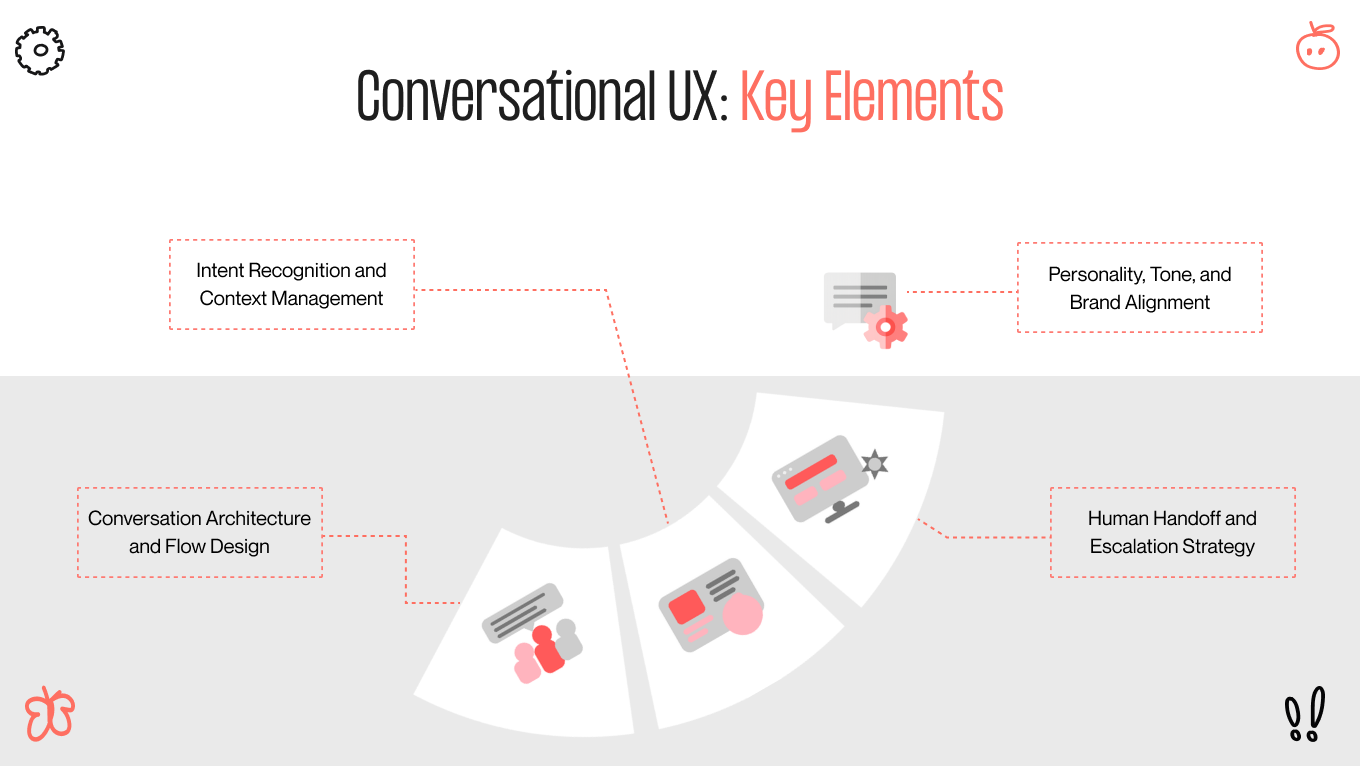
Intent Recognition and Context Management

If your system misunderstands what users want, everything that follows becomes friction. Poor intent detection leads to repeated questions, irrelevant answers, and abandoned sessions. That abandonment translates directly into lost leads, incomplete onboarding, and avoidable support tickets.

We approach intent recognition by mapping user goals to business objectives. Every major intent should connect to a measurable outcome, such as booking a demo, completing a checkout, submitting compliance data, or resolving an issue without agent intervention. When intent mapping is structured around business priorities, the conversation becomes a guided path toward value instead of a reactive FAQ.

Context management is equally critical. If a returning customer has to repeat information across sessions or channels, trust declines and support costs increase. Preserving context in cross-platform UX strategy reduces repetition and shortens resolution time.

What this means in practice

  • Map top user intents directly to revenue or cost metrics.

  • Define clear success criteria for each intent, such as a demo booked or a ticket resolved.

  • Store and reuse customer context across sessions and channels.

  • Route high-value or high-risk intents to appropriate teams automatically.

Conversation Architecture and Flow Design

Even the most advanced AI fails if the conversation architecture is flawed. Long, unstructured conversations increase cognitive load and create doubt. They reduce conversion and weaken perceived product competence.

We design a conversational UX strategy and architecture around decision clarity. A well-structured flow asks one meaningful question at a time and moves users progressively toward a defined outcome. Progressive disclosure ensures that complexity appears only when needed. For example, this matters in SaaS design, where overwhelming users early increases drop-offs and delays activation.

Decision trees provide predictability and control in regulated environments where compliance and auditability matter. Adaptive models introduce flexibility when user paths vary significantly, such as in e-commerce product discovery or multi-role SaaS platforms. The choice depends on your regulatory exposure, margin structure, and operational tolerance for ambiguity.

What this means in practice

  • Break complex processes into sequential, outcome-driven steps

  • Eliminate multi-intent prompts that force users to think too hard

  • Align each conversational step with a funnel milestone

  • Test flows against real user objections

Personality, Tone, and Brand Alignment

Conversation tone influences perception more than most founders expect. A conversational UX interface becomes the operational voice of your company. If it conflicts with your positioning, credibility weakens, and trust declines.

Emotional calibration is critical in regulated or high-stakes industries. For example, in healthcare or finance, users look for clarity, stability, and reassurance. Thus, clever phrasing or artificial friendliness can reduce confidence. Implementations with short-term engagement metrics improved while renewal rates declined because the tone didn’t match the responsibility of the product.

What this means in practice

  • Define tone guidelines that reflect your pricing, audience, and risk profile

  • Ensure consistency across marketing, product, and conversational UX interfaces

  • Test tone impact on trust metrics

  • Avoid humor or gimmicks in high-value or sensitive flows

Human Handoff and Escalation Strategy

Automation improves efficiency, but if it’s rigid, this destroys value. High-value customers and complex situations require human judgment. When escalation is slow or context is lost during transfer, frustration increases, and revenue risk follows.

A well-designed handoff preserves full conversation history, user intent, and relevant data. Agents enter the discussion informed and prepared. This reduces resolution time and prevents customers from repeating themselves. At the same time, faster resolution improves satisfaction and protects retention. 

Escalation should follow business logic. High transaction values, regulatory concerns, churn signals, or repeated misunderstandings should automatically route to trained agents. This ensures human intervention where financial or reputational risk is highest.

What this means in practice

  • Define escalation rules based on revenue impact and risk level

  • Preserve full conversational context during transfer

  • Prioritize enterprise accounts and high-value transactions

  • Measure resolution time and post-escalation satisfaction

Data Infrastructure and Continuous Optimization

Conversational UX generates structured behavioral data at scale. When captured and analyzed correctly, it becomes a strategic feedback loop for product, marketing, and revenue operations.

Every drop-off signals friction. Every misunderstood intent reveals a gap in messaging or positioning. Every repeated question points to unclear onboarding or product communication. We use conversation analytics to refine onboarding flows, adjust pricing explanations, improve qualification paths, and clarify value propositions.

What this means in practice

  • Track completion rates and drop-offs at each conversational step

  • Analyze misunderstood intents to refine positioning and messaging

  • Use conversation data to improve acquisition campaigns and landing pages

  • Run structured A/B tests tied to revenue and retention KPIs

Conversational UX Design Principles and Best Practices

Conversational UX changes how customers buy, onboard, and resolve issues. That means it influences revenue velocity, support workload, qualification quality, and regulatory exposure. For you as a founder or executive, this is a structural change to how your company interacts with the market.

If you treat it as a surface-level interface upgrade, you risk adding complexity without measurable return. If you govern it as part of your revenue and operations architecture, it becomes a controlled growth lever. The difference lies in how clearly you define ownership, metrics, and risk boundaries from the start.

Start With Business Outcomes

You should build conversational UX systems around measurable KPIs such as conversion lift, activation rate, qualified lead volume, or support cost reduction.

Before designing a single flow, clarify what success means. Are you increasing demo bookings, reducing ticket volume, accelerating onboarding, or improving upsell conversion? We define these metrics upfront and treat them as performance indicators. You should:

  • Define primary KPIs such as conversion rate lift, activation rate, qualified lead volume, or cost per ticket reduction.

  • Establish baseline performance metrics before implementation

  • Assign ownership for each metric across product, marketing, or support

  • Set a target improvement threshold that justifies the investment

  • Review performance regularly and adjust flows based on measurable impact

Every line of dialogue in your conversational UX should earn its keep by mapping to a funnel stage. A qualification prompt needs to tangibly boost sales efficiency; an onboarding sequence must compress the time-to-first-value; a support interaction has to slash resolution costs. The rule is: if a conversational flow doesn't drive a measurable business outcome, cut it.

Avoid deploying conversational interfaces as experiments without an ROI of UX design modeling. Technology enthusiasm without business alignment leads to inflated costs and unclear impact.

Reduce Cognitive Load Through Structured Dialogue

Simplifying decisions inside conversations increases completion rates and reduces churn. Users disengage when they must interpret multiple options at once. 

We design conversations around one decision at a time, with clear confirmation loops that reassure users they are progressing correctly. Multi-intent prompts, where users must interpret complex choices, create hesitation and errors. Structured dialogue reduces mental effort and speeds decision-making. 

Design for Edge Cases and Failure States

How your system handles failure matters far more than how it manages success. No conversational system is perfect, because users phrase requests unpredictably. When responses are unclear or dismissive, trust declines quickly. We design clear fallback responses that acknowledge limitations and guide users forward.

Transparency builds credibility. If the system can’t answer a question, it should state that clearly and offer alternatives. Escalation triggers should activate based on business risk, such as repeated misunderstanding, high transaction value, or compliance-sensitive queries.

Handling failure gracefully protects brand equity. In high-trust industries, this directly influences renewal rates and long-term loyalty.

Balance Automation With Human Involvement

Over-automation can damage premium positioning and reduce perceived service quality. You need defined automation boundaries. Routine inquiries, basic qualifications, and simple onboarding steps can be automated efficiently. High-risk interactions, complex negotiations, and compliance-heavy discussions require human oversight.

We recommend explicitly categorizing interactions by financial value and risk exposure. Enterprise accounts, large transactions, and regulatory questions should route to experienced agents automatically. Automation should increase efficiency without reducing perceived competence. When you protect high-value interactions with human judgment, you preserve trust and lifetime value.

Governance, Compliance, and Risk Management

In regulated sectors like finance and healthcare, compliance cannot be an afterthought. Here, a conversational UX is a formal interaction channel. Failing to embed regulatory and security controls into the architecture from day one exposes the business to severe legal and reputational risk.

You need to clearly define how conversational data is stored, processed, retained, and aligned to accessible design standards. Audit trails and logging mechanisms are mandatory because interaction history may require internal or external review.

From an operational standpoint, this demands you to

  • Define data retention policies aligned with regulatory standards

  • Implement access controls for sensitive conversational records

  • Maintain detailed logs for audit and dispute resolution purposes

  • Align conversational scripts with approved legal and compliance language

If you want to evaluate how conversational UX could impact your funnel, onboarding, or support economics, get a consultation, and we will assess the opportunity against your specific business goals and constraints.

Strategic Use Cases Where Conversational UX Delivers Real ROI

Conversational UX earns its place when it changes how a business grows. The use cases we keep coming back to are those in which the design shapes whether someone converts, stays, or leaves. Done with intention, it starts being part of how the product sustains itself.

Sales Qualification and Lead Conversion

Conversational qualification increases sales efficiency by filtering and structuring intent before a human conversation begins.

Instead of sending every inbound lead to your sales team, you can use conversational UX design to guide prospects through targeted qualification steps. The system can ask about company size, budget range, urgency, or product fit in a structured way. This reduces noise in your pipeline and ensures your team focuses on high-probability opportunities.

The business impact is clear:

  • Higher percentage of sales-ready leads.

  • Shorter sales cycles due to pre-collected context.

  • Lower customer acquisition cost because sales time is allocated efficiently.

  • Improved close rates from better-qualified conversations.

When qualification happens inside a conversational flow, you reduce manual screening and increase conversion precision.

Customer Support Cost Optimization

Structured automation can deflect repetitive tickets while maintaining service quality.

Many support teams spend the majority of their time answering predictable questions. Conversational UX systems can handle account updates, order tracking, password resets, and basic troubleshooting without human involvement. The key is to design flows that resolve issues fully rather than partially.

With proper conversational UX design principles in place, you achieve:

  • Lower cost per ticket.

  • Reduced average resolution time.

  • Higher first-contact resolution rates.

  • Improved support scalability without linear headcount growth.

Product Onboarding and Activation

Guided conversational onboarding reduces time to first value and improves early retention.

Complex products often fail at the activation stage because users feel overwhelmed. Conversational UX breaks onboarding into structured, sequential steps. Instead of presenting a dense dashboard, you guide users through setup decisions in dialogue form.

We see consistent outcomes when UX conversational design supports onboarding:

  • Faster activation within the first session.

  • Reduced drop-offs during setup.

  • Higher trial-to-paid conversion rates.

  • Stronger early retention curves.

Internal Workflow Efficiency and Employee Productivity

Conversational interfaces also improve productivity inside complex internal systems.

Enterprise platforms often require employees to navigate multiple dashboards and data layers. Design can act as an operational layer that retrieves information, triggers workflows, and guides processes through structured dialogue.

When conversational UX design principles are applied internally, you create:

  • Faster task execution for employees

  • Reduced training time for new hires

  • Lower operational error rates due to guided workflows

  • Increased productivity without expanding operational overhead

What Business Leaders Need to Know Before Building Conversational UX

Before you commit time and budget, the real questions are about ownership, fit, and whether success is even defined yet. Conversational UX stalls when nobody agrees on who's responsible or on how to tell if it's working. Get that clarity first, and it starts shaping how the whole product operates.

Build vs Buy Decision

You need to evaluate whether to build conversational UX capabilities internally or adopt a vendor solution based on scale, complexity, and strategic control.

If your use case is limited to basic support automation or simple lead qualification, established platforms can accelerate deployment and reduce time to value. However, you may require deeper customization when your conversational flows sit at the core of your revenue engine, such as complex SaaS onboarding or fintech verification.

Below is a simplified executive comparison to guide the decision:

Criteria

Build In-House

Buy Vendor Solution

Time to Market

Slower initial rollout

Faster deployment

Customization Depth

High, full control over logic and flows

Limited to platform capabilities

Data Ownership

Full control and internal governance

Dependent on vendor policies

Regulatory Adaptation

Easier to tailor for strict compliance needs

May require workarounds

Ongoing Maintenance

Internal team responsibility

Shared or vendor-managed

Strategic Differentiation

Strong, especially if conversational UX drives revenue

Limited differentiation

Cost Structure and Investment Model

The budget conversation is usually wrong. What catches most teams off guard is everything that comes after: weaving it into existing systems, getting people to use it, and keeping it from going stale.

Your cost structure typically includes

  • Integration with CRM, support systems, billing, and analytics platforms

  • Training data preparation and intent modeling

  • Conversation architecture, design, and testing

  • Compliance review in regulated industries

  • Continuous optimization and performance monitoring

Maintenance is not optional. Conversational systems degrade if product updates, UX/UI redesign, pricing changes, or messaging shifts are not reflected in flows. You should model investment as a recurring operational cost rather than a one-time project.

When scoped correctly, the ROI comes from conversion lift, reduced support headcount growth, improved qualification efficiency, and higher retention. Without structured budgeting and accountability, conversational UI/UX design becomes an isolated initiative with unclear returns.

Measurement Framework

Before launch, define your baseline UX metrics. After, measure against it. The metrics worth tracking are conversion lift, activation rate, support deflection, lead quality, and retention. Session length and message count are noise unless they connect to those.

The teams that get compounding value from conversational UX are the ones who measure ruthlessly and iterate. 

The success of implementing conversational design principles depends less on the interface and more on who owns it, what it costs, and how you'll know it's working. Get that right, and conversational UX scales. Get it wrong, and it becomes overhead

Contact us to assess where conversational UX can generate measurable impact in your business across conversion, activation, and support efficiency.

What Nine Years of Interface Design Taught Us

Gapsy is a full-service design agency that has been building digital products since 2017. Conversational UX sits at the intersection of what we do best: UX research, product design, and interface development. Over 9 years and 300+ projects, we know what separates interfaces that feel like a conversation from ones that just ask questions.

We work across the industries where conversational design has the most at stake: fintech, SaaS, healthcare, AI, and e-commerce. The outcomes across those projects reflect what disciplined implementation looks like: 

  • Conversion lifts of 11-25%

  • Engagement increases of up to 40%

  • Bounce rate reductions of 20–25%

  • A 97/100 user satisfaction score in one case.

Our work has earned 13 international awards, including Awwwards Site of the Day, and a 5.0 rating on Clutch. What clients mention most is that we communicate clearly, deliver on time, and produce work that moves numbers.

Conversational UX only works when the design thinking behind it is sound. That's the part we focus on.

Final Thoughts

Conversational UX design is not a cosmetic upgrade. When it's built around real business objectives, this can change how customers qualify, buy, onboard, and get help, reducing friction at the moments that cost you money. That's when it stops being a feature and starts becoming part of how the product operates.

But it only works with discipline behind it. Without clear KPIs, defined ownership, and the right compliance guardrails, even well-crafted conversational design will underperform. The teams that get lasting value are the ones that tie every design decision to measurable outcomes, then iterate on what users do. 

Done right, conversational UX turns interaction into something you can build on. Done carelessly, it becomes noise.

If you want to understand where conversational UX design can move the needle, the best next step is a focused conversation about your specific situation. Book a call, and we'll show you where it makes sense and where it doesn't.

Rate this article

20 ratings
Average: 4.9 out of 5

If you like what we write, we recommend subscribing to our mailing list to always be aware of new publications.

Do you have any questions? We tried to answer most of them!