
Navigating the ROI of UX: Unlocking Business Growth

14minutes read
roi ux design

It is often said that "good design is invisible," but its impact on your balance sheet is anything but. User Experience (UX) has graduated from a "nice-to-have" aesthetic layer to a critical lever for financial performance.

The data is undeniable: companies that prioritize design outperform the S&P 500 by 219%. Conversely, poor usability is responsible for 70% of online businesses failing due to bad user adoption. For business leaders, the question is no longer "What is UX?" but "What is the return on my UX spend?"

In this guide, we strip away the design jargon to focus on the economics of experience. We will explore how to calculate the ROI of UX, quantifying how strategic design reduces costs, mitigates risk, and—most importantly—drives measurable revenue growth.
Real-World Proof: How We Delivered 516% ROI for Scoop Solar

Theories and formulas are useful, but what does the ROI of UX design look like in practice? Let’s look at our work with Scoop Solar, a platform managing renewable energy field operations. We approached this project not as a visual refresh, but as a strategic overhaul designed to plug financial leaks.

The Financial Leak

Scoop Solar’s clients (extensive energy firms) were bleeding money through operational inefficiency. Field technicians were juggling five fragmented apps to report a single issue.

Every minute a technician spent fighting the interface was a minute they weren't repairing equipment. Multiplied across thousands of employees, this friction cost millions in lost productivity.

The Strategic Investment 

We conducted deep UX research to map the technicians' actual routes. As a result, our team engineered a centralized "WorkApp" ecosystem that automated data entry and operated seamlessly in outdoor conditions (high-contrast, large touch targets).

The Return on Investment

By focusing on efficiency metrics (time-on-task) rather than just aesthetics, the results were quantifiable and massive:

  • 516% ROI: The direct return reported by customers using the new platform.

  • $1.4 million annual savings: Major clients (such as RWE) saved over a million dollars per year through administrative efficiency alone.

  • Zero-friction adoption: The intuitive design required no training for new technicians.

This case proves that UX is an efficiency engine.

UX design directly impacts your metrics — for good, or for bad. If you want to make better decisions, contact us and let’s discuss all the details.

Why Invest? The 6 Strategic Pillars of UX Value

When talking about the ROI of UX design, entrepreneurs often limit the conversation to "conversion rates." While critical, conversion is just the tip of the iceberg. To truly understand the financial impact of design, you should examine the six foundational pillars in which UX generates or saves money.

Revenue Growth

Revenue is where the value of UX becomes impossible to ignore. When users hesitate, get confused, or abandon a flow, it’s rarely because they don’t want the product. It’s because the experience makes buying harder than it should be.

Strategic UX design systematically removes the friction. It guides users toward decisions, reduces cognitive load, and ensures that critical actions, like “Buy” or “Upgrade”, are always obvious and effortless.

  • The metric: Conversion Rate, Average Order Value (AOV).

  • The impact: A simplified checkout flow can increase conversion rates by up to 35%, directly increasing topline revenue without spending an extra penny on ads or acquisition. UX design amplifies marketing.

Cost Reduction

Bad design is expensive to support. If your interface is confusing, users will flood your call center or submit support tickets. Teams spend time adjusting features that should have been self-evident in the interface. This operational drag is one of the most costly and overlooked consequences of poor design.

Good UX flips that equation. Straightforward navigation, intuitive workflows, and thoughtful microcopy enable users to solve problems on their own. Every issue resolved through design is one less handled by a human at scale.

  • The metric: Support Ticket Volume, Call Handling Time.

  • The impact: Reducing support tickets by just 20% through better self-service UX can save hundreds of thousands of dollars annually in operational costs. Design is a cost-containment strategy.

Risk Mitigation

The most expensive mistake a company can make is investing heavily in a product or feature that nobody needs. Once code is written and infrastructure is in place, reversing course becomes exponentially more costly.

This is where UX research is needed. It reduces this risk by validating assumptions early. User interviews, testing, and behavioral analysis help teams learn what users want before committing engineering resources.

  • The metric: Wasted Development Hours.

  • The impact: The well-known 1:10:100 Rule — every $1 spent on research saves $10 in design rework and $100 in development bug fixes. Design is your insurance against market failure.

Customer Retention

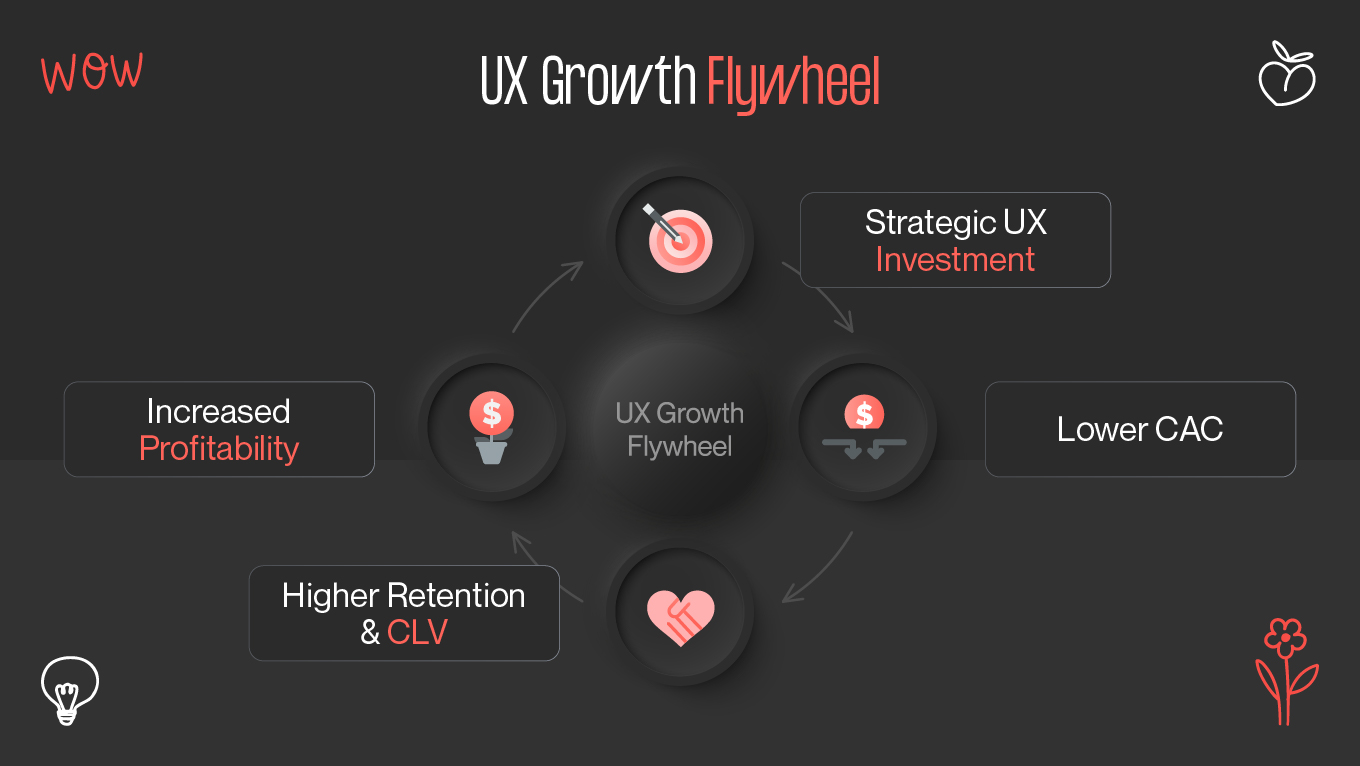
Acquiring a new customer costs 5 times more than retaining an existing one. In the subscription economy (SaaS), this reality makes churn a silent profit killer. Users don’t cancel because of one big failure; they leave because of accumulated frustration.

Good UX creates products that feel effortless, familiar, and dependable. It builds habits, which reduces friction over time. And most importantly, it gives users no reason to look elsewhere.

  • The metric: Churn Rate, Customer Lifetime Value (CLV).

  • The impact: Increasing retention by just 5% can raise profits by 25% to 95%. Few business levers deliver returns at that scale, and UX is one of them.

Internal Productivity

In B2B platforms, internal tools, and enterprise software, UX directly affects how efficiently people work. A clumsy CRM, a confusing dashboard, or an overcomplicated workflow burns payroll.

If a task takes two minutes longer than necessary and is repeated across a team multiple times a day, the cost compounds rapidly. Cohesive UX streamlines these interactions, reducing errors and accelerating routine work.

  • The metric: Time-on-Task, Error Rate.

  • The impact: Optimizing internal workflows can save hours per employee per week, effectively creating “free” headcount without hiring anyone new. Here, UX multiplies productivity.

Market Speed

Speed matters. Companies that ship faster learn quicker and win sooner. A mature design system gives teams a decisive advantage by eliminating repetitive decision-making and rework. Instead of designing and building from scratch, teams assemble interfaces from pre-validated components.

This consistency accelerates execution across design, development, and quality assurance.

  • The metric: Time-to-Market.

  • The impact: Companies with mature design systems launch new features and products up to 50% faster than competitors. In fast-moving markets, UX becomes the difference between leading the category and chasing it.

The Hidden ROI of UX Research

While design is often dismissed as a creative expense, experienced leaders understand that UX research is a risk mitigation strategy. In fact, the highest return on UX research doesn’t come from what you build. It comes from what you intentionally avoid building.

Launching a product based on assumptions is not innovation; it’s a gamble with your development budget. Every untested idea carries hidden costs that surface later as rework, delays, or failed features. UX research acts as an insurance policy, ensuring you solve the right problem before committing expensive engineering hours.

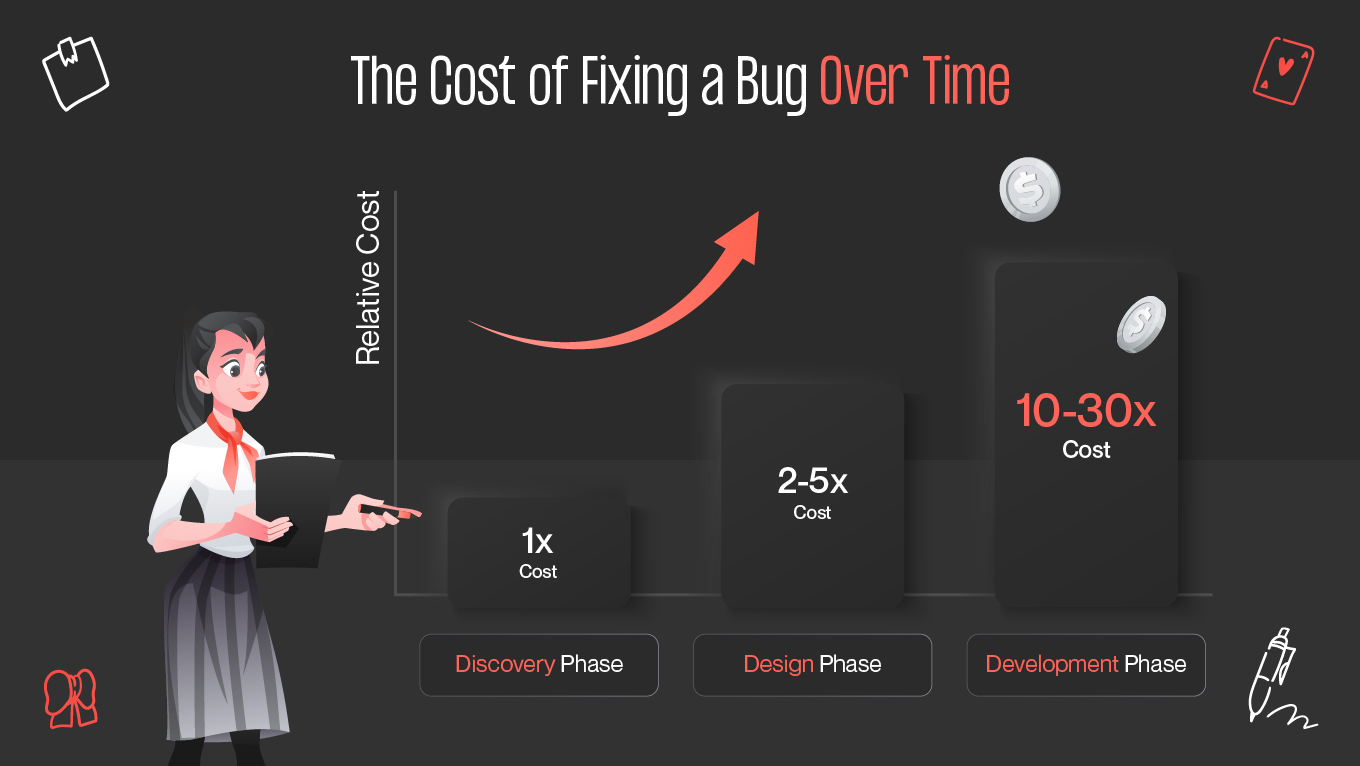
The 1:10:100 Rule

The 1:10:100 Rule best illustrates the financial logic behind UX research, a well-established principle in quality management that applies directly to digital product development:

  • $1: The cost to fix a problem during the research or design phase (e.g., erasing a sketch or adjusting a wireframe).

  • $10: The cost to fix the same problem during development (e.g., rewriting code, refactoring components).

  • $100: The cost to fix it after launch (e.g., emergency hotfixes, customer support escalations, lost trust, brand damage).

This is how every dollar spent on early UX research ROI saves you $100 in future headaches. It is infinitely cheaper to discard a prototype than to refactor a live product under pressure. Every dollar invested in research can prevent hundreds of dollars in downstream costs and protect your team from avoidable failures. 

Still confused about why your product doesn’t “work”? Reach out, and we’ll help you with thorough research.

We often tell clients: It is cheaper to fix a wireframe than to rewrite code. Our discovery phase is the most profitable project development phase, as it prevents you from building features no one wants. By validating user needs early, you protect your budget from the "Feature Factory" trap, building expensive, complex tools that users simply ignore.

the cost of fixing design mistake over time
the importance of ux roi research

How to Measure ROI of UX Improvements: The 2 Essential Formulas

UX is not magic. It’s logic. Every UX initiative ultimately affects one of two things that executives care about: revenue or cost. You are either looking to make more money (Conversion) or save more money (Productivity). Everything else, such as delight, usability, aesthetics, is a tool to meet one of those ends.

This is why UX ROI should be measured with the same financial precision as any other investment. When framed correctly, UX decisions stop being subjective and become predictable business approaches.

Here are the exact formulas you can use to prove value to CFOs.

Formula 1: The "Revenue Booster" (For E-Commerce and SaaS)

Use this formula when redesigning any experience that sits directly on the revenue path: checkout flows, pricing pages, onboarding sequences, lead-gen forms, or subscription upgrades.

The logic: If we make it easier to buy, more people will do this. By simplifying the path to purchase (e.g., fewer steps, clearer feedback, better hierarchy), you increase the percentage of users who complete the same action. Importantly, this growth compounds on existing traffic. 

We measure the difference between your old conversion rate and new conversion rate.

The calculation: (New Revenue - Old Revenue) / Cost of Design = ROI

Example: Imagine a checkout redesign costs $15,000.

  • Old design: Generates $100,000 / month.

  • New design: Increases conversion by 0.5%, generating $115,000 / month.

  • The gain: +$15,000 per month.

  • The ROI: In just 30 days, the project pays for itself. Every month after is pure profit.

Formula 2: The "Time Saver" (For Internal Tools and B2B)

Use when redesigning employee-facing products: dashboards, CRM systems, admin panels, reporting tools, or any software used repeatedly throughout the workday.

The logic: Time is money. If an interface forces employees to think harder than necessary or to repeat actions, you are effectively paying people to fight the tool rather than doing their job. This way, you burn payroll. UX improvements remove that friction, converting lost minutes into measurable productivity gains.

The calculation: (Time Saved x Hourly Wage x Employees) = Annual Savings

Example: We redesign a data-entry tool for a company with 100 employees.

  • The fix: We remove 3 redundant clicks, saving 5 minutes per employee per day.

  • The math: 5 mins x 100 people = 8.3 hours saved per day.

  • The savings: At an average wage of $40/hr, that is $332 saved every single day.

  • Annual impact: $86,000+ per year in regained productivity.

UX Metrics and ROI: How to Connect Them

For too long, design reports have relied on "customer satisfaction" (CSAT) for measuring UX ROI success. While satisfaction is comforting, it is not a business outcome. You cannot pay payroll, fund growth, or justify investment based on “users seem happier.”

While happy users are important, profitable customers are essential. To prove the ROI of UX, you should track the hard metrics that directly influence revenue and long-term business stability.

Customer Acquisition Cost (CAC)

CAC measures how much you spend to acquire one new customer. It includes ad spend, sales efforts, tooling, and time. When CAC rises faster than revenue, growth becomes fragile.

The UX connection: If a landing page is unclear and cognitively overwhelming, you may pay for 1,000 clicks but only convert 10 visitors. The experience is broken, and your CAC is sky-high.

The ROI impact: Strategic UX improvements increase the landing-to-lead conversion rate. When conversion doubles, CAC is effectively cut in half. You simply extract more value from the same spend. In high-competition markets, this efficiency is often the difference between scaling and stalling.

Customer Lifetime Value (CLV)

CLV represents the total revenue a customer generates over their entire relationship with your product, making it one of the most significant indicators of sustainable growth.

The UX connection: Users rarely leave because a product is “too expensive.” More frequently, they leave because it becomes frustrating to use over time. Poor UX erodes trust through friction, errors, and unmet expectations. Great UX, on the other hand, creates habit-forming experiences.

The ROI impact: As noted earlier, a 5% increase in retention can raise profits by 25% to 95%. Higher CLV also unlocks strategic flexibility: you can afford higher CAC, invest more aggressively in growth, and outspend competitors without destroying margins.

Churn Rate

Churn measures the percentage of customers who stop using or paying for your product. In subscription-based models, it is the single fastest way revenue disappears.

The UX connection: In SaaS, churn is caused by “death by a thousand cuts”. It’s where minor frustrations pile up until the user gives up. Confusing settings, slow workflows, unclear feedback, and missing affordances all contribute to silent attrition.

The ROI impact: Reducing churn is the fastest way to stabilize revenue. If UX improvements prevent even 10 enterprise clients from leaving, the ROI of investing in UX/UI redesign often pays for itself multiple times over. Churn reduction is one of the highest-leverage outcomes UX can deliver.

Quantifying the "Soft" Metrics

Not every UX outcome is immediately financial, but that doesn’t mean it’s unmeasurable. The key is to replace subjective opinion with standardized, comparable data. We don’t ask users, “Do you like it?” We use standardized scoring systems to turn views into data.

  • System Usability Scale (SUS): A 10-question survey that generates a score from 0 to 100, widely used across industries. It turns vague feedback like “This feels clunky” into actionable insight: “Our SUS score is 45 (F). Our target is 70 (B).” This allows teams to track usability improvements over time and correlate them with conversion, retention, or support volume.

  • Time-on-Task: For internal tools, time-on-task is one of the most powerful UX ROI metrics available. We measure how long a workflow takes down to the second. If UX improvements shave 30 seconds off a repeated task, this can be translated directly into payroll savings and productivity gains. This way, “usability” becomes a line item in a financial model.
ux growth flywheel
how ux investement works

UX ROI Case Studies: Proofs from Famous Companies

Theories are good, but bankable results are better. Let's look at three global giants that faced a financial crisis, turned to UX for the solution, and walked away with millions in value.

ESPN.com: The Revenue Jump

A few years ago, the sports giant faced a problem. Their homepage was a crowded mess of links, ads, and flashing tickers. Fans just wanted scores and news, but they were drowning in clutter. The bounce rate was climbing, and revenue was stalling.

Instead of guessing, ESPN listened. They launched a cleaner, responsive redesign that prioritized what the users asked for: simplified navigation and personalized scores. They removed the noise and focused on the content.

The results were immediate and explosive.

  • 35% increase in profits directly following the redesign.

  • 16% jump in unique visitors.

Listening to users isn't "soft" science; it becomes a complex revenue strategy.

Virgin America: The Efficiency Win

Booking a flight is historically one of the most stressful things a human can do online. Forms, pop-ups, and hidden fees created massive friction. Virgin America decided that its digital experience should feel as premium as its first-class cabin.

They bet on radical simplicity. This led to creation of the first responsive website with a "one-step-at-a-time" booking flow. No clutter, no distractions, just a smooth, linear path from "Search" to "Booked."

By respecting the user's time, Virgin won their wallet.

  • 14% increase in conversion rates.

  • 20% reduction in support calls (saving millions in operational costs).

  • 2x faster booking times for customers.

General Electric: The Productivity Multiplier

We often forget about internal tools. GE had a massive ecosystem of internal software for its field technicians that was complex, outdated, and hard to use. It was annoying employees and slowing down billion-dollar projects.

GE stopped treating internal tools like an afterthought. They invested in a "UX Center of Excellence" to completely redesign their employee software, focusing on usability and speed.

The impact on the bottom line was staggering.

  • 100% productivity gain for development teams.

  • $30 Million in estimated savings in the first year alone.

For enterprise companies, UX is a productivity engine. Saving employees' time is functionally equivalent to printing money.

The High Cost of Doing Nothing

You might look at the budget for a UX overhaul and think, "We’ll push this to Q3. We can't afford it right now." But in reality, standing still is not neutral or safe. It is expensive.

Every day you delay improving your user experience, you pay what can only be described as a “Status Quo Tax.” It doesn’t appear as a line item on your balance sheet, but it shows up in lost revenue, rising acquisition costs, frustrated users, and growing competitive risk. The longer the delay, the more that cost compounds.

Here is what the math of delay looks like:

  • The daily revenue leak: If your current conversion rate is 2% and a redesign could lift it to 3%, you aren't just "saving budget" by waiting. You are actively losing 33% of your potential revenue every single day the old site remains live.

  • The competitive gap: User expectations are set by the best experience they’ve had. If your competitor launches a seamless, modern platform while you debate the budget, your customers won't wait for your update. They will switch. And once they leave, the cost to win them back is 5x higher than the cost to keep them.

  • Compounding technical debt: Ignoring usability issues doesn't make them go away; it makes them harder to fix. What is a $5,000 design tweak today becomes a $50,000 architectural crisis next year as you pile more features onto a broken foundation.

The question isn't "Can we afford to invest in UX?" It’s "Can we afford to keep losing customers to those who already have?" The Status Quo is never free, and the bill is already due.

If you suspect your current product is costing you more than it’s making, let’s find out where the leaks are. We can help you audit your current experience to identify the specific friction points that are hurting your bottom line.

3 Myths About UX ROI (That Are Costing You Money)

Even with the math in front of them, stakeholders often hesitate. Old misconceptions about design still linger in boardrooms. Let’s debunk the three biggest myths that prevent companies from realizing their full revenue potential.

"UX is just about making it look pretty"

UX is functional engineering, not art. A site can look stunning and still be a financial disaster if users can’t find the checkout button. We don't design for "delight" alone; we design for behavior. Convertive user experience requires logic behind every move.

If a design change doesn't measurably improve a metric (like time-on-task or conversion), it isn't UX. 

"We can't afford a discovery phase right now"

You can't afford to skip it. There is a belief that research is a "luxury" step that slows down the timeline. In reality, skipping UX audit and research is the single most expensive decision a product team can make.

Spending $10,000 on research today prevents you from spending $200,000 building a feature nobody wants tomorrow. Research vastly helps with a risk mitigation strategy.

"We are B2B. Our users don't care about design"

B2B buyers are humans, too. There is a dangerous assumption that enterprise users will tolerate clunky software because "they have to use it." This is no longer true. In 2026, corporate buyers expect the same ease of use they get from Uber or Spotify.

If your B2B tool is challenging to use, your customers will churn to a startup that is easier to use. In enterprise, usability is the new competitive channel.

About Gapsy Studio: We Don't Just Design. We Solve.

Understanding the theory of ROI in UX is valuable, but deploying it effectively within a live business environment requires a different caliber of expertise. This is why Gapsy is here to help.

We operate as an extension of your product team, not just an outsourced design shop. We bridge the critical gap between "ambitious vision" and "market reality." Our role is to de-risk your investment by applying rigorous research, UX audit, and validation before development costs spiral.

Where we add value: 

  • Product discovery and de-risking: We don't just take orders; we challenge assumptions. Our team uses data to validate your roadmap, ensuring you aren't building features that drain the budget without driving revenue.

  • Complex system architecture: From SaaS platforms to enterprise tools (like Scoop Solar), we specialize in untangling messy workflows into intuitive experiences that reduce operational drag.

  • Scalable design ecosystems: We build the entire libraries instead of pages. Our design system equips your internal team with the assets they need to scale the product for years without needing a total redesign every 18 months.

Whether you are a Series A startup needing a high-fidelity MVP to secure funding or an enterprise seeking to optimize a legacy platform for higher conversion, we provide the strategic architecture to get you there.

Improve your ROI of UX with Gapsy Studio!

Our professional design team will provide you with a bunch of services.

The Bottom Line: Design is Your Strongest Asset

We have explored the formulas, unpacked the 1:10:100 rule, and analyzed the case studies. The data points to a single, undeniable truth: in a market saturated with options, UX design is the primary differentiator between a product that survives and one that scales. It is the bridge between a user's problem and a business's profit.

You can continue to view design as a line item on an expense report, or you can start viewing it as a revenue generator. The companies that dominate your industry have already made that shift.

The future belongs to the products that solve problems best. Are you ready to build yours? You don't have to do it alone. Contact us to start cooperation.

Rate this article

20 ratings
Average: 4.9 out of 5

If you like what we write, we recommend subscribing to our mailing list to always be aware of new publications.

Do you have any questions? We tried to answer most of them!