In-House Designer vs. Design Agency: How to Choose the Right Model for Your Business

15minutes read
in-house vs agency design

Design decisions rarely start as strategic debates. More often, they begin under pressure. Increasing workloads, tighter deadlines, higher expectations, and the quiet realization that the current setup can’t keep up create urgency. Many companies struggle to decide whether to build an in-house design agency or rely on external partners for complex projects. Nearly 40 percent of business, professional, and industrial leaders say they are outsourcing or considering outsourcing parts of their workforce to access better talent, while another 37 percent do so to support teams that are already overwhelmed.

Design becomes the clearest point of stress in this shift. It sits at the crossroads of brand, product, and growth, yet difficult to staff perfectly at every stage. An in-house team offers focus and continuity. A design agency provides breadth, speed, and a fresh perspective. Neither approach is distinctly better. The real problem lies in making choices based on assumptions rather than on context.

This article looks at that choice through a practical business lens. We’ll compare in-house teams and design agencies based on scope, cost structure, speed, collaboration, and long-term impact. The goal is to help you identify which model fits your situation and understand the trade-offs involved.
Key Takeaways

  • The choice between design agency vs. in-house depends on scope, speed, budget, and team capacity, not ideology. 

  • In-house teams perform well in steady and predictable settings where continuity, brand consistency, and deep internal knowledge are important. 

  • Agencies work best for complex, high-stakes projects, rapid scaling, or when a variety of expertise and senior strategic input are needed. 

  • Hybrid models often provide the best balance. They combine an internal focus with the flexibility of an agency for busy periods, rebrands, or transitions. 

  • The true cost of ownership goes beyond salaries. Agencies can stabilize output, reduce hiring risks, and turn hidden design costs into predictable investments.

Two Models, Two Operating Philosophies

At a high level, the difference between in-house design and agency work is about how it is embedded into the organization. When evaluating options, this helps to compare graphic design in-house vs. agency to understand costs, flexibility, and expertise. Each model reflects a distinct operating philosophy, shaped by how closely design is tied to day-to-day decision-making and how flexibly it can respond to change.

What an In-House Designer Optimizes For

An in-house designer is optimized for continuity and proximity. Being embedded within the company allows them to absorb context that is hard to document, from brand nuances to internal dynamics and long-term priorities.

Over time, this immersion leads to faster alignment, fewer handoffs, and a deep understanding of how design supports the business beyond individual projects. The value of in-house design compounds gradually through consistency and shared institutional knowledge.

What a Design Agency Optimizes For

A design agency is optimized for range and adaptability. Professional companies operate across industries, problem types, and scales, allowing them to bring structured thinking and an external perspective to each engagement. Their value comes from assembling the right mix of skills for a given challenge and scaling effort up or down without long-term commitments.

Rather than being shaped by one organization’s habits, agencies can challenge your assumptions and apply patterns proven elsewhere, bringing a unique, fresh perspective.

In-House Designer: Strengths and Constraints in Practice

In-house design works best when the environment is predictable enough for context to compound. Its strengths show up over time, but so do its limits. Understanding both is essential before committing to this model.

Where In-House Designers Perform Best

In-house designers tend to excel when design is incorporated into the business's daily operations rather than treated as a series of standalone projects. Their value compounds over time as context, relationships, and decision-making history grow.

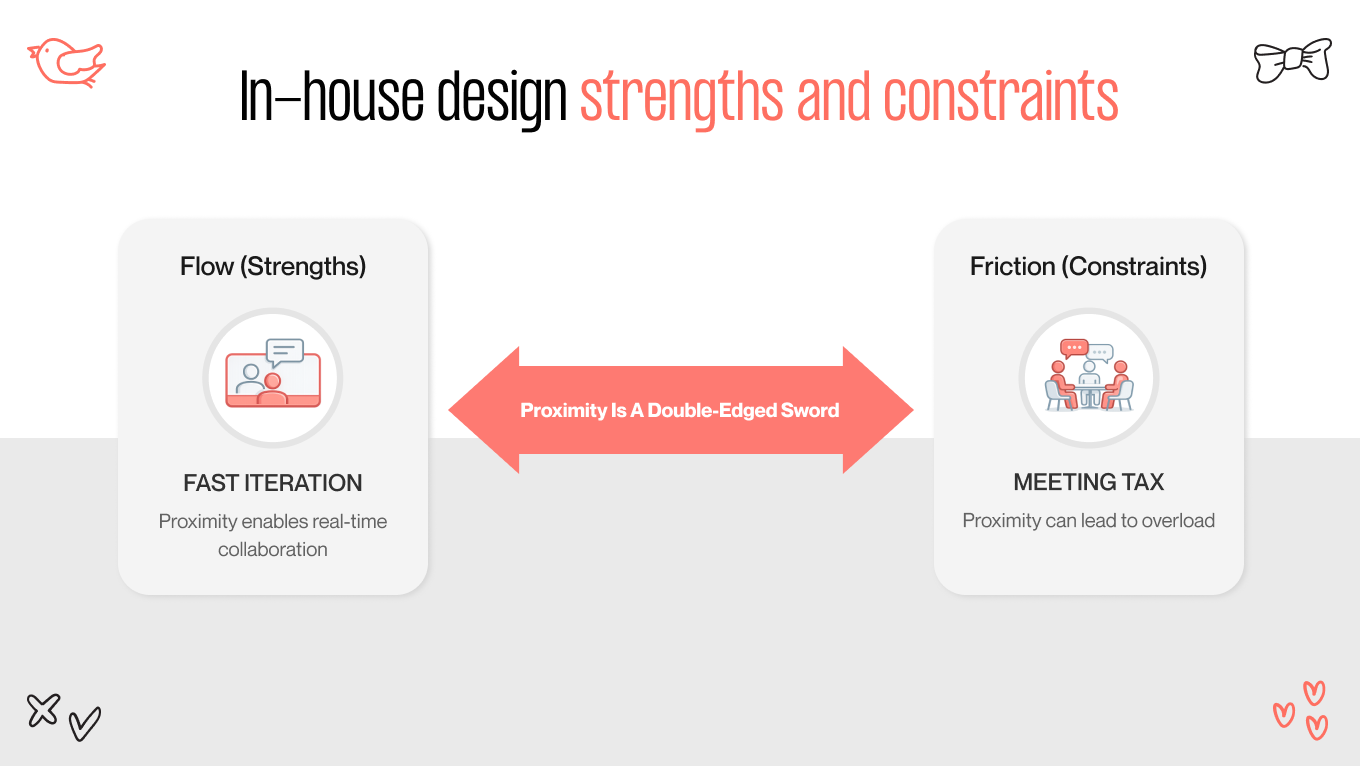
  • Brand consistency over time. Continuous exposure to the same product, audience, and internal stakeholders helps in-house designers absorb brand values and visual standards. As a result, decisions remain consistent over time, reducing fragmentation and the need for revisions as the company grows.

  • Fast iteration in stable environments. When priorities are clear and change rarely, in-house designers can move quickly. Small updates and refinements occur without lengthy briefs or realignment cycles, so teams can maintain momentum and respond effectively to feedback.

  • Close collaboration with product and marketing. Being part of internal teams makes design a regular topic of discussion rather than a separate function. This closeness improves alignment, shortens feedback loops, and leads to more practical decisions grounded in real constraints.

Where In-House Designers Struggle

The same proximity and continuity that make in-house design effective can also introduce limitations. These challenges often emerge as the company scales or the scope and pace of work increase:

  • Limited perspective and creative drift. Working within a single product, industry, or market can gradually narrow a designer’s viewpoint. Without regular exposure to external ideas or examples, their solutions may become less exploratory and more conservative.

  • Hiring, ramp-up, and retention risk. Building and maintaining a strong in-house design team takes time and ongoing investment. A slow hire, poor fit, or unexpected departure can disrupt workflows, delay projects, and increase pressure on the remaining team.

  • Burnout and skill coverage gaps. In-house designers are often asked to manage a wide range of tasks across multiple areas. As demands increase, this stretches their capacity and forces tough decisions between speed, depth of execution, and overall quality.
in-house designer strengths and constraints
in-house designer pros and cons

Design Agency: Strengths and Weak Points

Design agencies tend to perform best when the work demands breadth, perspective, or rapid scaling. At the same time, their distance from day-to-day operations introduces trade-offs that are worth acknowledging.

Where Design Agencies Perform Best

Design agencies are most effective when the scope, complexity, or stakes of a project exceed what a small internal team can handle. They are often called in when speed, experience, or variety matter more than long-term consistency.

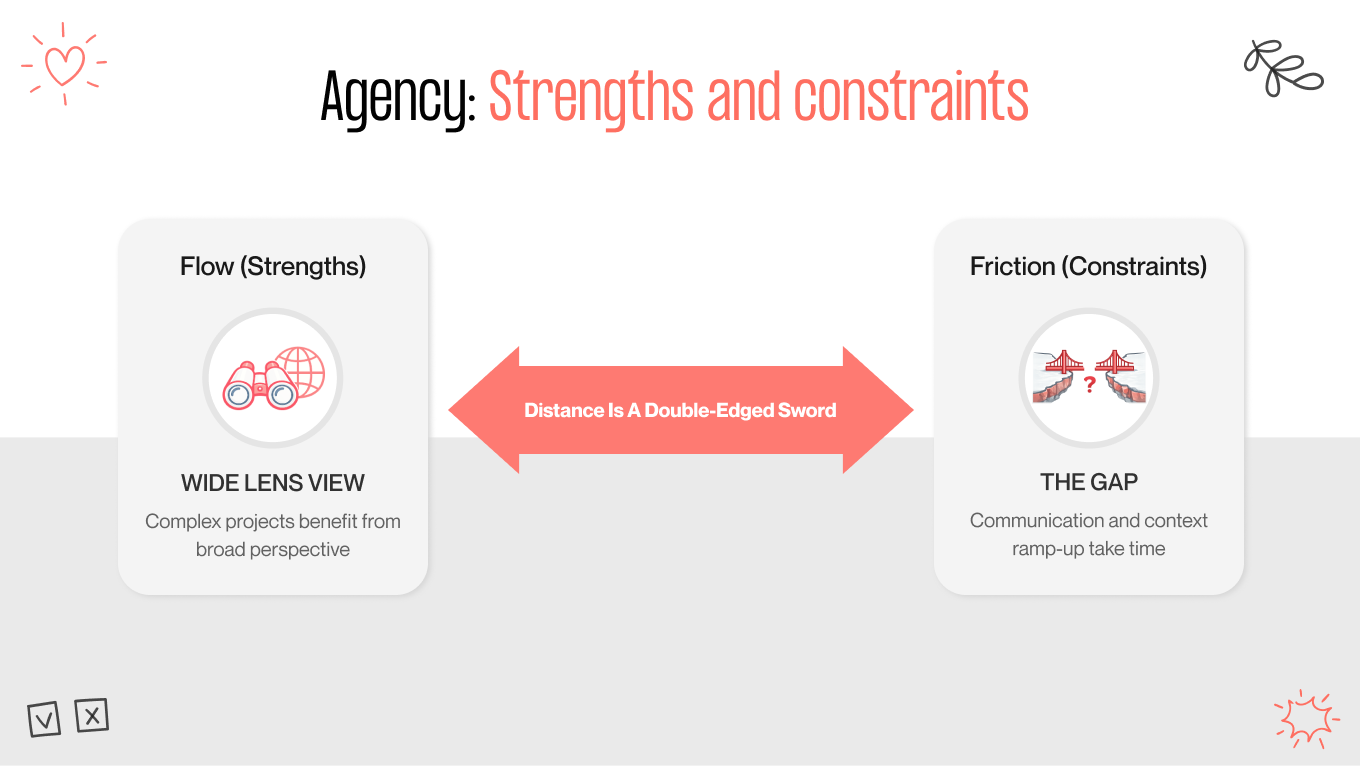
  • Complex or high-stakes projects. Large redesigns, new product launches, or significant brand changes benefit from agencies that use proven processes and have experienced teams. Having faced similar challenges in different companies, they can foresee risks and act with greater confidence.

  • Need for multidisciplinary expertise. Creative agencies combine designers, strategists, researchers, and specialists from various fields. This range enables complex problems to be addressed simultaneously, which is hard to achieve internally without substantial hiring and coordination.

  • Fresh thinking and challenge to internal assumptions. Working outside of the company allows agencies to question long-held beliefs. The “outside” perspective helps reveal alternatives, spot blind spots, and keep teams from defaulting to familiar solutions.

A fresh perspective, balanced with professional experience, can enhance your product — Gapsy is ready to work together.

Where Design Agencies Create Friction

While agencies offer scale and perspective, their advantages come with practical trade-offs. These tend to show up in day-to-day operations rather than in the quality of the work itself.

  • Cost predictability. Outsourcing partners typically charge per project or by the hour, which can make long-term budgeting less predictable. As requirements change, costs may rise in ways that are harder to foresee compared to fixed salaries for internal staff.

  • Communication overhead. Collaborating with an external team requires clearer documentation, more structured feedback sessions, and planned check-ins. If both sides lack strong process discipline, this extra coordination can delay progress.

  • Cultural and context ramp-up. Design agencies need time to grasp a company’s products, users, and internal dynamics. Until they’re fully in this context, finding alignment can feel less natural than with in-house teams who are already part of the organization’s daily reality.
agency strengths and constraints
pros and cons of hiring an agency

The Decision Framework of Choosing Between In-House vs Design Agency

The right choice is rarely ideological. It usually comes down to how your work shows up, how often it changes, and where your real constraints are. Team structure is less about preference and more about fit. But there are clear trade-offs when choosing in-house vs. agency design, from speed and continuity to access to specialized skills.

The framework below is designed to make that choice explicit.

Project Scope and Volatility

  • Choose in-house design when the workload is steady, predictable, and closely tied to ongoing product or marketing cycles. In these environments, context builds over time, handoffs are minimal, and execution naturally speeds up.

  • Choose a design agency when demand fluctuates, projects vary in scope, or priorities shift frequently. Outsourcing agencies are built to absorb spikes and complexity, allowing you to scale effort up or down without permanently increasing headcount.

Budget Structure

  • Choose in-house when you want predictable, fixed costs and design is a continuous need. Salaries, tooling, and overhead are easier to plan for when the volume and type of work remain consistent.

  • Choose an agency when flexibility is what you strike for. Variable investment makes sense when design needs change quarter to quarter or are tied to defined initiatives rather than ongoing execution.

Speed, Feedback Loops, and Decision Access

  • Choose in-house when speed comes from proximity and informal access. Quick conversations, real-time feedback, and shared context reduce friction when decisions can’t wait for documentation.

  • Choose an agency when speed is driven by the design process. Clear briefs, defined milestones, and structured reviews can outperform ad hoc collaboration, especially when work is complex, distributed, or cross-functional.

Talent Depth vs. Focus

  • Choose in-house when a focused skill set covers most of your needs. A small team — or even a single designer — with deep product and brand understanding can be remarkably effective in a stable environment.

  • Choose an agency when the work demands breadth. A coordinated group of specialists is better equipped to tackle challenges that require strategy, UX, visual design, and execution simultaneously.

To help you make the right choice, we’ve compiled a table that reframes the decision in terms of practical questions that most teams implicitly answer, often without realizing it.

Question you answer

In-house design makes more sense when

A design agency makes more sense when

What does most of the design work look like?

Ongoing improvements to the same product, brand, or system

Distinct initiatives with clear starts and ends

How predictable is demand?

Design needs are steady month to month

Workload comes in waves or spikes

Where does speed come from?

Fast decisions, hallway conversations, and shared context

Parallel workstreams and dedicated delivery capacity

What kind of mistakes are most expensive?

Losing brand coherence or internal alignment

Missing ideas, patterns, or solutions already proven elsewhere

How specialized is the work?

One primary skill set covers most needs

Multiple specialties are required at the same time

What kind of risk is acceptable?

Hiring, ramp-up time, and reliance on a small team

Scope definition, external coordination, and vendor dependency

What does “quality” depend on?

Deep familiarity with the product and audience

Breadth of experience and comparison across industries

How long does this need to work?

Indefinitely, as a core internal capability

For a defined period or phase of growth


3 Common Hybrid Models and When They Work

Most companies don’t operate at either extreme for long. As needs shift and organizations mature, hybrid models tend to emerge naturally, offering a more resilient balance between focus and flexibility.

  1. In-house core with agency support for peaks. This setup works well when design needs are generally stable but surge around launches, campaigns, or major product updates. An internal designer anchors brand and product knowledge, while an agency steps in to absorb short-term pressure without committing to long-term headcount.
  2. Agency-led brand with in-house execution. Here, an agency defines or refreshes the brand system, then hands off execution to an internal team. It’s a practical approach when strategic brand direction is needed upfront, but ongoing production and iteration benefit from close, internal ownership.
  3. Temporary agency support during scale or rebrand. During rapid growth, market shifts, or large rebrands, agencies can act as a temporary extension of the team. Once the transition stabilizes, design responsibility can be returned in-house with clearer standards, stronger alignment, and reduced operational risk.

When an Agency Is the Better Strategic Choice

From our perspective, the agency model works best when design decisions carry structural weight. These are moments when mistakes are costly, timelines are compressed, and internal teams are already operating near capacity. In such situations, the value of an agency is a coordinated expertise applied at speed, without adding long-term organizational drag.

Rapid Growth or Repositioning

When a company is scaling quickly or redefining how it shows up in the market, internal teams are usually focused on keeping operations moving. Design becomes both more critical and harder to resource at the same time. Momentum matters, but so does consistency.

We most often step in when teams are entering new markets, shifting from service to product, or outgrowing an early-stage brand. In these phases, agencies add value by working in parallel with internal teams. Our role is not to replace internal knowledge, but to bring structure, clarity, and forward motion when change is happening faster than hiring and onboarding can realistically support.

Complex Digital Products

These products tend to expose the limits of single-discipline design. Platforms with multiple user types, deep functionality, or technical constraints demand coordination across UI/UX design, visual identity, interaction patterns, and system thinking.

We see this frequently with SaaS platforms, marketplaces, and data-heavy solutions. An agency model allows these disciplines to work together as a unit, rather than forcing one in-house designer to stretch across areas where depth and specialization directly affect product quality and usability.

Need for Senior Strategic Input

Some design challenges are not about execution. They relate to direction. When teams are discussing positioning, product narrative, or how design supports long-term business goals, a senior perspective becomes essential. 

Agencies outsource experienced design leads who have navigated similar challenges in different companies and industries. This often helps leadership teams make fewer, clearer decisions early on. It also reduces rework, minimizes downstream issues, and saves time and costs once execution begins.

Scale your design with Gapsy – contact us to bring expertise and bandwidth to your team when it matters most.

When Building In-House First Makes More Sense

There are also situations where starting with an in-house designer is the more disciplined and sustainable choice. Being explicit about these cases matters because agencies are not the right solution to every design problem.

Early-Stage Budget Control

For early-stage companies, design needs are often ongoing but limited in scope. Predictable costs are more important than access to a wide range of specialties. Hiring a single in-house designer can be more sustainable than paying external fees, especially when priorities shift frequently and the work is closely linked to daily tasks. In such situations, proximity and flexibility often matter more than range.

Narrow, Repetitive Design Needs

When most design work follows a clear and repeatable pattern, such as maintaining marketing assets, updating product interfaces, or supporting an established brand system, in-house designers tend to be more efficient.

Context accumulates quickly, feedback loops are short, and the overhead of briefing and re-briefing external teams can outweigh the benefits of a fresh outside perspective.

Strong Internal Design Leadership

When strong design leadership is already in place, investing in an internal team becomes a much safer bet. Strategic clarity, established standards, and consistent decision-making reduce the fragility that small in-house teams often face.

With that foundation, in-house designers can work independently and stay focused on execution, while agencies can be brought in only when specific skills or short-term capacity are required, rather than as a default solution.

The table below summarizes the core trade-offs between in-house design and agency support. It is not meant to declare a winner, but to make the differences visible at a glance so you can judge which model fits your current reality.

Aspect

In-house design

Design agency

Cost behavior

+ Predictable monthly expense
Fixed cost regardless of workload

+ Pay only for active work
Harder to forecast long-term spend

Context depth

+ Deep understanding of product and brand over time
Perspective can narrow

+ Broad exposure across industries
Requires ramp-up to absorb context

Speed mechanics

+ Fast informal feedback and decisions
Speed drops when capacity is maxed

+ Parallel execution across roles
More process and coordination

Skill coverage

+ Strong ownership within a focused scope
Gaps outside core strengths

+ Access to multiple specialists
Less continuity per individual

Operational risk

+ Full internal control
Hiring and retention risk

+ Low people risk
Dependency on external partner

Best used when

+ Work is steady and well-defined

+ Work is complex or changing


The Salary Myth, or Why In-House Design Looks Cheaper Than It Is

Entrepreneurs may think that having an in-house design team is cheaper. The math looks straightforward: one salary, a laptop, some tools, and the expectation that productivity will naturally increase over time. Compared to paying an agency, this option seems easier to justify and manage. On paper, it appears to be the safer financial choice. However, the reality is more complex.

Salary is just the most obvious cost. When you factor in benefits, taxes, paid time off, recruiting fees, gaps from vacancies, onboarding time, and software, the actual expense rises quickly. The risk is even more significant: if an in-house designer leaves or becomes overwhelmed, the team's capacity vanishes. It can take weeks or months to recover, causing delays and stress throughout the business.

This is why the idea that in-house design is always cheaper is a misconception. When you look at the total cost of ownership, agencies provide more than just execution. They shift hiring risks away from you, stabilize output, and turn hidden costs into predictable, manageable investments.

In-House Design vs. Agency: Total Cost of Ownership Comparison

A senior in-house designer comes with far more costs than just a salary. Benefits, taxes, paid time off, software, hardware, recruiting fees, and gaps from vacancies all accumulate. Each of these costs may seem small on its own, but together they significantly affect your design function's overall budget.

Agencies handle pricing differently. At first glance, a retainer might seem expensive, but it includes capacity, tools, continuity, and backup at a single predictable cost. This approach removes surprises and spreads risk across the team rather than focusing it on a single individual.

Here’s a detailed comparison:

Cost component

In-house designer (Senior)

Design agency

Base cost

~$113,000 average annual salary

Fixed monthly fee

Overhead multiplier

1.25x–1.4x for benefits, taxes, PTO

Included

Recruitment cost

~$15,000–$25,000 per hire

None

Time to productivity

~44 days average vacancy, plus ramp-up

Typically under 48 hours

Software and hardware

$2,000–$5,000 per year

Included

Operational risk

If they leave, output drops to zero

Capacity is replaced immediately

This does not mean agencies are always cheaper. It highlights the comparison should not stop at salary versus retainer. In-house design is a fixed investment with concentration risk. Agency support is a variable investment with built-in redundancy. The right choice depends on whether your business values cost or output predictability, or a balance of both.

How Gapsy Typically Works With Teams

We tend to get involved after a company has already tried to solve the design question internally. Sometimes, that means an in-house designer who is stretched too thin. Sometimes, it means a rotating set of freelancers who never quite build momentum. What we usually see is not a lack of talent, but a lack of structure around how design work should scale as the business changes.

Our role is shaped by what the team already has in place. How can we help you?

  • Support in-house designers when the scope expands beyond what one person can reasonably own. We step in to fill gaps, provide extra bandwidth, and ensure that critical work doesn’t stall without disrupting the core team’s focus or autonomy.

  • Step in during growth phases, product rebrands, or shifts where experience matters. Whether a company is scaling rapidly, entering new markets, or redefining its brand, we bring proven methods and lessons from similar transitions to accelerate decision-making and reduce risk.

  • Bring structure and senior perspective when design decisions begin to affect business direction. From product strategy to user experience and brand positioning, we help leadership make high-impact choices with clarity and confidence, minimizing costly iterations downstream.

  • Adapt to existing workflows instead of forcing new ones. We integrate seamlessly with internal teams, aligning with current tools, processes, and communication habits to enhance productivity rather than introduce friction.

  • Focus on long-term coherence. Beyond individual projects, we help maintain consistent design quality, ensure brand integrity, and build a foundation that can scale with the business over time.

Our approach allows design to scale with the business, without adding unnecessary complexity or overhead.

Reimagine Your Product with Gapsy!

We're ready to help you bring a fresh perspective.

Final Take

Choosing between in-house design and an agency is less about ideology and more about fit. Both models can work well and fail, depending on how closely they match the reality of the business. The problems usually start when design is staffed based on assumptions rather than on how work flows through the organization.

In-house teams tend to excel when design needs are steady, well-defined, and closely integrated into daily operations. Agencies tend to perform best when complexity increases, change accelerates, or a broader perspective is needed. Many companies move between these models over time, or combine them, as priorities shift and the cost of being wrong grows.

The most reliable decisions come from being honest about constraints. Budget structure, risk tolerance, speed requirements, and talent depth all matter more than preference. When these factors are clear, the right model becomes obvious, and design starts supporting the business instead of slowing it down.

If you’re facing high-stakes design decisions and need clarity before committing resources, this is where an experienced agency partner can make the difference. Let’s talk.

Rate this article

20 ratings
Average: 4.9 out of 5

If you like what we write, we recommend subscribing to our mailing list to always be aware of new publications.

Do you have any questions? We tried to answer most of them!