
Cryptocurrency Exchange Development Cost in 2026: A Realistic Breakdown

12minutes read
how much does it cost to make a cryptocurrency exchange

Imagine a market processing over $79 trillion in annual trading volume, where fortunes change hands every second. For founders, the harsh reality is that no amount of solid backend engineering or strong security can make up for a platform that fails to inspire user confidence. In the crypto world, trust is easy to sense. A trader faced with a confusing onboarding process, unclear error messages, or a messy dashboard during a market spike will leave, taking liquidity with them and hurting your market credibility.

The size of the crypto market makes mistakes expensive. Entering it tests your operations and design strength. Competing effectively requires an upfront investment in smooth order flows, clear security indicators, and compliance processes that work from the start. Spending money on professional UI/UX is a move that protects your runway, reduces churn, and builds long-term trader loyalty.

This guide examines the cost to develop a cryptocurrency exchange from a product design perspective. We will break down the main UX cost drivers, evaluate how interface complexity affects different business models, examine screen-by-screen development costs, and uncover hidden design expenses that founders often overlook.
Key Takeaways

  • A basic MVP for a cryptocurrency exchange typically costs between $70,000 and $150,000.

  • Mid-tier platforms with advanced trading dashboards, compliance workflows, and mobile parity usually range from $300,000 to $800,000.

  • Enterprise-grade exchanges built for institutional volume and complex regulations often exceed $1 million in transaction volume.

  • Development costs reflect strategic choices in UX, onboarding, and target audience, rather than just engineering hours.

  • Investing in modular design systems, user research, and seamless onboarding increases upfront spend but protects long-term profitability and user trust.

What Are the Key Drivers of Cryptocurrency Exchange Development Cost?

When founders ask, “How much does it cost to start a crypto exchange?” they want a single answer. In reality, the price comes down from choices about product structure, user journeys, regulatory risks, and operational goals. To predict costs, you need clear structures in user experience and product design from the start. Each design choice affects your platform’s scalability, risk, and revenue potential.

Here are the main factors that influence both your initial investment and long-term financial exposure.

Information Architecture and UX Strategy

The design of your platform depends on your audience. A retail-focused exchange needs simple, guided processes, while an institutional platform requires complex dashboards, advanced order tools, and customizable options. Doing UX research before development helps clarify user journeys, prioritize features, and organize the interface.

Example: A platform aimed at both retail and professional traders launched with a single interface for everyone. Retail users felt overwhelmed, and institutional ones wanted advanced features that were unavailable. The outcome is extensive redesigning, lost liquidity during a market surge, and damage to the platform's reputation.

The possible business impact: Poor navigation or cluttered dashboards create confusion, irritate users, and lead to costly redesigns after launch. On the other hand, a clear information structure lowers friction, speeds up trade execution, and supports higher volumes, which affects liquidity and revenue growth.

Trading Interface and Data Visualization

Trading crypto is mainly about speed and clarity. A simple interface can handle orders, but high-value traders expect real-time charts, advanced order types, and instant data updates.

Example: During a sudden market spike, a platform with poorly optimized charts crashed for five minutes. Traders moved their funds to competitors, causing a liquidity gap that lasted for weeks and hurt revenue and trust.

The possible business impact: Every millisecond matters for professional traders. If the UI struggles with charts lag, orders fail, or unclear market depth during volatility, traders leave. This means lost trading fees and harms your platform's reputation, leading to less repeat use and lower liquidity.

Wallet UX and Security Friction

A wallet assumes that everything is still there when you check. Hot wallets stay close; cold ones фку quiet. Multi-sig means no single point of failure, human or otherwise. Two-factor adds a second voice before anything moves. None of it should feel like a checkpoint.

Example: A poorly designed key management process caused repeated withdrawal failures. Users overwhelmed support, creating operational strain and public complaints, while some chose to move their funds elsewhere.

The possible business impact: Poor wallet UX can lead to user mistakes, lost funds, and high support costs. By creating intuitive flows and clear visual signals about security, exchanges can protect capital, reduce operational risks, and build user confidence.

Compliance Workflows and Onboarding

Following regulations is a crucial cost factor. KYC (Know Your Customer) and AML (Anti-Money Laundering) rules differ by region, but are essential in serious markets.

Example: An exchange hurriedly launched without testing its onboarding flows. KYC issues caused a 40% drop in user activation in the first month, while compliance issues led to regulatory warnings, creating a double blow to liquidity and credibility.

The possible business impact: Complicated onboarding processes can cause users to drop off, while cutting corners on compliance can lead to fines and regulatory issues. Clear and efficient KYC processes balance legal obligations with ease of access, helping protect both revenue and reputation.

Partner with Gapsy to translate complex financial logic into clear, secure, and high-converting user experiences.

Cost to Start a Cryptocurrency Exchange by Business Models

The choice of business model affects your regulatory exposure, the interface's complexity, security responsibilities, and the long-term operational load. Misjudging this decision can lead to mispriced roadmaps, unexpected compliance fines, and expensive redesigns. Each model changes capital requirements, UX/UI design, and infrastructure priorities,so founders need to understand these before investing funds.

Centralized Exchange (CEX) Development Cost

Centralized exchanges give complete control over matching engines, liquidity management, custody, and user experience, but this control also comes with full accountability.

Key strategic cost drivers:

  • Dashboard Complexity: Serving both beginners and professional traders requires “Lite” and “Pro” modes, with customizable charts, advanced order types, and real-time updates.  

  • Fiat On-Ramp UX: Smooth integration with banks and payment gateways prevents liquidity issues and reduces drop-off during deposits or withdrawals.

  • KYC Integration: Multi-tiered identity verification must balance compliance requirements with user engagement.

Let’s look at the strategic scenario: A founder launched a CEX MVP without separating retail and institutional dashboards. During a market surge, the platform’s order execution failed for advanced traders. This mistake forced emergency infrastructure upgrades and temporarily halted revenue.

Estimated cost range

  • Lean MVP CEX: $150,000 to $300,000

  • Mid-tier secure and compliant exchange: $300,000 to $800,000

  • Enterprise-grade institutional platform: $1M+ for full infrastructure and compliance

Decentralized Exchange (DEX) Development Cost

DEX platforms lower custodial liability but increase complexity in smart contract reliability, protocol design, and gas efficiency. Founders trade operational risk for more technical depth and security.

Key strategic cost drivers include:

  • Wallet Connectivity: The user experience must make MetaMask, WalletConnect, and other wallets feel seamless, or users will abandon trades midway.

  • Gas and Slippage Transparency: Dynamic network fees must be communicated clearly through UI; failing to do so can frustrate users and lead to lost liquidity.

The strategic scenario in this case: A DEX MVP launched with basic wallet integration. Users were often caught off guard by fluctuating gas fees, prompting several high-volume traders to shift their liquidity to a competitor, thereby reducing market depth and trading fees for weeks.

Estimated cost range

  • Basic DEX: $80,000 to $250,000

  • Advanced DEX: $250,000 to $600,000 (with governance, tokenomics, and layered audits)

P2P Cryptocurrency Exchange Development Cost

P2P (peer-to-peer) exchanges find a middle ground; the platform facilitates trades while users transact directly. This introduces operational responsibilities regarding trust and dispute resolution.

P2P key strategic cost drivers:

  • Escrow UX: Clear step-by-step visual feedback must show the status of funds to avoid confusion and reduce disputes.

  • Dispute Resolution & Chat: Integrated messaging and moderator dashboards are vital for operational reliability and user retention.

  • Reputation Systems: Ratings and historical performance screens reduce fraud risk and maintain user trust.

Imagine a strategic scenario: A P2P platform launched with limited dispute resolution tools. High-value trades occurred without moderation during conflicts, resulting in lost funds, dissatisfied users, and reputational damage that slowed down liquidity acquisition.

Estimated cost range

  • Focused MVP: $70,000 to $200,000

  • Platform with advanced escrow, compliance, and reputation layers: $200,000 to $400,000

Business model comparison table

Feature/Risk Area

CEX

DEX

P2P

Strategic Implications

Regulatory exposure

High

Medium

Medium

Determines compliance investment and potential fines

Custody responsibility

Full

Minimal

Shared

Impacts capital security, insurance, and user trust

UX complexity

High

Medium

Medium

Drives design cost and post-launch friction

Liquidity management

Full control

Depends on protocol

Limited, user-driven

Affects revenue stability and scalability

Operational burden

High

Medium

Medium

Influences staffing, support, and long-term costs


Different Models Cryptocurrency Exchange Comparative Cost Overview

Before you budget, pick your model. Everything else follows from this choice.

A CEX is built around compliance; that's where the time and money go. A DEX lives or dies on its smart contracts and how cleanly it connects to a Web3 wallet. P2P is a trust problem first; the escrow UI either earns confidence, or it doesn't.

Each model is a different platform entirely. The table below makes the tradeoffs concrete.

Crypto Exchange Model

Initial Cost Range

Primary Design/Dev Cost Drivers

Risk Profile

Operational Complexity

CEX

$150k - $1M+

Complex trading views, KYC UI, fiat integration

High regulatory risk

High

DEX

$80k - $600k

Web3 wallet UX, slippage/fee transparency

Smart contract risk

Medium to High

P2P

$70k - $400k

Escrow status UI, chat, trust/rating systems

Fraud/Trust risk

Medium


Detailed Breakdown of Crypto Exchange Development Cost by Component

Founders often view the user interface as just one line item when budgeting for a cryptocurrency exchange. In truth, hiring a professional design agency is a wise investment. It helps turn complex financial and regulatory details into user-friendly, secure, and effective screens. Every design choice affects capital allocation, operational risk, and long-term revenue stability.

Breaking your platform down into its key design elements clarifies where to deploy resources most strategically.

UX Discovery and User Journey Mapping

Before designing any part of the platform, define how money, data, and users interact. Skipping this step leads to costly redesigns and delays in launching.

  • Deliverables: Competitor analysis, user personas (Retail vs. Pro), and detailed wireframes for core flows (Deposit → Trade → Withdraw).

  • Cost Driver: Regulatory complexity. Creating a smooth KYC flow that addresses failed uploads, manual checks, and jurisdiction limits requires careful planning.

  • Operational Impact: Neglecting detailed journey mapping results in user confusion, support bottlenecks, and expensive fixes after launch. This can reduce liquidity retention and revenue consistency.

The Core Trading Interface (UI/UX)

The trading dashboard is the platform’s most essential and costly part. It needs to present dense market data clearly and quickly without overwhelming users.

  • Deliverables: Modular widgets for order books, candlestick and depth charts, trade history, and order entry. Includes simple swap ("Lite") and advanced trading ("Pro") modes, along with Light and Dark themes.

  • Cost Driver: Interaction design. Each micro-state (hover, click, loading, and order failure due to insufficient funds or slippage) needs careful mapping.

  • Operational Impact: Poorly designed trading interfaces lead to order errors, frustrate important traders, and reduce liquidity in volatile markets. This directly affects revenue from fees.

Wallet, Custody, and Asset Management Screens

Wallets are where user trust is most vulnerable. Mistakes here can result in irreversible fund losses and damage the platform's reputation.

  • Deliverables: Portfolio allocation dashboards, deposit/withdrawal flows, transaction histories, and network selection interfaces.

  • Cost Driver: Visual friction and error prevention. Two-factor authentication confirmations, whitelist address management, and clear warning messages are crucial to reducing costly support tickets and fund recovery issues.

  • Operational Impact: Confusing wallet flows or weak visual security signals increase user errors, raise support needs, and risk capital loss. This can undermine the platform's long-term credibility.

Admin and Compliance Tooling

An exchange’s reliability depends on how effectively its internal team manages liquidity, disputes, and compliance.

  • Deliverables: Dashboards for KYC document approval, monitoring liquidity pools, managing fees, and resolving P2P conflicts.

  • Cost Driver: Data density. Compliance officers require interfaces that enable them to quickly cross-reference user data with AML flags without sacrificing accuracy or speed.

  • Operational Impact: Inefficient administrative tools slow decision-making, increase errors, and increase regulatory risk, potentially resulting in fines or delayed transaction processing.

Design System and UI Handoff

A professional agency provides more than just static mockups. They create a scalable asset library that developers can use to efficiently implement the platform.

  • Deliverables: UI Kit (typography, color palettes, button states, grids) and high-fidelity interactive prototypes.

  • Cost Driver: Component reusability. Spending a bit more upfront on a robust design system reduces future development costs and speeds up mobile or new-feature launches.

  • Operational Impact: A weak design system leads to inconsistent interfaces, longer development cycles, and higher maintenance costs, reducing agility and increasing capital expenditure.

Design Phase / Deliverable

Primary Focus

Business Impact

Approximate Cost Range

UX Discovery & Wireframing

User journeys, KYC flows, architecture

Reduces development rework, lowers user drop-off

$5,000 – $15,000

Trading Dashboard UI

Data visualization, order book states, Pro vs. Lite modes

Trader retention, execution speed perception

$15,000 – $50,000+

Wallet & Asset Management

Network selection, visual security, and error prevention

Protects user funds, reduces support overhead

$5,000 – $20,000

Admin & Operations UI

KYC approval queues, liquidity monitoring

Operational efficiency, team size scaling

$5,000 – $15,000

Design System & Handoff

Scalable UI components, interactive prototypes

Speeds up front-end development, ensures consistency

$5,000 – $25,000+

Underinvesting in the sensitive parts defers the cost until it's worse. A trading dashboard that confuses, a wallet that erodes trust, an onboarding flow that loses people early, and churn, support load, and reputation damage that compound quietly until they don't. The layers that feel optional rarely are.

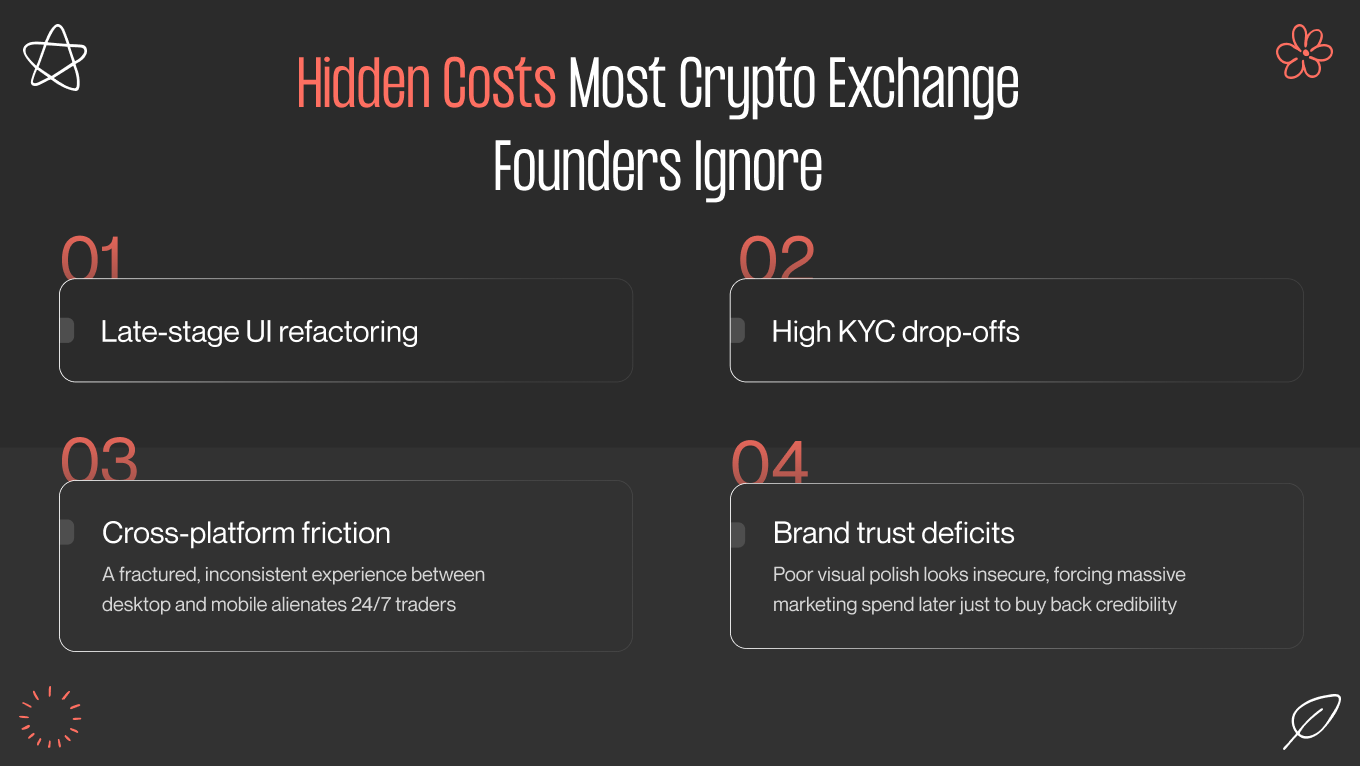
Hidden Costs Most Founders Ignore

When founders budget for a cryptocurrency exchange, the visible engineering cost is just a small part of the whole picture. The real risks and costs stem from hidden factors that can disrupt timelines, erode liquidity, and force costly strategy shifts. Failing to recognize these costs impacts runway, operational risk, and long-term trust.

Late-Stage UI Refactoring

Regulations change quickly, and your crypto exchange platform must keep up. If your UI isn’t based on a modular, reusable design system, updated KYC flows or new transaction reporting rules will require a complete interface overhaul.

A modular design system means updating a flow rather than rebuilding a platform. Without one, every regulatory change becomes a construction project. For example, a single compliance update may cost platforms two months and $75,000 in unplanned rebuilds, because the foundation wasn't ready for it.

High Onboarding Drop-Offs

Onboarding is where revenue is won or lost before the platform ever trades.

A clunky KYC flow or a registration process that demands too much too soon frustrates users and drives them away. Every drop-off raises acquisition costs, shrinks the user base, and drains liquidity before the platform finds its footing.

Skipping UX research here has a documented price. A friction-heavy verification flow can lose 40% of signups before completion, which turns $50,000 in marketing spend into users who never arrive.

The UX and acquisition budgets are the same.

Mobile and Web Inconsistency

Traders want a smooth experience across devices, from the website to mobile. Not budgeting for high-quality mobile app design creates a disjointed brand experience, lost engagement, and lower trading frequency.

A desktop-first design is a signal that the experience wasn't fully considered. Missing features and inconsistent layouts get replaced. A 25% drop in daily volume is what it looks like when traders quietly move on.

Trust and Branding Deficits

In crypto, trust is communicated through visuals. Cutting corners on interface quality or consistent branding sends a message of amateurism or, even worse, unreliability to traders, leading founders to spend heavily later to restore credibility.

A strong backend behind a disjointed frontend still loses trust. Rebuilding credibility after the fact costs more than building it correctly the first time. A $100,000 emergency rebrand is a painful way to learn that branding wasn't optional.

hidden costs in crypto exchange

Gapsy guides founders through every step of exchange development, from UX research to compliance-ready design, ensuring your capital is invested wisely — drop a line!

How Geography Affects the Cost to Develop a Cryptocurrency Exchange

The markets you target determine the compliance flows, language support, and UX conventions your platform needs to feel native. The talent you hire influences the cost of that work. Both decisions are made within the design budget before a single wireframe is drawn.

UI/UX Design Talent Market Rates

The cost of professional design varies widely by region, but you don’t have to sacrifice quality. For instance, places like Eastern Europe have become global centers for Web3 and FinTech design skills at much lower rates than those in Silicon Valley.

Below are average hourly cost equivalents for mid-to-senior UI/UX product designers and agencies in 2026:

  • United States: $80 to $150+ / hour (High overhead, premium market)

  • Western Europe (UK, Germany): $60 to $100 / hour

  • Central and Eastern Europe: $30 to $60 / hour (High concentration of specialized Web3/crypto design talent)

  • Asia & India: $15 to $40 / hour

Choosing an experienced design partner in a region like Eastern Europe allows founders to afford comprehensive UX research and high-fidelity prototyping for the same price they would pay for basic wireframes in the US.

Regional Compliance and Onboarding UX

Your users’ locations affect the regulatory complexity of your design. Operating in the European Union under MiCA or targeting U.S. customers requires detailed KYC and AML processes that generic login templates cannot handle.

Progressive KYC Profiling (EU/UK)

Instead of making users complete a long onboarding form upfront, a progressive approach collects minimal information to begin ($1,000 trading limit). It then escalates to ID verification for larger trades and requires Source-of-Funds disclosures for high deposits. Designing these contextual, trigger-based flows requires extensive wireframing and testing.

State-by-State Geo-Fencing (USA)

U.S. regulations differ by state. For example, New York’s BitLicense restricts certain tokens and margin trading. The user interface must adapt to the user's zip code, displaying compliant dashboards rather than error messages or generic blocks. This requires multiple interface versions.

Biometric Liveness Feedback Loops

Integrating third-party KYC providers like Sumsub or Onfido involves more than just embedding their APIs. Good crypto UX design considers user errors, such as lighting issues and camera angles, and provides visual guides, dynamic indicators, and friendly messages to help recover conversions that might otherwise be lost.

Cultural UX and Financial Psychology

Global expansion also requires adjusting to local cognitive patterns, trading habits, and visual conventions. One-size-fits-all interfaces can alienate users.

When you hire a UI/UX design agency for a global rollout, they must account for the following cultural UX realities:

The Red/Green Financial Color Flip

In the US and Europe, the financial color language is universally understood: green means a stock or crypto is going "up" (profit), and red means it is going "down" (loss). 

However, in mainland China, Taiwan, and several other Asian markets, the psychology is entirely reversed. Red is traditionally the color of wealth, good fortune, and market gains, while green indicates a drop in value.

That’s why you cannot simply hardcode colors into your charts. Your design team must build a color preference toggle in the user settings and utilize semantic color variables (e.g., color-trend-positive) within the design system so the entire platform's visual logic can flip instantly based on user preference or geolocation.

Information Density and Trust Signals

Cultures measure platform credibility differently.

Traders in the US and EU prefer minimalist, breathable interfaces with significant whitespace. They want a linear, step-by-step onboarding process (e.g., the Coinbase model) that keeps cognitive load to an absolute minimum. A cluttered screen feels overwhelming and untrustworthy.

In countries like China, South Korea, and Japan, users are highly adapted to dense, holistic interfaces. Because logographic languages (like Chinese Hanzi) visually pack massive amounts of meaning into compact characters, these users process dense data much faster. To an Asian trader, an interface packed with order books, depth charts, micro-promotions, and chat boxes on a single screen signals abundance, feature-richness, and trust. A minimalist, empty screen might actually be perceived as lacking functionality or liquidity.

Typographical Shifts and Grid Flipping

If your expansion strategy includes the Middle East and North Africa (MENA), translating the UI copy into Arabic or Hebrew is only 10% of the work.

These languages are read Right-to-Left (RTL). This means the entire UI grid must be mirrored. The "Back" button moves to the right, charts must render data flowing in the opposite direction, and navigation menus flip sides. Your design system must be structurally designed to support bidirectional layouts from day one.

Thus, if your geographic strategy includes both East and West, your agency cannot just hand over a standard set of screens. They must build a highly flexible, localized UI component library that can seamlessly toggle between color psychologies, RTL typography, and varying layout densities.

While this increases your upfront design system costs by 20% to 40%, it creates a massive financial moat. It ensures that when you decide to launch in a new global market, your development team doesn't have to rewrite the entire crypto application from scratch.

How to Reduce Crypto Exchange Development Cost: 6 Tips Based on Gapsy Experience

Cutting costs only works if it doesn't erode trust. In crypto exchange design, the wrong trade-offs show up quickly in low conversion rates, support overload, or a frontend that has to be rebuilt before the product finds its footing.

The right approach is spending where it's confirmed. Nail the core flows, test the assumptions, and avoid designing 100 screens for a product-market fit that nobody has validated yet.

1. Validate Revenue Priorities Through UX Research Before Designing Features

Before creating any features, define the conditions your business must meet to succeed in the first year. Are you competing on professional trading depth, fast retail onboarding, or meeting local compliance?

Through thorough UX research, we link these priorities to real user behaviors and expectations. This helps founders avoid funding screens and features that traders will not use, keeping wireframes lean and minimizing engineering hours. Without this step, the project scope increases based on opinions rather than data-based strategies.

2. Build a Modular UI Design System to Prevent Expensive Rework

Treating your interface as a set of separate, static pages will lead to future rework. Instead, design a strict, modular UI system with a library of reusable buttons, charts, input fields, and typography.

If you need to switch a KYC provider or add a new fiat gateway, you can update just one component. As a result, this method reduces the need for platform-wide redesigns, saving both time and money in the long run.

3. Prototype the MVP Before Writing a Single Line of Code

Launching a fully coded exchange all at once is costly and risky. Define a Minimum Viable Product (MVP) to test demand and core trading flows.

High-fidelity, clickable prototypes allow you to test deposits, swaps, and withdrawals with actual users and investors before starting backend development. Fixing an issue in a prototype costs much less than rewriting a live application, saving considerable time and money.

4. Leverage Familiar Web2 UX Patterns for Web3 Integrations

Financial tools thrive on predictability. While cutting-edge design may work for marketing sites, standard Web2 patterns lower cognitive friction in financial stages.

What should you do? Use familiar layouts for password recovery, identity verification, and checkout. You can shorten design timelines and help users onboard faster, reducing both design hours and drop-off rates.

5. Design for Visual Security Early

Security involves more than just backend systems; it must be visually communicated. Users who do not feel secure will not deposit funds, no matter how protective the platform is.

Incorporating trust signals — such as 2FA prompts, clear fee breakdowns, encrypted connection badges, and anti-phishing indicators — into the initial wireframes ensures users feel safe. Doing this early prevents the costly situation where a technically secure platform is abandoned because it appears unprofessional.

6. Consult Regulatory Experts to Map the KYC UX Early

Why you should consider a UX consulting? The onboarding UX must align with regulatory requirements. Designing a smooth, one-click registration only to find that your jurisdiction requires multi-step KYC processes will lead to expensive redesigns.

Collaborating with regulatory experts from the start lets you build a progressive onboarding experience. Users can provide minimal information initially and share additional verification details only when necessary, reducing drop-offs and protecting your budget and timeline.

Create a Crypto Exchange Platform with Gapsy!

Our agency is ready to work together — drop a line.

Final Thoughts

So, what does it take to design and develop a custom cryptocurrency exchange in 2026? A well-planned MVP usually costs between $70,000 and $150,000. Platforms with more complex features, such as tailored compliance workflows, trading dashboards, and mobile app compatibility, typically cost between $300,000 and $800,000. For exchanges built to handle institutional volume and complex regulations, budgets often exceed $1 million.

None of these is arbitrary. Each range reflects real decisions about who the platform serves, what it promises, and how much it can be trusted. Founders who chase the lowest number build the platform that proves why it was a mistake. Abandoned wallets and thin liquidity are what happen when trust wasn't budgeted for. The exchanges that last aren't the cheapest. They're the ones where someone decided early that user research, flexible design systems, and frictionless onboarding were costs worth carrying.

Want to ensure your platform is built with strategic foresight, robust UX, and regulatory-ready architecture? Gapsy can guide your team from concept to launch, helping you allocate capital wisely while minimizing hidden risks.

Rate this article

20 ratings
Average: 4.9 out of 5

If you like what we write, we recommend subscribing to our mailing list to always be aware of new publications.

Table of contents

desktop bannermobile banner

Need a design expert?

Do you have any questions? We tried to answer most of them!