Why You Should Outsource UI/UX Design Logic

14minutes read
outsource-ux-ui-design

The transition from "hiring designers" to acquiring specialized design maturity is a strategic pivot for market leaders. In an environment where rapid deployment is the norm, 84% of businesses anticipate UX design becoming more popular over the next decade. It is a response to so-called "proximity bias", the reality that internal teams are often too close to their own product to see the friction points causing user churn. This is where the decision to outsource UX design becomes a tool for objective clarity rather than just a way to cut costs.

By leveraging UX design outsourcing, companies bypass the six-month recruitment cycle and immediately inject unbiased user research into their roadmap, which is a critical step that internal teams frequently overlook due to ingrained assumptions. Our expertise at Gapsy Studio is built on this "externality advantage." We function as a strategic thought partner, utilizing cross-industry logic to identify exactly where a product’s architecture is failing its users.

In this guide, we will explore the operational mechanics of UX design outsourcing, from matching a partner to your business stage to integrating external logic into your internal sprints. We’ll also break down the logic audit process to help you vet partners who prioritize user psychology over aesthetic trends.
How Strategic UI/UX Design Outsourcing Helped Our Client Turn Vision Into a Growth Engine

The true value of choosing to outsource UX design isn't found in a list of deliverables, but in the "externality advantage"—the ability of a strategic partner to identify the friction points that internal teams have become too close to see. A successful partnership moves beyond a static brief to challenge the product's underlying logic, ensuring every design choice serves a specific business KPI.

The Challenge of Moving Beyond Standard Aesthetics

Our work with Adsellr illustrates this shift from task-based work to vision-driven performance. Operating in the competitive e-commerce landscape, the client needed more than a professional interface. They required a platform that addressed the unique psychological hurdles and operational pressures of online business owners.

The Solution: A Research-Backed Growth Engine

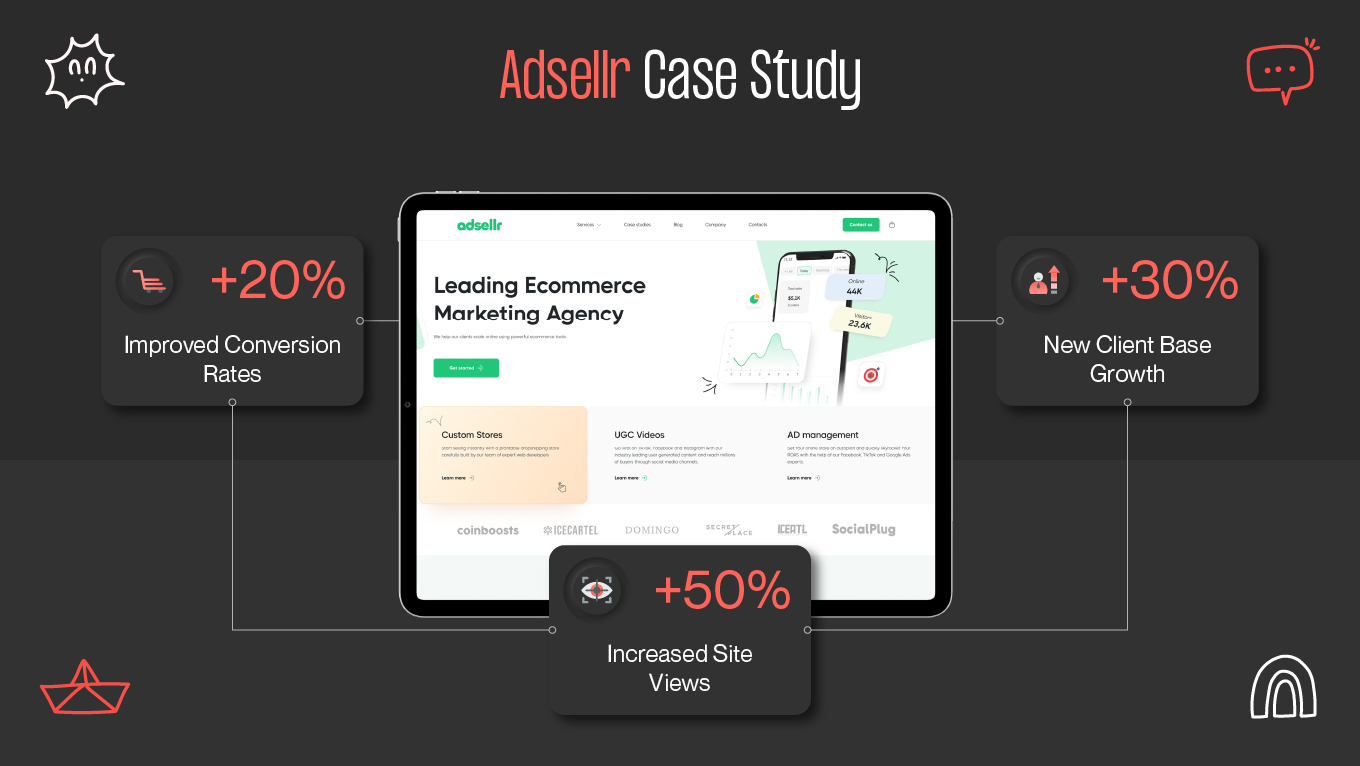
By leveraging specialized UX design outsourcing, we bypassed standard aesthetic trends to build a research-backed growth engine. Our "outsider" perspective allowed the client to refine their user journey with high-performance patterns that delivered measurable results:

  • We optimized the service delivery path, turning passive visitors into active leads.

  • The refined logic-first design acted as a catalyst for significant e-business growth.

  • An increase in site reviews signaled that the new experience resonated deeply with their target demographic.

The Result: Efficiency Over "Pixels"

This case proves that when you outsource design work to a partner who prioritizes business logic over "pixels," the result is a high-retention infrastructure that transforms user behavior into long-term efficiency.

Adseller Case Study
Adseller Case Study

Sometimes, the best way to see the path forward is to let someone else look at the map for a moment. If you feel like your team is hitting that wall of "proximity bias," we’re open to a fresh look at your product's logic to see where the hidden friction is.

Why Your Business May Require User Experience Design Outsourcing

Choosing to outsource UX design isn't merely about finding someone to draw screens. It should be your strategic decision to acquire a level of product maturity that is difficult to sustain internally. While a generalist agency might focus on a site’s visual appeal, specialized outsourcing is about securing the structural integrity of your user journey.

Accessing Specialized Objectivity

The most significant hurdle for any established product is proximity bias. When an internal team lives inside a product every day, they naturally develop "blind spots." They stop seeing the friction-heavy checkout or the confusing navigation because they’ve learned to work around it.

An external partner provides a "cold eye." By opting for UX design outsourcing, you are hiring a team that doesn't share your internal history or departmental biases. This independence allows for truly unbiased user research, the kind that identifies exactly why users drop off at the 80% mark of a funnel. It’s about catching the structural flaws that internal teams often overlook because they are simply too close to the work.

Cross-Industry Innovation

At Gapsy Studio, our expertise is built on the externality advantage. Because working across diverse, high-stakes sectors (from complex Fintech ecosystems to high-velocity e-commerce) we bring a library of stress-tested patterns to your specific niche.

Our team applies the high-performance logic of other sectors to your product. This cross-pollination of ideas ensures your product isn't just "functional" by industry standards, but is strategically positioned to drive user retention that leads to a measurable profit rise.

Cost vs. Value: Scaling with the Roadmap

From a purely operational standpoint, the move to outsource design work represents a shift in how a business values its capital. Maintaining a high-level internal design team is often a significant financial anchor; between salaries, benefits, and the $4,700 average cost just to hire for a single role, the overhead adds up before a single pixel is moved.

The Reality of the "Subscription Model"

Traditional hiring locks you into a fixed annual expense that doesn't account for the natural ebbs and flows of a product roadmap. In contrast, UX design outsourcing, particularly through flat-rate models, allows for a much leaner approach. For instance, while an in-house UX designer in the US averages around $170,000 annually, leveraging a specialized partner can yield cost reductions of 40–50% without a dip in quality.

To put this into a monthly perspective:

  • In-house team: Managing three UX talents typically costs upwards of $14,100 per month when factoring in overhead.
  • Outsourced partnership: Accessing a similar talent pool through a subscription model costs roughly $5,385, creating a monthly savings of over $8,700.

Predictability as a Strategy

Beyond the raw numbers, there is a "humane" business advantage to this model: predictability. Fixed monthly fees eliminate the anxiety of "hidden" costs like equipment, taxes, or unexpected revision fees. This predictable budgeting creates a 10–20% contingency buffer; money that can be reinvested into marketing, R&D, or scaling the very product logic the design team is building. Ultimately, you stop paying for "seats" and start paying for the value-based outcomes that actually move your business forward.

To help you visualize the financial shift from a fixed overhead to a flexible, value-driven model, here is a breakdown of how the numbers typically stack up for a growing product team.

Expense category

In-house team (3 UX talents)

Outsourced subscription

Recruitment cost

$14,100+ ($4,700 avg. per role)

$0 (On-demand access)

Monthly salary/fee

$14,100

$5,385

Annual burden

$170,000+ (Per senior role)

40–50% total reduction

Hidden overhead

Benefits, taxes, equipment, & software

$0 (Inclusive flat rate)

Total 1st month cost

$28,200

$5,385

How to Outsource UX Design for Your Stage

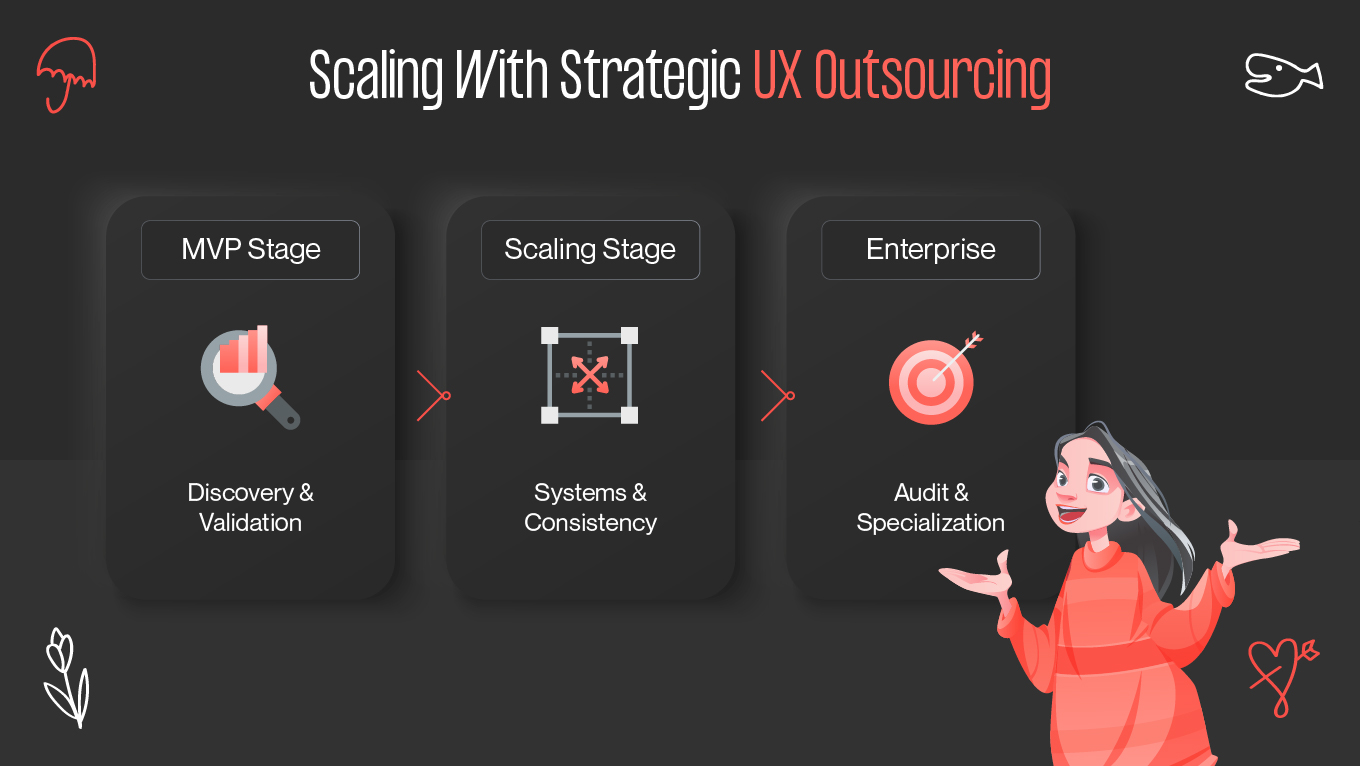
Outsourcing isn’t a "one-size-fits-all" transaction. The way a three-person startup integrates an external designer is fundamentally different from how a Fortune 500 company audits a legacy system. To outsource UX design effectively, you must align the partnership model with your current operational maturity.

Here is how to navigate the transition based on your business stage.

Strategic UX Outsourcing

The MVP Stage: Defining the "Why" Before the "How"

At this stage, your biggest enemy is lack of clarity. Startups often fall into the trap of hiring "hands" to build what they think they need, rather than hiring "brains" to discover what the user actually wants.

  • The goal: Rapid validation and high-level product logic.
  • The strategy: You need a partner who functions as a fractional Product Lead. At Gapsy Studio, our work with early-stage ventures focuses on stripping away the noise. We prioritize building a research-backed foundation that ensures your first 1,000 users don't just land on your site, but understand your value proposition in under five seconds.
  • Key benefit: You bypass the $14,100/month overhead of a full team while gaining senior-level strategy that prevents expensive "re-dos" six months down the line.

The Scaling Stage: From Craft to System

Once you have product-market fit, the challenge shifts from "discovery" to "consistency." This is where "proximity bias" begins to set in; your internal team is so focused on shipping new features that the core user experience begins to fray.

  • The goal: Building a Design System and maintaining objective quality.
  • The strategy: Use UX design outsourcing to build a scalable infrastructure. This is where we create a unified language (Design Systems) that allows your developers to move faster without breaking the UI.
  • The "externality" value: We act as the objective auditor. While your team focuses on the roadmap, we look at the data to see where the growing complexity is causing new user friction. This is exactly how we helped Adsellr scale; by creating a high-retention infrastructure that supported a 30% growth in their client base.

The Enterprise Stage: Specialized Strategic Audits

For established companies, outsourcing is rarely about "capacity." It’s about "specialization." Large internal teams often become siloed, and innovation can stall under the weight of legacy processes.

  • The goal: Unbiased audits and niche expertise (e.g., Accessibility, FinTech security, or complex SaaS logic).

  • The strategy: Targeted UX design outsourcing for high-impact projects. Enterprises bring us in to solve specific, high-friction problems, like a checkout flow that has slowly degraded over years or a dashboard that no longer serves its primary user persona.

  • Key metric: Turning a 1% improvement in a high-volume funnel into millions in recovered revenue. We use the "cold eye" of an outsider to challenge the "we've always done it this way" mentality.

Understanding where you sit on this maturity curve determines whether you need a tactical vendor or a strategic partner. If you're ready to get an outside perspective on your user journey or just want to see if our approach aligns with your goals, drop us a line.

Want to Outsource UX/UI Design?

You are in the right place! Gapsy Studio is willing to help you, so press the button and we will contact you.

How to Integrate External UX Logic with Your Internal Sprints

Successful UX design outsourcing fails the moment it feels like a detached "add-on." For a partnership to increase profit through better retention, the external logic must be seamlessly woven into your internal engineering cycles.

In our experience, the friction usually isn't in the design itself, but in the "handoff." We don't believe in the "black box" model where designs are delivered in a vacuum. Instead, we sync our specialized workflows with your existing internal sprints to ensure our strategic insights actually make it into your production environment.

The Synchronized Sprint Framework

We prioritize proactive synchronization to prevent the "design lag" that often stalls product roadmaps. By utilizing a unified framework, we ensure that while your developers are building the current feature set, our designers are already validating the logic for the next one.

The "Developer Handshake"

A common pitfall in outsourcing design work is receiving high-fidelity visuals that are technically impossible to implement within the project’s constraints. Our approach focuses on technical feasibility from day one:

  • Component-based logic: We build using atomic design principles, ensuring every UI element is a modular component your developers can easily replicate.
  • Live documentation: Rather than static PDFs, we provide living design systems so your team understands the "why" behind every interaction.
  • Real-time collaboration: By integrating into your Slack or Jira channels, we eliminate communication silos and "design debt."

Consistency as a Growth Strategy

Operational maturity means recognizing that design is an ongoing infrastructure. When you outsource UX design to a specialist, you gain a partner dedicated to maintaining your design system. This "single source of truth" ensures that as your product scales, it doesn't lose the structural logic.

Tips for Auditing UX Design Outsourcing Partners

When deciding to outsource UX design, you are looking for a guardian of your product’s logic. The vetting process should move beyond a portfolio review; it should feel like a deep-dive into how a partner thinks, not just how they paint.

A true specialized partner should be able to demonstrate not just "pretty screens," but the strategic reasoning that led to them.

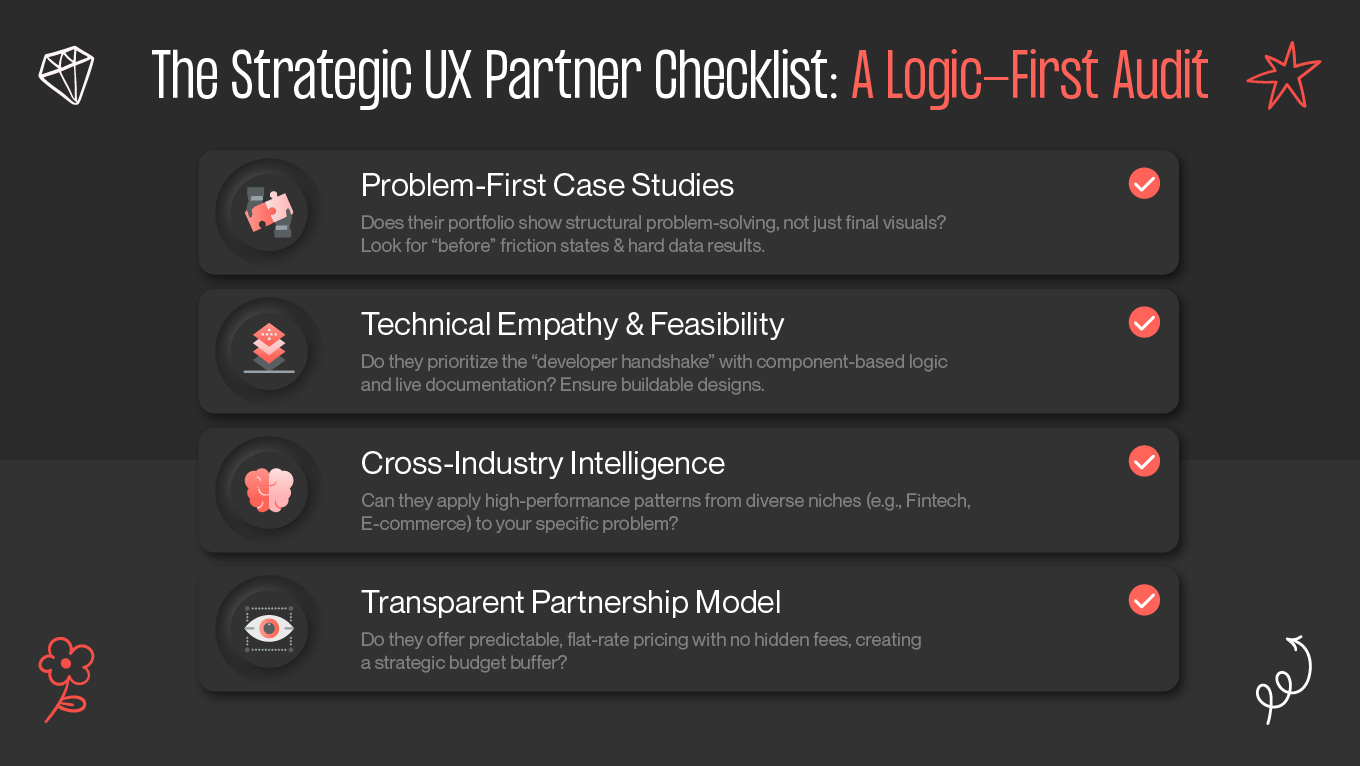
1. Look for "Problem-First" Case Studies

A professional design partner won't just show you a finished dashboard; they will show you the mess they inherited. When reviewing portfolios, look for evidence of structural problem-solving.

  • The "Before" state: Did they identify specific friction points or "proximity bias" hurdles?

  • The "Why": Can they explain the logic behind a navigation change in terms of user psychology or business conversion?

  • The results: Look for hard data, like the conversion lift or increase in site views seen in high-performing transformations.

2. Test Their Technical Empathy

The "Developer Handshake" is the litmus test of a specialized team. During your audit, ask about their handoff process. A partner with high operational maturity will prioritize technical feasibility to ensure you don't inherit "design debt."

  • Ask to see a design system: Do they use atomic components that your engineers can actually implement?

  • Communication style: Do they integrate into your Slack or Jira, or do they disappear for two weeks and return with a "final" file?

3. Evaluate Cross-Industry Intelligence

One of the greatest values of UX design outsourcing is the ability to tap into high-performance patterns from other niches. Ask your potential partner how they’ve applied logic from a sector like Fintech to a project in E-commerce.

A partner who only knows your specific industry might just copy your competitors. A team with "externality advantage" will bring fresh, stress-tested solutions that give you a competitive edge.

4. The "Culture of Transparency"

Vet the partnership model itself. A humane and organic partnership is built on predictability. Specialized partners should offer flat-rate or subscription models that eliminate "hidden fees" for revisions or software. 

Ready to sync specialized UX logic with your internal sprints? Let’s discuss how to eliminate your design debt and scale with professional consistency. 

UX Partner Checklist

How to Mitigate Risks of Design Outsource

The primary hesitation businesses feel when they outsource UI/UX design to a global partner is about the "distance." Whether it is measured in miles, time zones, or cultural nuances, the perceived risk of losing control over the product roadmap can be a significant barrier.

However, in a mature partnership, these risks are not just managed; they are designed out of the process through structural transparency and professional logic.

Navigating Time Zones

Many see a 7-hour time difference as a hurdle; we see it as a "follow-the-sun" productivity cycle. When managed with a high level of operational maturity, geographic gaps become a secret weapon for speed.

  • While your internal team finishes their day, our designers begin theirs. This creates a 24-hour development cycle where the "logic" is being validated while you sleep, ensuring that your roadmap moves twice as fast.
  • We eliminate "meeting fatigue" by prioritizing asynchronous communication (recorded walkthroughs, live documentation, and Slack-integrated updates) reserving real-time calls for high-level strategy and complex problem-solving.
  • This model ensures that when you open your laptop in the morning, the "heavy lifting" is already done, allowing for immediate feedback and implementation.

Cultural Sensitivity

A product that works in one market may fail in another due to subtle behavioral differences. When you outsource design work, you need a partner who understands that UX is a cultural language.

  • We don't just design for a "user"; we design for your user. Whether it's the specific shopping habits of a Shopify merchant or the security expectations of a Fintech user, our research focuses on the psychological triggers of your target demographic.
  • Different regions interact with technology differently, from preferred payment gateways to the density of information on a screen. Our "externality advantage" allows us to bridge these gaps, ensuring your product feels "native" to its users, no matter where they are.
  • We apply global high-performance patterns while adjusting the "humane" elements of the UI to resonate with local sensibilities.

IP Protection

In a global partnership, data security and Intellectual Property (IP) are the foundation of trust.

  • Every partnership is anchored by robust NDAs and legal agreements that ensure 100% of the IP belongs to you from the moment the first pixel is created.
  • We utilize secure, encrypted servers and industry-standard tools (like Figma’s Enterprise security) to ensure your data is never compromised.
  • Predictable billing through a subscription model eliminates the risk of "hidden costs" and budget creep. By reducing hiring and overhead costs by 40-50%, you create a 10-20% contingency buffer that protects your business from market volatility.

Bridging the "Knowledge Gap"

One of the most overlooked risks in outsourcing design work is the loss of institutional knowledge when a project ends. A professional partner ensures that the "why" behind every decision is documented and transferable.

  • We don't just deliver files; we deliver the rationale. This ensures that if your internal team expands or shifts focus, they aren't starting from scratch but building on a validated foundation.
  • By creating and maintaining a robust design system, we provide a "single source of truth" that prevents the fragmentation of your brand's visual and functional identity as you scale.

Identifying Future Friction

A high-level partnership isn't reactive; it’s predictive. Instead of waiting for a dip in metrics, a specialized team continuously audits the user journey against emerging market trends and competitor shifts.

  • We regularly compare your product’s UX logic against high-performing standards in your niche. 
  • We help you prioritize your feature backlog based on what will drive the highest ROI, ensuring that every dollar spent on design directly contributes to UX transformations.

Operational Agility

The ability to pivot is a competitive necessity. Specialized UX design outsourcing provides the elasticity needed to respond to sudden changes without the friction of a 3-month recruitment cycle.

  • When a market opportunity arises, we can ramp up design efforts instantly, bypassing the average cost and time-intensive nature of hiring new in-house talent.
  • Flexible subscription models allow you to redirect your design focus toward new product logic or different user segments without the long-term liability of fixed senior salaries.

Your Product’s Logic, Our Specialized Eye

We don't believe in being a "black box" vendor. The Gapsy designers function as a strategic extension of your team to bridge the gap between high-level business goals and technical execution. 

Our focus is on product maturity, ensuring your design is a resilient architecture that supports scale.

  • We leverage insights from UX/UI redesigns across diverse, high-stakes sectors like Fintech and SaaS to solve your niche-specific friction points.
  • Every logic-driven component we build is stress-tested for developer feasibility, preventing the accumulation of "design debt".
  • Our partnership model provides immediate access to senior-level talent that adapts to your roadmap’s velocity, allowing you to pivot or scale features without the delays of traditional recruitment cycles.

If you feel your internal team has reached the limits of proximity bias, it's time for an objective perspective. We can help you identify exactly where your product logic is leaking revenue and turn those friction points into growth levers. Let’s talk!

Final Thoughts

At its core, the decision to outsource UI/UX design is a commitment to your product’s clarity. It is about recognizing that even the most talented internal teams can develop blind spots over time due to proximity bias.

By introducing a specialized, objective perspective, you replace internal assumptions with a stress-tested logic refined across hundreds of diverse challenges. Ultimately, this partnership isn't just about offloading tasks; it’s about ensuring that every step of your user's journey is intentional, validated, and built to scale alongside your vision. Curious about where your product’s logic stands? Let's start a conversation. We’re here when you’re ready.

Rate this article

20 ratings
Average: 4.9 out of 5

If you like what we write, we recommend subscribing to our mailing list to always be aware of new publications.

Do you have any questions? We tried to answer most of them!