
Why UX Design Strategy Is Important for Building Successful Digital Products

13minutes read
ux strategy

Companies frequently talk about wanting to create “user-centered products,” yet very few build the organizational habits required to achieve it. Research shows that organizations with mature user research practices are 1.9 times more likely to improve customer satisfaction, but only 3% have reached that highest level of maturity. That gap explains why so many digital products struggle: they’re designed with good intentions, but without a strategy that aligns user needs with business goals.

Across our work with fintech products, SaaS platforms, marketplaces, and complex data-driven systems, one issue keeps coming up: teams pour resources into design and engineering yet operate without a clear UX strategy that ties everything together. User expectations, business objectives, and long-term product direction often live in separate silos. Without that connection, products grow fragile over time — harder to evolve, costlier to improve, and increasingly vulnerable to competitors.

Here, we explore why UX design strategy matters, the moments when a business truly needs one, and how to create a strategy that shapes real product decisions rather than sitting in a deck. We’ll also unpack the essential building blocks of a strong UX strategy, highlight frequent mistakes, and help you recognize when your product is ready to move from execution to intention.
How a Strong UX Strategy Transformed the Memix Experience

Memix, a fast-growing platform for creating custom memes across mobile and web, approached us with a challenge common to many modern digital products: how to deliver a playful, trend-driven experience without losing consistency, clarity, or brand identity. 

With a user base spanning meme enthusiasts, creators, and marketers, Memix needed a UX strategy that balanced creativity with structure and scaled effortlessly across devices.

Creating a Cohesive Cross-Platform Identity

Our priority was aligning Memix’s visual language. The mobile app had already established a strong, recognizable identity, so the goal was to extend what worked. We translated its key brand signals — color palette, typography, and overall visual mood — into the web product, creating a seamless experience across platforms. Returning users immediately felt familiar with the experience, while the interface gained a sharper, more contemporary feel. At the heart of the UX strategy was a simple idea: creativity should feel intuitive, not intimidating.

Design Thinking Grounded in User Behavior

Because the meme creation space is crowded and trend-sensitive, we began by researching how users browse templates, customize content, and share across platforms. This informed our decisions, such as:

  • simplifying navigation

  • prioritizing template discovery

  • reducing the number of steps in creation and sharing workflows

Understanding what influences user engagement allowed us to create a design that supports longer sessions and more frequent content creation.

From Wireframes to Scalable Product Architecture

We extended the product’s structure with new flows for onboarding, registration, profiles, and cross-device use. Wireframes emphasized clarity and actionable layouts, ensuring users never felt lost (which is crucial in a creation tool where experimentation is part of the experience). Prototypes explored upcoming integrations with platforms such as Bumble, LINE, Tumblr, and Reddit, enabling the team to visualize future opportunities and refine flows early.

To support Memix’s growth, Gapsy also developed promotional assets: App Store screenshots, investor decks, character-based animations, and new blog layouts.

Solving Core Product Challenges

Memix needed to evolve quickly without losing what users already loved. Key challenges included translating a successful mobile experience to web, maintaining visual coherence across environments, supporting rapid template updates, and differentiating in a highly saturated market.

We approached this through:

  • streamlined cross-platform design rules

  • intuitive template browsing and editing interfaces

  • flexible component systems that allowed rapid iteration

  • marketing visuals designed with platform-specific guidelines in mind

The strategy ensured Memix could react to trends without constant redesigns.

Impact: A More Engaging, Trustworthy, and Share-Ready Product

The results were significant. Users found the product easier to navigate, faster to create with, and more enjoyable overall. Shareability improved across major social platforms, boosting organic growth. Onboarding became smoother, retention increased, and the refreshed visual identity elevated brand perception in a competitive niche.

Ready to elevate your online presence? Contact us and let’s work together.

UX Strategy Definition for Businesses

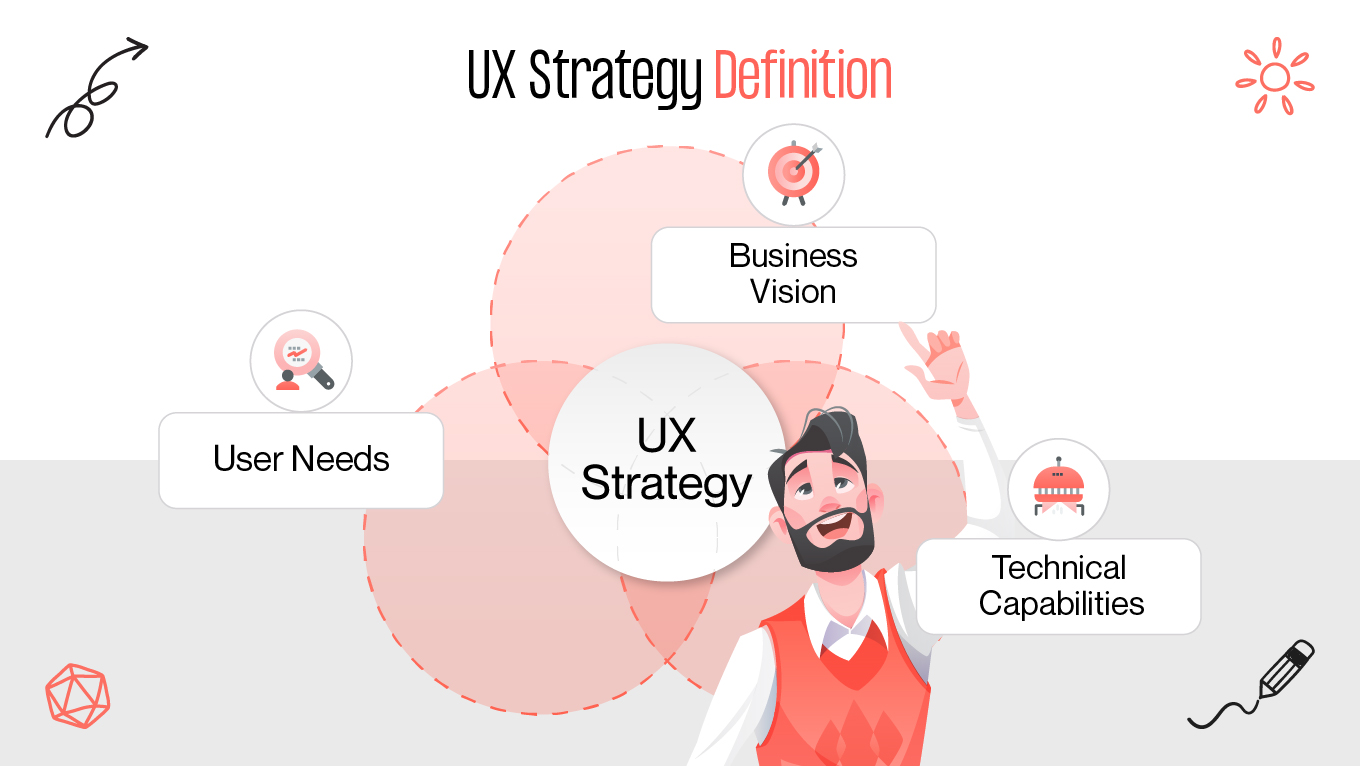
For businesses, a UX strategy is a decision-making framework that ensures every product choice supports both the user’s needs and the company’s goals. It defines how your product should work, why it should work that way, and what success looks like long before pixels or features are created.

A strong UX strategy aligns four core elements:

  • User Insights — understanding behaviors, motivations, and pain points that actually influence adoption and retention.

  • Business Objectives — clarifying the outcomes the product must deliver, from conversion and activation to retention and revenue.

  • Market and Competitive Landscape — identifying what differentiates your product and where the most significant opportunities (or risks) lie.

  • Execution Path — outlining the principles, workflows, and success metrics that guide design and development.

In day-to-day work, UX strategy helps leaders avoid mistakes, reduce costly course corrections, and create experiences that feel effortless because they’re grounded in evidence rather than assumptions. It adds structure to creativity and gives product, design, engineering, and marketing teams a common reference point for consistent, user-centered decisions. In a nutshell, UX strategy deliverables translate insight into action.

UX Strategy vs. Product Strategy

UX strategy and product strategy often get mixed up, but they address different problems within a company. Understanding the difference is critical because when these two strategies aren’t aligned, teams ship features that look good on paper but fail in the real world.

  • Product strategy defines what the business is building and why it matters in the market. It’s concerned with positioning, differentiation, revenue models, and long-term direction.

  • UX strategy defines how the product should work for users so business goals can actually be realized. UX strategy tasks focus on usability, behavior patterns, decision flows, and experiences that drive adoption and retention.

In simple terms:

  • Product strategy sets the destination.

  • UX strategy designs the path to get there.

When both are aligned, teams create products people quickly understand, adopt, and come back to. When they’re not, features get shipped that make sense on paper but fall apart in use, resulting in churn, rework, and unclear value.

Aspect

Product Strategy

UX Strategy

Core Purpose

Defines what the product should be and why it exists in the market.

Defines how the product should work to support both user and business goals.

Primary Focus

Market fit, competitive advantage, revenue models, long-term vision.

User behavior, usability, experience flow, reducing friction.

Key Questions Answered

- What problem are we solving?

- Who is our target market?

- What features support business goals?

- How will we win?

- How do users think and behave?

- What pain points block adoption?

- How should journeys flow?

- How do we ensure clarity and consistency?

Business Output

Product direction, roadmap priorities, value proposition, growth strategy.

Experience principles, IA, user flows, design system rules, usability improvements.

Main KPIs

Revenue, market share, CAC, LTV, ARR/MRR, adoption.

Activation, task success rate, retention, satisfaction (CSAT/NPS), drop-off reduction.

Time Horizon

Long-term (quarters to years).

Near-term to mid-term (sprints to quarters).

Stakeholders Involved

Product management, executives, marketing, sales.

UX/UI designers, researchers, product managers, engineering.

Deliverables

Product roadmap, feature sets, business cases, strategic positioning.

User journeys, prototypes, usability insights, experience guidelines.

Risk Without It

Building the wrong product for the wrong audience.

Building a product users can't understand, navigate, or enjoy.

How They Work Together

Sets the destination — the market, vision, and goals.

Designs the path — the experience that gets users to those goals.


How to Know It’s Time for a UX Strategy

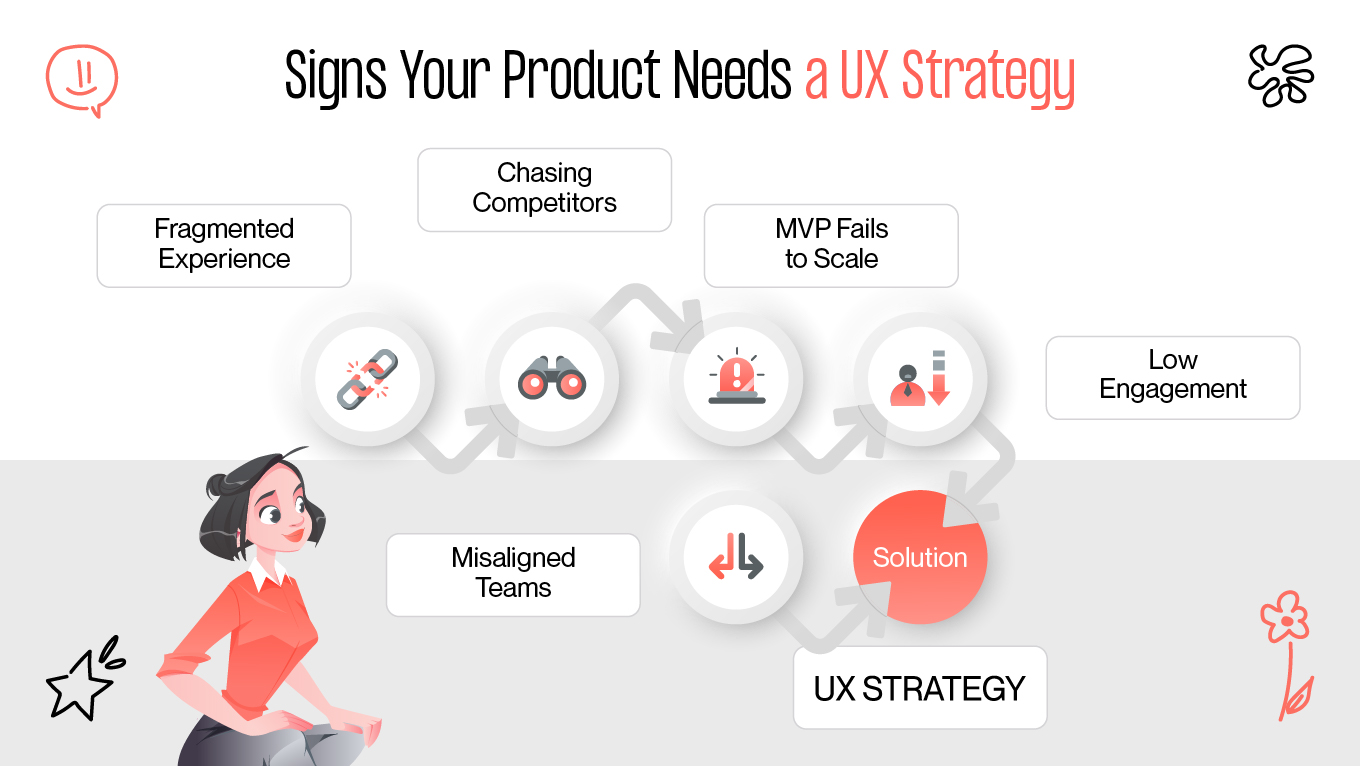
A UX strategy isn’t just for large enterprises or design-driven brands. Any company building or scaling a digital product eventually reaches a point where intuition, quick fixes, and isolated design decisions no longer work.

When Multiple Teams Build Products Without Shared Direction

As companies grow, different teams often build features in parallel. Without a UX strategy, the product starts to feel fragmented: different patterns, inconsistent logic, and conflicting assumptions about the user.

What happens:

  • Users get confused as navigation and interactions vary across features

  • Development slows because teams constantly reinvent design patterns

  • The brand feels inconsistent, reducing trust

In this case, UX strategy provides a unified framework. This is critical because while 85% of organizations establish brand guidelines, only 30% actually enforce them. A deliberate strategy ensures that every team adheres to the same principles, preventing the visual fragmentation that dilutes brand value.

When a Company Enters a Competitive Market

Launching a new product in a crowded space requires clarity on what will differentiate the experience.

What happens without a strategy:

  • Teams chase “cool features” instead of solving real user problems

  • Competitors dictate expectations, forcing reactive decisions

  • Limited resources are spent on low-impact improvements

UX strategy helps because it guides positioning and identifies where the product can win. For example, consumers are 4-6 times more likely to trust and defend brands with a strong purpose. A strategy ensures your design decisions aren't just aesthetic, but support a clear competitive edge that drives this deep loyalty.

When an MVP Needs to Evolve Into a Scalable Product

MVPs are built for speed, not longevity. They’re designed to test assumptions quickly, which often means temporary layouts, simplified flows, and decisions that don’t hold up once the product gains traction. As new features are layered on, those early compromises start to show.

Common signs include:

  • user flows breaking as functionality expands

  • onboarding that works for early adopters but not real customer segments

  • declining conversion because the experience wasn’t designed to scale

In these moments, fragmented MVP learnings transform into a clear, intentional UX strategy roadmap, replacing reactive fixes with structured growth.

When User Behavior Doesn’t Match Business Expectations

When users ghost after signing up or browse without acting, the problem is rarely skin-deep. It’s not a design issue, where there is disconnection between your product’s intent and the user’s reality

This often shows up as:

  • high churn despite an abundance of features

  • core functionality being overlooked by users

  • support teams repeatedly addressing the same usability issues

A strong UX strategy helps uncover the real behavioral blockers, align teams around root causes, and set targeted initiatives that move KPIs.

When the Product Is Outgrowing Its Original Structure

Growth often exposes foundational issues: outdated navigation, unclear hierarchies, or new features that don’t fit anywhere.

Main signs:

  • User journeys feel long or illogical

  • Roadmaps become hard to prioritize

  • New features complicate rather than enhance the experience

UX strategy helps reset the information architecture and design principles so the product can expand without becoming unwieldy.

When Leadership Needs Clearer Alignment Across Functions

Product, engineering, marketing, and design often operate with different success metrics. A UX strategy gives everyone a common language.

Why it matters:

  • It reduces decision friction

  • It makes prioritization easier

  • It ensures every feature supports both user needs and business goals

These statements are supported by market statistics: 42% of product managers now actively participate in user research alongside designers. Such a cross-functional involvement is the hallmark of a mature approach that unifies business goals with user needs.

Still not sure if a problem is an outdated UX strategy? Reach out and we will help to bring your product back to life.

The UX Strategy Framework We Use to Align Teams and Improve Outcomes

Every strong digital product has a moment when instinct stops working and structure needs to take over — that’s when UX strategy becomes essential. Based on years of working with fintech platforms, SaaS tools, marketplaces, and consumer apps, we at Gapsy shaped a UX strategy framework that helps companies reduce uncertainty, make better decisions, and build experiences users actually want to return to.

Here’s how we typically approach the work:

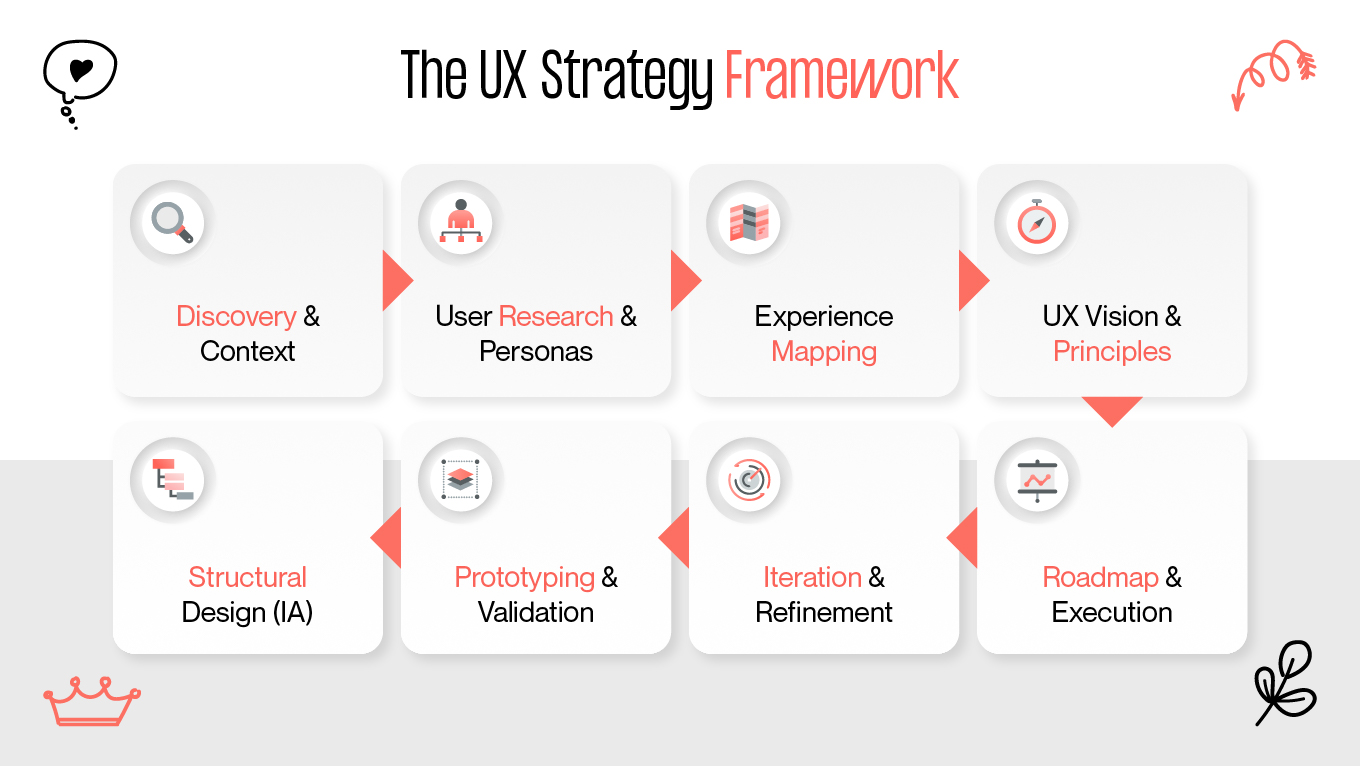
Step #1: Discovery and Context Alignment

Before developing solutions, we define the landscape your product operates in.

What we do:

  • Stakeholder interviews to surface goals, constraints, success metrics, and hidden assumptions that influence decisions.

  • Product audit to evaluate usability, existing flows, inconsistencies, and accumulated design debt.

  • Market and competitor analysis to understand positioning, category expectations, and differentiation gaps.

  • Analytics and behavioral review to identify friction points, drop-offs, and underperforming journeys.

Deliverables:

  • Insight report summarizing strategic risks, opportunities, and alignment gaps.

  • Heuristic evaluation highlighting usability issues based on proven UX principles.

  • Competitive benchmark showing where the product stands close to alternatives.

  • Problem definition summary that defines what must be solved.

Our experience shows that most strategy failures start from skipping this phase. Without shared context, execution turns into educated guesswork.

Step #2: User Research and Persona Definition

Our team moves beyond demographics and focuses on real behaviors, motivations, and decision patterns.

What we do:

  • Qualitative interviews and observational research to understand user patterns and unmet needs.

  • Task analysis and jobs-to-be-done (JTBD) mapping to identify what users try to accomplish.

  • Segmentation into actionable archetypes based on user behavior, not assumptions or demographics.

  • Identification of emotional drivers and friction sources that influence trust, motivation, and drop-off.

Deliverables:

  • Behavioral personas based on evidence, not fictional backstories.

  • JTBD statements that clarify success from the user’s perspective.

  • User ecosystem maps showing touchpoints, dependencies, and external influences.

Step #3: Experience Mapping and Opportunity Prioritization

We visualize the complete journey to uncover gaps, redundancies, and missed value opportunities.

What we do:

  • End-to-end journey mapping across key scenarios and user states.

  • Pain point clustering to identify recurring friction and structural weaknesses.

  • Opportunity sizing based on impact, effort, and business relevance.

  • Prioritization alignment to ensure opportunities support both product vision and business goals.

Deliverables:

  • Journey map visualizing the current and ideal experience.

  • Opportunity matrix ranking initiatives by value and feasibility.

  • Strategic recommendations tied directly to measurable outcomes.

This step replaces opinion-driven roadmaps with outcome-driven decisions.

Step #4: UX Vision and Experience Principles

This stage defines a clear direction for how the product should feel and behave over time.

What we do:

  • Establish experience principles such as clarity, trust, speed, and control to guide decisions.

  • Define the UX vision statement that aligns teams around a shared future experience.

  • Set the core interaction model that shapes navigation, feedback, and user control.

Deliverables:

  • UX vision framework that acts as a long-term reference point.

  • Experience principles guide to support consistent decision-making.

  • Interaction model outline defining how users engage with the system.

Step #5: Structural Design with IA, Flows, and System Architecture

This is where strategy becomes structure.

What we do:

  • Information architecture redesign to clarify hierarchy, navigation, and findability.

  • User flows for core journeys to remove friction and unnecessary steps.

  • Feature hierarchy and content organization that are aligned with user priorities.

  • Engineering alignment to balance UX intent with technical constraints and opportunities.

Deliverables:

  • Information architecture (IA) sitemap defining the product’s structure.

  • Flow diagrams mapping key user journeys end-to-end.

  • Structural UX strategy blueprint that supports long-term scalability for the entire product.

If the structure is flawed, no amount of UI polish will fix the experience.

Step #6: Prototyping and Validation

We test strategically — not to prove ideas, but to learn fast and adjust.

What we do:

  • Low- to mid-fidelity prototypes to test concepts without heavy investment.

  • Usability testing with representative users to uncover real-world issues.

  • Flow experimentation to compare alternatives and refine decisions.

  • Success metric definition to evaluate changes objectively.

Deliverables:

  • Interactive prototypes ready for testing and iteration.

  • Usability findings report with clear recommendations.

  • Updated flow and IA guidance informed by honest feedback.

Validation should reduce uncertainty before scaling.

Step #7: Roadmap and Execution Alignment

Finally, we ensure the strategy is implementable and measurable.

What we do:

  • Translate insights into a phased UX roadmap aligned with product milestones.

  • Define KPIs for adoption, engagement, retention, and satisfaction.

  • Create clear handoff documentation for design and engineering teams.

  • Support cross-functional alignment to ensure consistent execution.

Deliverables:

  • UX roadmap with clear phases and priorities.

  • Prioritized backlog tied to strategic goals.

  • KPI measurement model for tracking impact over time.

  • Implementation guide to maintain strategic integrity during execution.

A strategy only delivers value when teams can execute it; the roadmap is where direction turns into momentum.

Your product has potential; we have the expertise. Let’s see what we can build together.

What Your UX Design Strategy Document Should Include

A UX design strategy document serves as a foundational guide for decision-making, ensuring alignment across product, design, and engineering teams. A well-structured document typically includes:

  • Product and user context: A concise overview of business objectives, target user groups, behavioral insights, and the competitive environment.

  • Experience vision: A defined aspirational direction for the product experience, describing the intended user perception and differentiating qualities.

  • Experience principles: A set of governing guidelines that inform consistent, user-centered design decisions across all touchpoints.

  • Product architecture: A high-level representation of the information structure, navigation model, and relationships between core product modules.

  • Primary user journeys: A documentation of essential flows with identified friction points, opportunities, and behavioral drivers that influence user actions.

  • Strategic opportunity areas: Prioritized initiatives that address experience gaps and deliver measurable business impact.

  • Research and validation plan: Key assumptions requiring confirmation, recommended UX research and strategy methods, and the metrics used to evaluate success.

  • Implementation roadmap: A phased execution outline detailing priorities, sequencing, and cross-functional responsibilities.

Governance and maintenance guidelines: Standards for sustaining consistency, assessing new features, and updating the strategy as the product evolves.

3 Unusual UX Strategy Examples from Leading Brands

UX strategies have moved beyond “fast and clean.” Leaders are winning by fundamentally rethinking the relationship between the user and the product. These three examples show how rethinking the role of the product can reshape entire industries.

L’Oréal Turned Beauty Shopping Into Scientific Diagnosis

Buying beauty products online is notoriously high risk, where the wrong shade, finish, or texture leads to returns and frustrated customers. L’Oréal shifted the entire UX model from “browse and choose” to “analyze and recommend.” Using AI and AR technologies, the app evaluates skin tone, texture, and concerns through the phone camera, offering personalized routines that mimic an in-store consultation.

This data isn’t limited to the digital experience. When users walk into a physical store, beauty advisors can access their digital “skin scan” profiles, creating a seamless transition from online exploration to in-person expertise. That continuity — bridging digital precision with human reassurance — significantly changed customer behavior. AR-engaged users convert at three times the rate of non-AR users, and specific campaigns saw sales increase by 22–25%. This UX strategy example effectively turned a cosmetic purchase into a diagnostic journey, elevating trust and boosting lifetime value by personalizing routines rather than one-off buys.

Duolingo Reframed Learning UX as Habit Formation

Most educational products focus their UX on clarity and content delivery with lessons, progress bars, completion states. Duolingo took a different route: the real problem wasn’t understanding language concepts, but staying consistent long enough to learn anything at all. Instead of optimizing for “better lessons,” the company optimized for return behavior. Daily active users climbed to about 47 million, indicating a healthy routine engagement cadence.

The product’s UX design and strategy centered on habit psychology. Streaks, playful reminders, emotionally expressive feedback, and even guilt-driven nudges weren’t superficial gamification — they were deliberate behavioral levers. Missing a day feels influential; returning feels rewarding. The interface constantly reframes learning as something lightweight, forgiving, and routine rather than demanding or academic.

Klarna Redefined Fintech Support Through an AI-First Experience

In 2024, Klarna challenged one of the most significant assumptions in fintech: that customer support must be human to feel trustworthy. Instead of introducing another chatbot to deflect tickets, the company reframed the UX problem around resolution time. Users didn’t want empathy as much as they wanted issues solved immediately.

Klarna built an AI-powered system capable of handling complex actions like refunds, disputes, or account adjustments — tasks usually reserved for human agents. The AI became the frontline team, resolving 66% of all inquiries end-to-end. The result was a support experience that moved from 11-minute resolutions to 2 minutes, proving that “instant” can outperform “human” in the moments where urgency matters most. 

The operational impact was equally significant: the AI now performs the work of roughly 700 full-time employees and is projected to drive around $40 million in profit improvement.

Our Experience Applying UX Strategy Across Industries

In our time working with lean startups to sprawling digital ecosystems, we’ve noticed a recurring pattern. Most teams don't have a "speed" problem; they have a "direction" problem. Without a strategic anchor, moving fast just means you’re creating technical and design debt at record speed.

Our job isn’t just to hand over a set of wireframes; it’s to build a foundation that makes growth feel intentional. Our approach is: we solve for human behavior first, and pixels second.

Here’s where we apply this thinking: 

  • Fintech & Crypto. In finance, the real currency is trust. We’ve helped our clients redesign their platforms to increase engagement by 35%, not by making buttons prettier, but by making complex transactions feel safe and transparent. When cutting onboarding time by 40%, we were removing the friction that makes people doubt a product.

  • Marketplaces & Content Tools. For products like Memix, we learned that the best UI is the one that disappears. By unifying fragmented experiences across web and mobile, we helped creators stay in their "flow state." When retention goes up, it’s usually because the design system finally caught up to the user’s imagination.

  • SaaS & eCommerce. We’ve seen session durations jump by 35% and conversions climb as high as 41%. These wins didn't happen because of "UI tweaks." They happened because we stopped treating users like "traffic" and started treating them like people with specific goals. We restructured journeys to match the way people actually shop and work.

  • Scaling High-Growth Products. A great design system is a communication tool. We’ve built systems that let teams ship updates 3x faster, but more importantly, we gave those teams their confidence back. No more "franken-products", just cohesive, scalable growth.

For us, a UX strategy is not a PDF that sits in a folder. It’s an ongoing conversation between your business goals and your users’ reality. We come in as partners who are as curious about your users as you are.

Create an Effective UX Strategy with Gapsy!

We're here to help you improve your online presence — let's work together.

To Conclude

In the rush to ship, most teams default to "velocity" as their primary metric. But speed without a strategic anchor is just a faster way to reach the wrong destination. A thoughtful UX strategy provides the one thing that usually evaporates in high-growth environments: permission to be precise. When we help teams shift their focus from "clearing the roadmap" to "solving the friction," the entire culture of the product changes. Decisions stop being arguments about personal preference and start being conversations about user intent.

We’ve seen this play out across dozens of industries. The companies that thrive are those that realize their product's value isn't found in a list of features, but in the coherence of the experience. They invest in the "why" before they commit to the "how," ensuring that every release builds trust rather than just adding noise.

It’s the invisible logic that makes a product feel inevitable rather than accidental.

Rate this article

20 ratings
Average: 4.9 out of 5

If you like what we write, we recommend subscribing to our mailing list to always be aware of new publications.

Do you have any questions? We tried to answer most of them!