

Fintech UX Design Trends Shaping Financial Products in 2026

12minutes read
Fintech UX trends

Fintech products are no longer niche tools for early adopters. They have become the infrastructure through which people save, borrow, invest, and make everyday decisions. The global fintech market is projected to reach $1.38 trillion by 2034, growing at nearly 20 percent annually. As financial services expand into more products and platforms, the margin for poor user experience narrows.

Fintech’s rapid growth has shifted UX from a supporting role to a strategic priority. As embedded finance, digital-first banking, and AI tools make financial actions easier to access, they also require more mental effort and a heightened sense of risk. Users now make quick, high-impact decisions in settings that don’t always resemble traditional finance.

This article explores the fintech UX trends that are defining products today and shaping their development through 2026. It highlights new design patterns driven by regulation, product scale, and changing user expectations. It also explains what these trends mean for teams creating financial experiences in a more complex and crowded market.

Key Takeaways

  • Fintech UX success is driven less by trends and visuals and more by reducing uncertainty and cognitive load.
  • Trust is no longer communicated through branding but earned via clear flows, predictable behavior, and transparent explanations.
  • In fintech UX, AI and automation add value only when they preserve user agency and make complex financial decisions easier to understand.
  • Mature fintech products prioritize clarity of decision-making, accessibility, and compliance as core design principles.
  • In a market where features are easily replicated, long-term advantage comes from UX that helps users feel in control.

Why UX Matters More in Fintech Than in Most Other Industries

Fintech UX operates under constraints that most digital products never face. Financial exposure, strict regulations, and high user anxiety mean even small design choices can have significant consequences. These choices affect trust, user adoption, and long-term loyalty.

  • Higher cognitive load by default. Users have to grasp unfamiliar terms, complex numbers, and the real financial implications simultaneously. Poorly structured UX increases mental effort and uncertainty. Effective UX, however, does not oversimplify finance. It organizes complexity, allowing users to process information confidently.

  • Risk perception shapes trust. A product may be secure, but it can still feel unsafe if the interactions are unclear or inconsistent. In fintech, trust builds through predictable user flows, clear feedback, straightforward language, and consistent behavior on every screen and interaction.

  • Regulatory friction cannot be removed. Processes like identity verification, disclosures, confirmations, and consent flows are essential parts of the experience. UX influences whether these moments are perceived as protective measures or unnecessary hurdles, thus shaping how users emotionally respond to compliance.

  • User confusion has a direct financial cost. Misunderstood actions can result in drop-offs, costly mistakes, increased support needs, and a gradual loss of confidence. In fintech, usability problems quickly turn into real impacts on revenue, retention, and brand credibility.

These constraints influence fintech UX trends 2026 in practical ways. Design choices are not just about surface-level improvements; they focus on reducing risk, enhancing understanding, and building trust in environments where mistakes can be costly.

Top 7 FinTech UX Design Trends in 2026

From our experience working with fintech teams, UX trends do not come from looks or fleeting design tendencies. They arise from pressure, including regulatory requirements, rapid growth, and users who want financial products to be as easy to use as consumer apps, while being much more reliable and transparent. In 2026, the most successful teams will not be chasing trends. Instead, they will focus on integrating clarity, control, and confidence into every interaction, particularly when decisions have real consequences.

The examples below reflect patterns we see in real products, not concept presentations or marketing prototypes. They demonstrate how fintech UX design trends are evolving to support higher-stakes, longer, and more complex user journeys, and an increasing expectation for experiences that feel intuitive without misrepresenting financial reality or obscuring trade-offs.

Trend #1: From Feature Density to Decision Clarity

In the race to become "Super Apps," a lot of fintech products have unintentionally created cluttered interfaces. We often find dashboards filled with charts, metrics, shortcuts, and promotions. They resemble professional trading terminals more than tools for everyday financial choices. The issue is about a lack of prioritization.

Teams that make meaningful progress are open to removing, delaying, and organizing features instead of just adding more. The focus on user experience is shifting from helping users manage complexity to guiding them through decisions.

Instead of showing every data point simultaneously, effective fintech UI/UX design predicts what the user wants to accomplish and organizes the interface accordingly. Actions are presented in human terms (saving, transferring, protecting, planning) rather than in technical language or internal data structures. When users feel guided rather than overwhelmed, their anxiety decreases, and they’re ready to use the product fully.

Trend #2: Trust as a Designed Experience

In fintech, trust forms less from slogans or legal guarantees and more from how the product works in real situations. It grounds itself through clear information, predictable interactions, and a solid understanding of what will happen before a user takes action. As products become more complex, reliability increasingly results from user experience rather than branding efforts.

This change shows up in specific design choices: 

  • Financial data is organized by meaning and context, rather than mimicking backend structures.
  • Key numbers are accompanied by explanations before users are asked to act, which reduces hesitation and second-guessing.
  • Visual hierarchy highlights what is most important at the moment, rather than treating everything as equally significant.
  • Data visualizations help users understand relationships, trends, and implications instead of just showing numbers.
  • Risks, fees, and limitations are presented early in the process to help inform decisions, not being hidden behind secondary screens.

On a larger scale, this marks a key shift in how trust is handled in fintech UX. It is no longer assumed or requested right away. It is built gradually through consistent actions, clear explanations, and respect for the user’s ability to grasp financial details when presented thoughtfully.

Example from our experience 

Designing trust was a central focus in our work on the T2PAY platform. The challenge was not a lack of data, but how that data was communicated. We redesigned the UI and UX around strong value propositions, clear messaging, and credibility cues that made the platform feel transparent and deliberate. Financial information was presented through infographics, plain language, and a logical information architecture that guided users through decisions rather than confronting them with raw complexity. The result was an interface that supported confidence rather than demanding it, leading to stronger engagement and a more trusted user experience.

Trend #3: AI and Personalization Move to UX Infrastructure

From what we see in today's fintech products, artificial intelligence has stopped being a feature you add to UX. It is becoming the layer that shapes the entire experience. With AI in fintech already a multi-billion-dollar market and growing quickly, the question for teams is no longer whether to use it. It is the amount of agency users retain once it is there.

In practice, this shift shows up in a few consistent ways:

  • Interfaces adapt dynamically to user behavior, intent, and risk profile instead of relying on manual configuration.
  • Recommendations become context- and time-sensitive, helping users decide rather than endlessly explore.
  • In areas like lending, predictive models dramatically reduce waiting times, reshaping how users perceive momentum and reliability.
  • Across wealth management and banking, AI guidance is now trusted enough that many users treat it as a primary reference point, not a supporting tool.

For UX, this represents a subtle but critical shift. The goal is no longer to surface more insights. It’s to reduce how much information users must process to feel confident and in control.

Generative AI Shifts Users Toward Guided Financial Journeys

Generative AI is accelerating this change by transforming the user journey itself. Instead of facing dead ends, like error states, generic help pages, or abandoned flows, users have conversations.

  • The context remains throughout the process, so users don’t need to repeat their problems.
  • Guidance replaces command structures, allowing users to express their intent as the system builds the path ahead.

This shift goes beyond improved chatbots. It creates products that seem aware. When users feel understood by the interface, compliance and administrative hurdles become less noticeable, allowing the transaction's main value to remain intact.

Example from our experience 

Our work on Klever AI reflects how we approach AI-driven UX in fintech. The goal was not to automate decisions for users, but to support them in making better ones without losing a sense of control.

We integrated AI-driven personalization and decision-making features that adapt to user behavior while remaining transparent about how suggestions are generated. Recommendations were presented as guidance, not commands, and users could easily understand, adjust, or override them. This balance between intelligence and agency kept the experience predictable and trustworthy.

As a result, user engagement increased by 18%. More importantly, the product avoided a common fintech pitfall. AI enhanced the experience without becoming opaque or authoritative. This reinforced our view that in fintech UI/UX, the success of AI depends less on how advanced it is and more on how clearly users remain in control.

Gapsy will help you transform your fintech product — contact us and let’s discuss all the details.

Trend #4: Security and Compliance as First-Class UX Elements

By 2026, the strongest UX signal is the quiet confidence of a secure system. We are seeing a clear shift where security and compliance are no longer seen as backend issues but as important parts of the interface.

How do we perceive this? Trust must be visible. When users don’t understand why they need to provide their identity or how their data is protected, they feel exposed. That emotional gap is a UX problem.

We design security flows that educate rather than interrogate. Whether it’s a progress indicator that explains a KYC process or a contextual alert that clarifies a transaction hold, design serves as the bridge between strict rules and human worry. The goal is to welcome every user with confidence.

Example from our experience 

In the volatile cryptocurrency market, user anxiety is the biggest barrier to entry. For the OXFX exchange platform, we knew that "standard" security wasn't enough — the interface itself had to radiate safety without slowing down the trader.

Our approach was to treat security cues as first-class UX elements. Instead of burying verification steps or creating aggressive barriers, we integrated security markers directly into the data flow. We balanced the density of real-time trading charts with clear, reassuring signals that validated user actions instantly.

By making the security visible and predictable, we turned compliance into a confidence builder. The friction wasn't removed; it was optimized to feel protective. Moreover, together with the client, we achieved the following results: 

  • 96/100 user satisfaction
  • 10-minute average session duration
  • +11% conversion rate
  • +16% organic traffic growth

Positive results come not just from pretty visuals; Gapsy will balance aesthetics and reliability for your fintech product — drop a line.

Trend #5: Embedded Finance and Invisible UX

Embedded finance presents a paradox: how do you design something that should disappear?

When financial actions occur within non-financial products, invisibility should be balanced with reassurance. If users can’t see the bank, how do they trust the transaction? This is where design shifts from visual emphasis to signaling.

We rely on subtle but clear cues, micro-interactions, clear brand handoffs, and plain-language confirmations. These elements communicate safety without disrupting the flow. Our design aims to make finances dependable. When done correctly, financial matters fade into the background, leaving the user feeling empowered rather than processed.

Trend #6: Accessibility, Inclusion, and Financial Literacy by Design

For decades, financial products were created with an ideal user in mind: tech-savvy, fully abled, and financially knowledgeable. This model no longer reflects reality.

We view accessibility as an essential principle, not just a regulatory requirement. It involves designing for unsteady hands, screen readers, mental fatigue, and first-time investors who are exploring unfamiliar territory. Now, inclusion is a fundamental aspect.

Clarity is key to this approach. By eliminating jargon and incorporating financial education directly into the interface, such as explaining concepts like APY or compound interest at the point of decision, we make products into educators. We don’t just create tools; we foster user competence.

Trend #7: Design Systems Built for Regulation

Regulation is often viewed as a barrier to creativity in fintech. We see it differently. A solid system supports better design.

By integrating regulatory logic directly into design systems with smart components, we can trigger disclosures, enforce data masking, or guide compliant interactions. This reduces the mental effort required from designers. They do not have to worry about legality; the system ensures it.

This changes the focus from “Is this legal?” to “Is this useful?” Teams spend less time checking rules and more time creating user-centered experiences that set the product apart. In highly regulated environments, that clarity offers a competitive edge.

What FinTech UX Trends Mean for Product Teams

If there is one takeaway from these trends, it is this: UX is no longer a layer you apply after the functionality is built. It is the infrastructure for managing risk, trust, and decisions. In 2026, the code makes the product work, but the design makes the product sell.

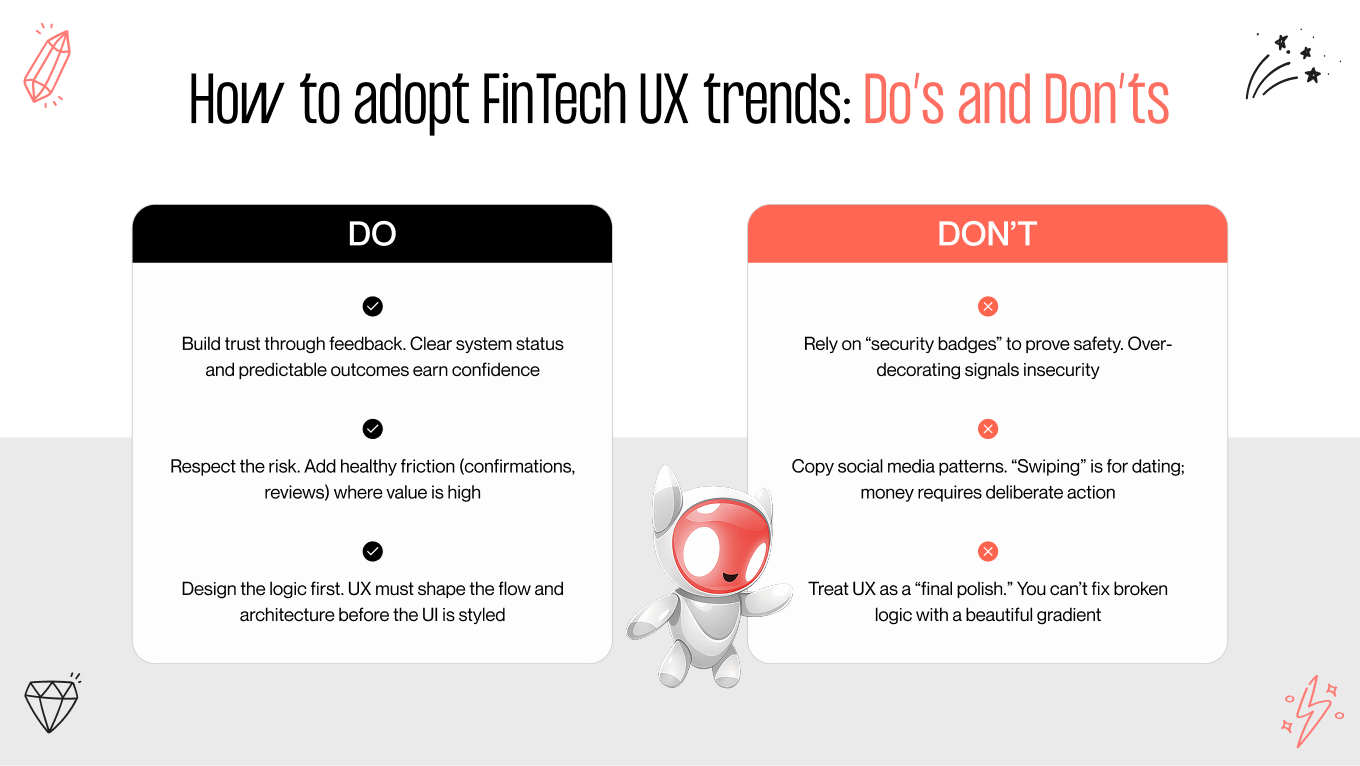
fintech ux trends do's and don'ts
impementing fintech ux trends

Here is how successful teams are shifting their focus.

From Pixel-Pushing to Logic-Building

The most experienced product teams are now focusing on improving actual user outcomes instead of just refining individual screens. Design has become a critical decision-making tool rather than just a final touch.

  • Old way: Design is seen as a later-stage task, added at the end to make the product look appealing.

  • New way: Design is integrated early in the process, helping to shape product logic, user paths, and trade-offs before any visual elements are created.

  • The reality: Design is a strategic rather than cosmetic element; teams spend less time on superficial changes and more on clarity, flow, and predictability. Products become easier for both users and internal teams to understand.

When designers help define the reasons behind decisions, fewer costly adjustments are needed later, leading to fewer compromises that can harm the user experience over time.

Over-Building vs. Under-Explaining

Across fintech projects, we often see a risky imbalance in how effort is allocated.

  • Over-investment: Teams pour resources into feature density, creating complex dashboards, complicated controls, and specialized functions for a small group of power users.

  • Under-investment: The “boring” but critical parts — onboarding, empty states, error handling, and explanations that help users understand the effects of their actions.

This imbalance damages trust. The "boring" moments are where users decide if they feel safe, skilled, and confident. Clear language, strong hierarchy, and timely reassurance are not just minor details; they are essential for conversion. You cannot build a high-retention fintech product while ignoring the points where users feel most uncertain or vulnerable.

When Features Converge, Experience Wins

As fintech markets develop, functionality becomes less of a key differentiator. The same APIs are available to everyone. Rates, features, and even AI capabilities begin to seem similar.

  • The differentiator: What sets strong products apart from forgettable ones is no longer what they provide, but how easily users can navigate the experience.

  • The moat: A mature UX creates a barrier by reducing support requests, lowering abandonment rates, and increasing lifetime value through consistency and reliability.

In a landscape where trust is fragile and switching costs are nearly zero, UX maturity becomes one of the few benefits that builds over time. Products that feel clear, predictable, and respectful gain loyalty not by demanding it, but by making it easy to stay.

Want to minimize the risks in your fintech UX? Let’s work together — Gapsy Studio will help you develop a platform for your target audience.

Common Mistakes Teams Still Make When Following “Trends”

In the majority of cases, fintech teams fail because they apply trends without understanding the context. We often see these shifts turned into simple visuals. They are used for show instead of to address real user problems. This is where the disconnect usually begins.

The "Trust Theater" Mistake

There’s a thin line between reassurance and overcompensation. Many interfaces are overloaded with security badges, shield icons, and loud “Safe & Secure” messages. Paradoxically, the more a product tries to look trustworthy, the less credible it can feel.

In practice, trust is about reliability. It’s built through calm, predictable consistency. A clear confirmation state or a transparent transaction receipt does more to build confidence than a dozen animated locks ever could.

The "Gamification" of Risk

Another common mistake is importing interaction patterns from social or entertainment apps, such as swipes, infinite feeds, and rapid loops, without considering context. These patterns may seem intuitive in low-stakes environments, but when real money is at stake, they can feel careless or even risky.

Finance shouldn’t always be frictionless. Some pauses, confirmations, and moments of resistance are necessary. In fintech, restraint isn’t a flaw in user experience; it’s a sign of responsibility.

The "Lipstick on Logic" Error

The most damaging mistake is treating UX as a layer added after product decisions are finalized. This leads to visually polished interfaces that cover up broken or confusing flows. In fintech, you can’t hide complexity with gradients or motion.

If UX doesn’t guide the information structure, decision paths, and system logic from the beginning, no amount of visual improvements will fix the underlying experience. Design must shape how the product functions, not just how it appears.

Who We Are

We are Gapsy Studio, a collective of designers who believe that clarity is the ultimate sophistication.

We know that building a fintech product is a balancing act between strict regulation and user expectations. We don't sit on the sidelines; we get in the trenches with you. We ask the hard questions about your data, challenge your user flows, and simplify your architecture before we ever open a design tool.

We aren't here to sell you a "reskin." We are here to build the kind of digital infrastructure that respects your users' time and intelligence. Whether you are a crypto disruptor or a legacy bank reinventing itself, we bring the craft, the calm, and the code-ready systems to get you there.

Enhance Your Platform with Gapsy!

Want to reimagine your fintech product? We're open to discussing all the details.

Final Thoughts

Fintech UX trends 2026 are converging on a responsibility. The industry is shifting from disruptive and game-like designs to a more practical, utility-first approach. For product teams, success is now measured not by how long users stay in an app but by how well they understand their decisions and outcomes. The best interfaces are becoming nearly invisible; they handle compliance, logic, and complexity quietly, allowing users to focus on their financial goals. 

This change raises the standards for design discipline. Compliance should be seen as a design factor, not a barrier to overcome. Accessibility and financial knowledge are no longer optional extras; they are essential for products that aim to grow responsibly. When design aims to lower uncertainty and emotional stress, rather than just reducing the number of taps, it sends a strong message of trust to users. 

Features can be copied easily. Trust cannot. The true advantage lies with teams that see trust as a UX challenge, not just a branding task. By prioritizing clarity in decision-making, using automation carefully, and designing security with human behavior in mind, fintech products can go beyond grabbing attention and begin to build long-term loyalty.

Gapsy Studio is here to help you achieve this — a transformative and reliable fintech design is just one click away.

Rate this article

20 ratings
Average: 4.9 out of 5

If you like what we write, we recommend subscribing to our mailing list to always be aware of new publications.

Do you have any questions? We tried to answer most of them!