
How to Use a Holistic Design Approach for Sustainable Product Growth

14minutes read
holistic approach to design

We see it happen all the time: a company builds a visually stunning product, only for it to fall flat because it was designed in a vacuum. The interface is beautiful, but it feels disconnected from the marketing message, the customer service experience, and the broader business goals.

When design operates in a silo, products fail. But when it connects to strategy, operations, and customer value, performance compounds. The proof is in the data: McKinsey found that companies integrating design into their broader business strategy outperform industry peers by 32% in revenue growth and 56% in shareholder returns. The secret to that advantage is an absolute alignment.

That is the core of a holistic design approach. It ensures your product, brand, experience, and business objectives operate as one coordinated system. 

With over 12 years of digital design experience at Gapsy, we wrote this guide to clarify what holistic design means in a business context. We’ll show you why fragmented execution eats away at your growth, and how to structure design to drive true scalability and long-term profitability.
Key Takeaways

  • Holistic design drives sustainable growth by aligning product, brand, marketing, and operations into one coordinated system.

  • Fragmented design execution leads to unstable conversion, higher CAC, weaker trust, and repeated redesign cycles.

  • A holistic approach starts with business model logic and customer journey structure, then translates it into UX, content, and architecture.

  • System-level alignment improves marketing efficiency and conversion predictability because expectations match experience end to end.

  • Scalable design requires consistent information architecture, reusable design systems, and measurement built in from the start.

  • Results compound over time through continuous optimization driven by real behavioral data, not subjective design preferences.

What Is Holistic Design in a Business Context?

To understand the holistic design approach in business, you should think of your product as a living ecosystem rather than a collection of separate parts. It is the opposite of tunnel vision. Instead of asking, "Does this specific feature look good?" a holistic approach wonders, "How does this feature impact the user's journey, reflect our brand identity, and drive our overall business goals?"

While the term is frequently used in architecture or interior design, in digital, it’s a foundational methodology. It means moving beyond aesthetics to orchestrating strategy, user experience, visual identity, and operations into one cohesive system.

what is holistic design

How Holistic Design Applies Across Different Domains

True holistic design thinking doesn't just sit in the design department. Achieving a genuinely comprehensive user experience moving past pure aesthetics and adopting a much broader mindset. Here is how this holistic perspective transforms specific design domains:

  • Product design. In digital, holistic design requires considering the entire lifecycle of a digital product, from initial user research and system architecture to development, continuous iteration, and eventually, graceful feature sunsetting. With it, you can build sustainable systems rather than shipping isolated features.

  • Graphic design. Here, the holistic approach involves considering the broader context in which visual communication occurs. It includes understanding the target audience, cultural sensitivities, and the conveyed message.

  • User experience and interface design. UI/UX design focuses on creating seamless and intuitive user experiences across various touchpoints. Holistic design in UX considers the entire user journey and satisfaction at every step.

  • Service design. Standard UI/UX focuses on creating seamless interfaces, while a holistic approach considers the entire user journey across multiple touchpoints. The goal is to ensure satisfaction, accessibility, and logical flow at every step.

Holistic Approach to Web Design for 2026

A holistic approach to website design means you stop treating the site as a standalone asset and start managing it as part of your revenue system. Every decision across UX research, structure, messaging, design, and technology connects back to how you acquire customers, convert them, retain them, and grow their value over time.

When applying holistic principles, we begin with your business model, margins, acquisition channels, and growth constraints. The website becomes an operational tool that aligns marketing investment, product experience, and brand positioning into one coherent engine.

Business Model Alignment

Your revenue logic should dictate your website’s architecture.

For example, if you rely on high-volume, low-ticket transactions, as is common in direct-to-consumer apparel brands, your layout should prioritize speed, clarity, and a frictionless checkout. For an enterprise cybersecurity platform, where services are complex and high-value, your structure needs to build authority, reduce perceived risk, and gently support a longer decision-making cycle.

Every strategic choice impacts the interface:

  • Pricing strategy influences how much education your user needs. 

  • Acquisition channels explain how much context you should provide on a landing page. 

To analyze all these points, we start by mapping how your business generates revenue. This allows us to engineer the conversion flows, page sequencing, and information hierarchy that will be a direct extension of your model. 

User Psychology and Behavioral Mapping

Traffic converts when motivation meets clarity and trust. Your users arrive with intent, concerns, alternatives, and mental shortcuts. If you ignore these factors, navigation becomes confusing, content feels generic, and decision friction increases. High bounce rates and drop-offs often result from psychological misalignment.

Before even thinking about structuring a page, our team maps out your users' core motivations, hidden objections, and decision triggers. This groundwork dictates how we sequence information, place social proof, and design a call to action. By removing uncertainty, user flows become effortless, mirroring how people evaluate risk and value. 

Brand System Integration

Brand consistency = credibility. When your tone shifts between an ad, a landing page, and the product interface, trust fractures. If your visual language lacks structure, your authority instantly declines. This kind of fragmented narrative is a conversion killer, especially for high-consideration purchases. 

Gapsy Studio sees your website as the hub of your entire brand ecosystem. We ensure that typography, spacing, imagery, and tone of voice work together to reinforce the exact same positioning at every single touchpoint. Because when brand design coherence improves, perceived stability follows. This is what drives equity and higher conversions.

Technical Architecture and Scalability

A website that can’t scale will eventually constrain growth.

Your CMS choice affects publishing speed and operational efficiency. Performance standards affect SEO visibility and paid traffic efficiency. So, tracking structure determines whether you can measure and optimize behavior accurately.

We evaluate technical architecture through a business lens. 

  • Can your team update content without friction?

  • Can the system support new landing pages at scale?

  • Can you integrate analytics, CRM, automation, and experimentation tools without patchwork fixes?

Technical decisions should reduce operational cost over time.

Cross-Channel Consistency

Far too many companies still make the critical mistake of optimizing their marketing channels in total isolation. This siloed approach creates a fragmented user journey that drains your return on acquisition spend (ROAS).

  • Conversions drop, if your paid ads promise one value proposition and your website communicates another. 

  • Trust erodes, if your email sequences contradict your landing logic. 

  • Retention suffers, if your product onboarding diverges from marketing expectations. 

To avoid this, you should treat your website design as a central node in your ecosystem. Paid traffic, organic search, email flows, product experience, and support systems should follow the same logic and narrative. When you create continuity across channels, customer acquisition becomes more efficient and lifetime value increases as the experience feels coherent from first click to long-term engagement.

If your digital touchpoints are disconnected, you are leaving money on the table. Reach out to us for a strategic design consultation. Let’s see how we can align your digital channels, streamline user experience, and maximize your customer lifetime value.

Case Study of Holistic Design Approach by Gapsy

Adsellr approached us to simplify how creators and entrepreneurs launch and promote their Shopify stores. They wanted to create a platform that combined store setup, custom branding, and video-based marketing into a single system.

Their challenge was strategic alignment. The product had to be intuitive for beginners, powerful for advanced users, and visually bold enough to reflect a creator-driven brand. This required a holistic structure that would connect onboarding, customization, marketing tools, and brand identity. 

Business Model-Driven Architecture

Adsellr’s value proposition centers on speed and simplicity. Users should move from idea to active store with minimal friction.

We began by mapping the revenue logic before designing screens. Store creation, product uploads, template selection, and video campaign setup were structured as one guided system rather than isolated features. This ensured that the interface directly supported the business promise of rapid launch and integrated marketing capability.

User-Centric Journey Structuring

The platform had to serve both experienced entrepreneurs and beginners launching their first store.

We structured navigation and workflows to reduce cognitive load. Step-by-step progression, contextual guidance, and real-time previews helped users understand where they were and what actions to take next. Educational cues were embedded directly into the interface to eliminate dependency on external documentation.

Integrated Brand and Experience System

Adsellr positions itself as bold, creative, and marketing-driven. The interface had to reflect that identity without compromising clarity.

We developed a clean visual system with strong hierarchy, consistent interaction logic, and purposeful illustrations. Graphic elements reinforced the brand’s creative positioning, while structured layouts preserved usability.

Scalable Design Infrastructure

Adseller’s platform required more than 50 responsive screens across store setup, product management, video previews, and ad campaign configuration.

We implemented a component-based design system to ensure consistency and flexibility. Responsive standards were prioritized to support mobile-first behavior. The structure allows Adsellr to introduce new features without redesigning the foundation.

The Result

As a result, the final product delivered to our client a streamlined workflow that guides users from store creation to active promotion within a unified system.

The modular structure reduced onboarding friction and improved cross-device usability. Adsellr’s team highlighted clarity, brand alignment, and execution speed as key strengths.

Most importantly, the platform now functions as an integrated growth engine where product capability, marketing execution, and brand positioning operate together.

Just as we did for Adsellr, Gapsy Studio can help you align your brand, user experience, and business goals into a single ecosystem. Book an intro call with us.

Holistic Website Design Benefits Over Traditional UX

Traditional UX redesigns focus on individual pages or interface improvements. You adjust layouts, refine buttons, simplify forms, and expect conversion to rise. Sometimes it does, temporarily. But if the underlying business logic, messaging, acquisition strategy, and product experience are misaligned, the gains plateau quickly.

Holistic website design is at a different level. Instead of optimizing isolated screens, you focus on enhancing the system that produces revenue. That means aligning positioning, traffic sources, user intent, brand signals, conversion architecture, and post-conversion experience.

Compounding Growth

Fixing a button or a form optimizes for a single click. Aligning your messaging, business logic, and product experience improves the entire customer lifecycle. When every touchpoint reinforces the others, friction disappears. This way, you get conversion growth that compounds over time rather than spikes briefly and fades. This is the foundation of a coherent UX strategy.

Maximum Return on Every Pound Spent

A misaligned acquisition strategy is an expensive one. If the promise made in your paid ads or organic search results isn't immediately validated by what the user finds on your site, you pay for traffic that was always going to leave. A holistic approach closes that gap by ensuring continuity from the first click to the final conversion, lowering your Customer Acquisition Cost and ensuring your acquisition spend actually earns its return.

Faster Decisions and Deeper Trust

Subconscious doubt is the silent killer of conversion. Inconsistent messaging, mismatched tone, and disjointed layouts create a low-level unease that users can’t articulate but act on (usually by leaving). When your visual language, proof points, and narrative are synchronised across the entire experience, perceived risk drops. 

Staying current with web design trends ensures that synchronisation feels natural and credible rather than dated. For high-ticket or complex services, this is particularly significant: authority is established quickly, and the time between first visit and purchasing decision shortens considerably.

A Foundation for Scale

Conventional UX/UI redesign is reactive by nature, with redesigns triggered by declining metrics and patches applied after problems emerge. Holistic design works differently. Because the system is rooted in your core revenue model and brand strategy from the beginning, it doesn't buckle under growth. Launching features, entering markets, or scaling your product becomes a matter of building on a solid foundation. Nonetheless, it should be provided by the right design team. 

Comparison of Traditional UX vs. Holistic Website Design

Aspect

Traditional UX Redesign

Holistic Website Design

Primary Focus

Individual pages and interface elements

Full revenue system and customer journey

Starting Point

Visual or usability improvements

Business model and growth strategy

Conversion Impact

Short-term lifts, often unstable

Stable, compounding performance improvements

CAC Influence

Often unchanged or rising

Improved efficiency through alignment

Brand Consistency

Secondary consideration

Integrated into structure and messaging

Scalability

Requires repeated redesign cycles

Built for long-term growth and iteration

Measurement

Page-level metrics

End-to-end performance tracking


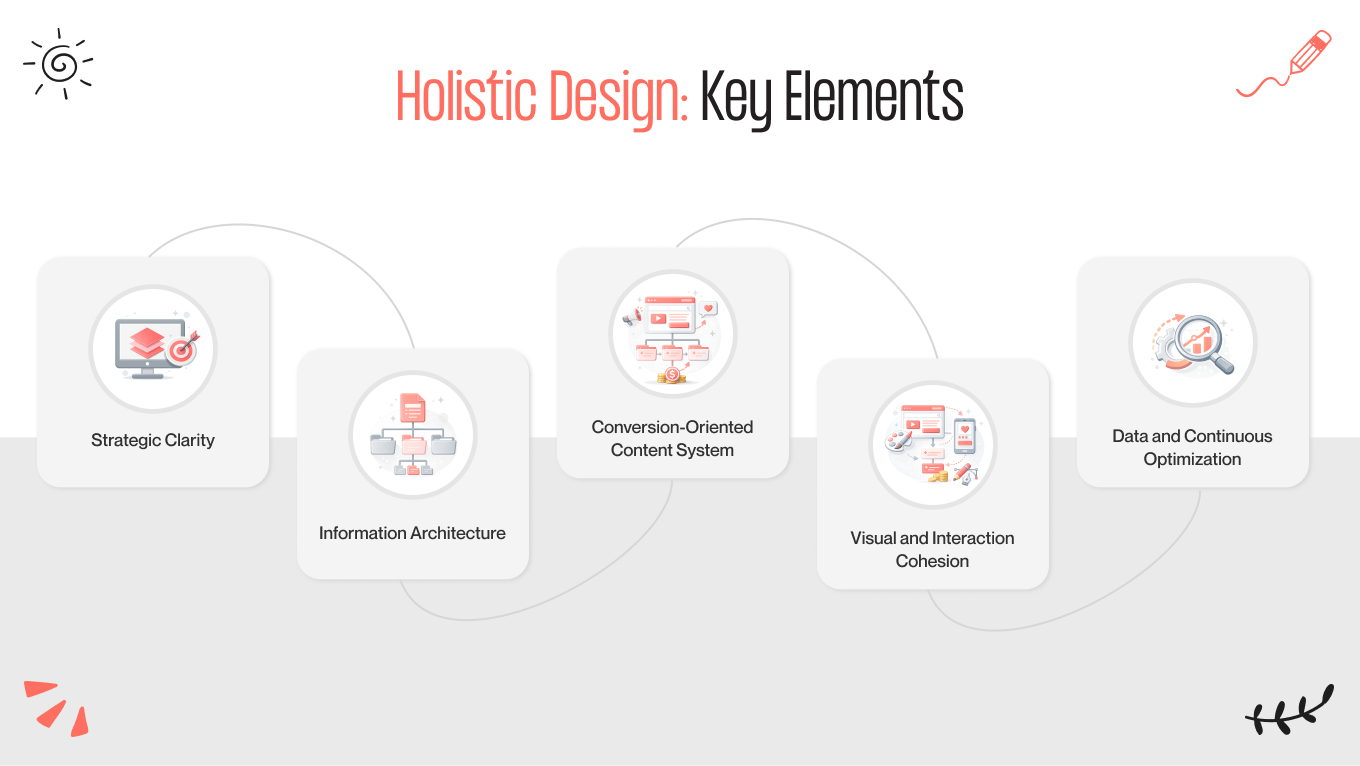
Key Elements of Holistic Design

Holistic B2B website design only works when several core pillars operate together. If one element is disconnected, performance weakens. You can’t compensate for unclear positioning with better visuals, as well as fix structural confusion with more traffic.

When creating a holistic system, we align strategy, structure, messaging, design execution, and measurement into one coordinated framework. Each pillar supports profitability, efficiency, and long-term scalability.

Strategic Clarity

Before design begins, you need clarity on three things: who you serve, how you win, and what outcome defines success:

  • Defined positioning determines what you emphasize and what you deliberately exclude

  • Clear audience segmentation ensures your messaging speaks to real decision drivers instead of generic personas.

  • Measurable goals anchor the project in business reality, whether that means qualified leads, subscription growth, or revenue per visitor.

We at Gapsy start with strategy because design without positioning creates noise. When you know what problem you solve and for whom, structure and messaging become precise. 

Information Architecture as a Business Tool

Structure influences revenue more than visual styling:

  • If your information hierarchy is unclear, users hesitate

  • If navigation forces cognitive effort, trust declines

  • If your value proposition is buried, conversion drops

For us, information architecture is a strategic tool. It determines how quickly users understand your offer, how authority is perceived, and how confidently decisions are made. A clear structure reduces friction and accelerates movement toward action.

Conversion-Oriented Content System

Content should operate as a system. Use testimonials, case studies, guarantees, and data-driven website design points to remove doubt. Your messaging have to guide users through a logical progression: 

  1. Problem recognition
  2. Value explanation
  3. Risk reduction
  4. Proof
  5. Action

Our team builds content frameworks that serve your broader business goals. By timing calls to action precisely when users are ready to decide, and executing them through a highly user-friendly design, we remove barriers to entry. When messaging is rooted in business logic, conversion becomes a predictable reality rather than a hopeful guess.

Visual and Interaction Cohesion

Consistency reduces cognitive load. In turn, analytical ease increases trust. When typography, spacing, proven UX design patterns, and motion behave predictably, users focus on decision-making instead of figuring out how the interface works. On the opposite, inconsistent design creates subtle friction that accumulates over time.

To achieve cognitive clarity, we make visual systems and interaction rules that support clarity. This is about reducing mental effort so users can move forward confidently.

Data and Continuous Optimization

To understand user behavior, you need clear analytics, event tracking, heatmaps, and testing frameworks. Without measurement, your decisions revert to mere opinion. But with the right data, you can see how your visual identity design impacts users, pinpoint friction points, validate your hypotheses, and systematically refine the experience.

We recommend our clients integrate data tracking into their digital structure from day one. This allows for iteration based on hard evidence. Over time, this optimization compounds your performance and protects your investment.

Book a consultation with Gapsy specialists to ensure your next redesign is built for measurable ROI.

Best Holistic Website Design Examples

The most compelling proof of holistic design isn't found in a single beautiful screen. It emerges when you step back and examine how a company has woven brand, technology, psychology, and long-term strategy into a single coherent system. 

The examples below are studies in systemic thinking, and what becomes possible when design is treated as a business discipline. 

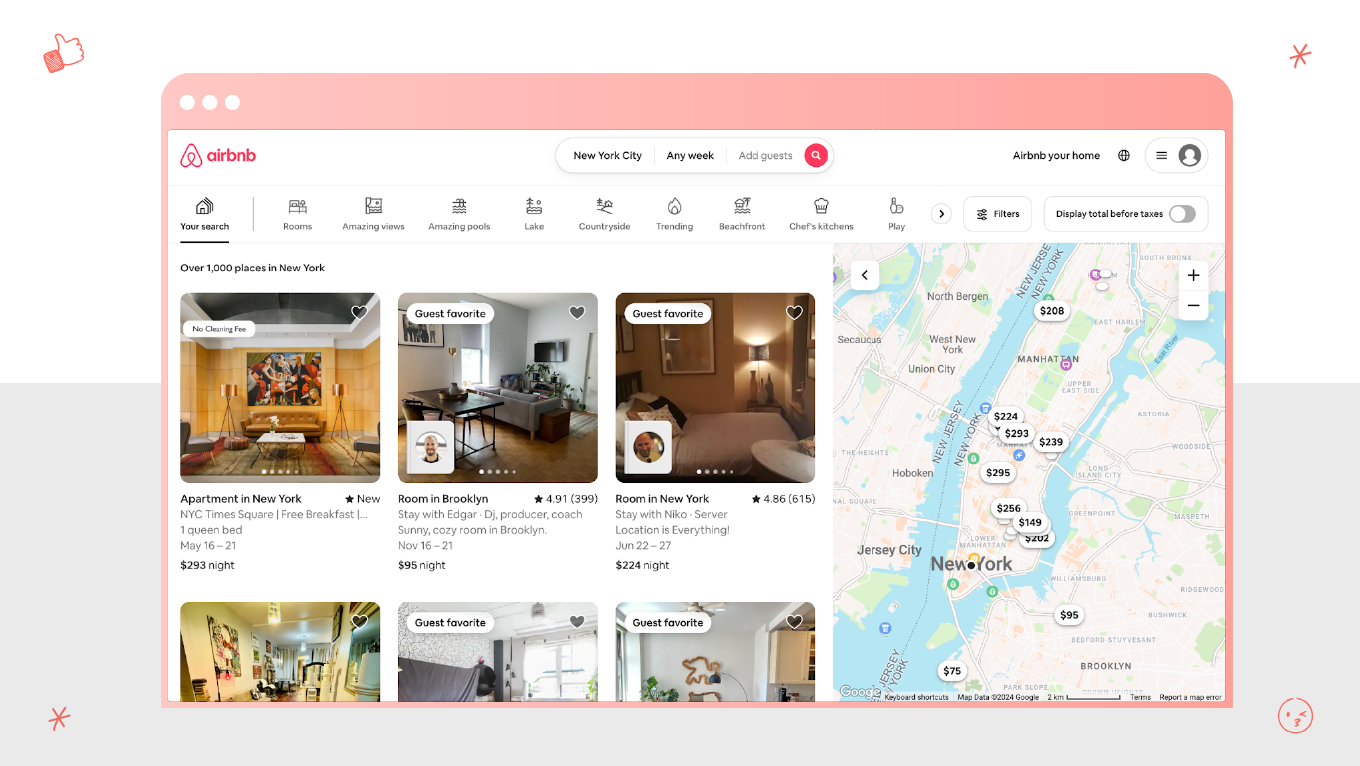
Airbnb: Trust, Search Logic, and Global Scalability in One Ecosystem

Airbnb's platform succeeds because it was never designed around a single problem. Instead, it answers a question of what it takes for a stranger to hand over their home; and for another stranger to feel safe staying in it. 

The answer turned out to require an entire ecosystem: 

  • Trust signals are embedded at every decision point, including reviews, ratings, identity verification, and transparent policies.

  • Social proof reinforces credibility through visible host activity, guest feedback, and community indicators.

  • Search behavior drives the core experience, with filters, personalization, and intent-based discovery shaping how users navigate.

  • The system scales globally through a consistent structure while adapting to local regulations, languages, and cultural contexts.

  • Sustainability and community impact initiatives align operations with broader brand positioning.

Airbnb’s success is the result of an ecosystem where search logic, user psychology, brand trust, and operational scalability reinforce one another.

airbnb holistic design example

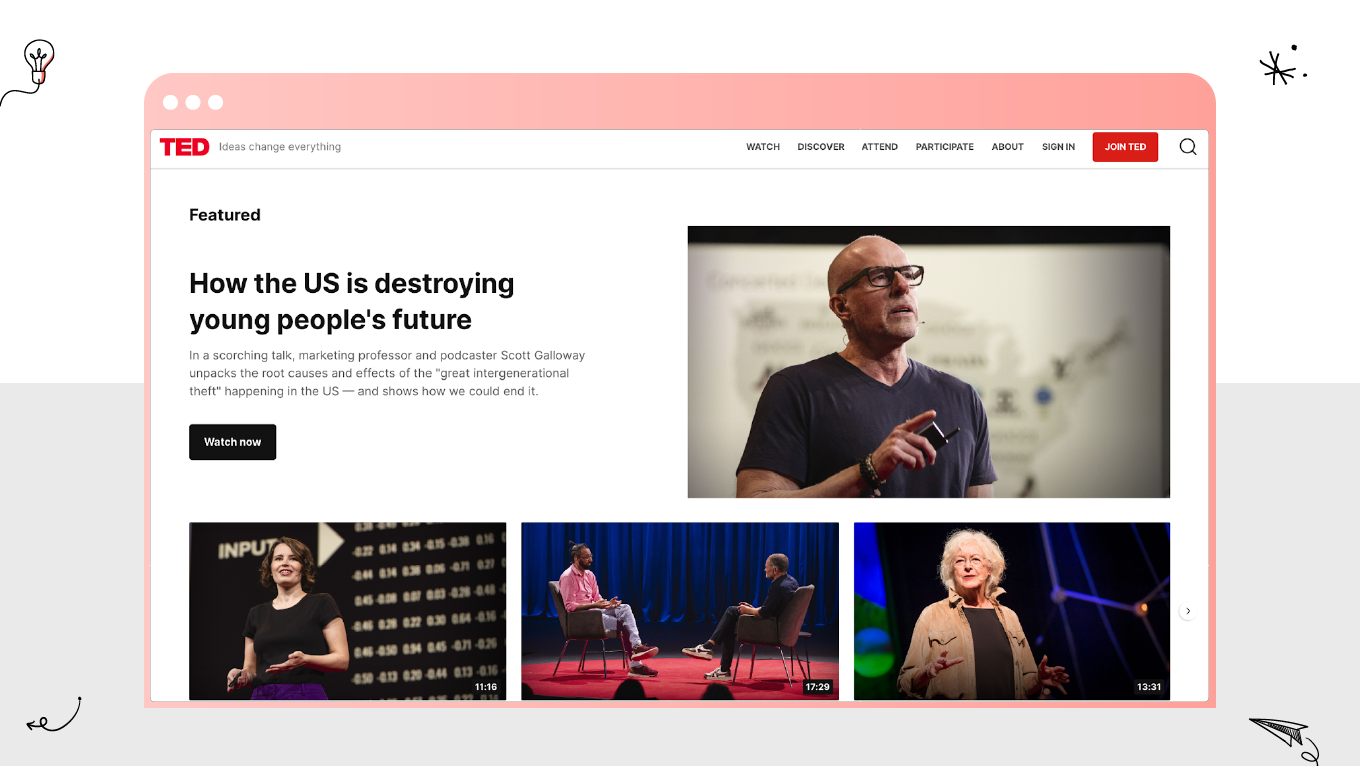
TED: Content Architecture and Authority Driving Engagement

TED's central design challenge is one that grows harder the more successful you become: how do you make thousands of ideas feel discoverable? The answer is treating content architecture as an experience in itself.

  • Storytelling acts as the structural backbone, with talks designed to deliver clear ideas supported by visual narratives.

  • Content architecture organizes thousands of talks into intuitive categories, themes, and collections.

  • Brand authority is reinforced through speaker selection, editorial standards, and consistent presentation quality.

  • Data-driven recommendations personalize discovery based on viewing behavior and topic interest.

  • Multimedia integration across video, articles, podcasts, and transcripts supports cross-platform engagement.

This is how TED has become a platform where structure, technology, and storytelling operate simultaneously. Engagement grows because the design makes pursuing ideas feel effortless.

ted holistic design example

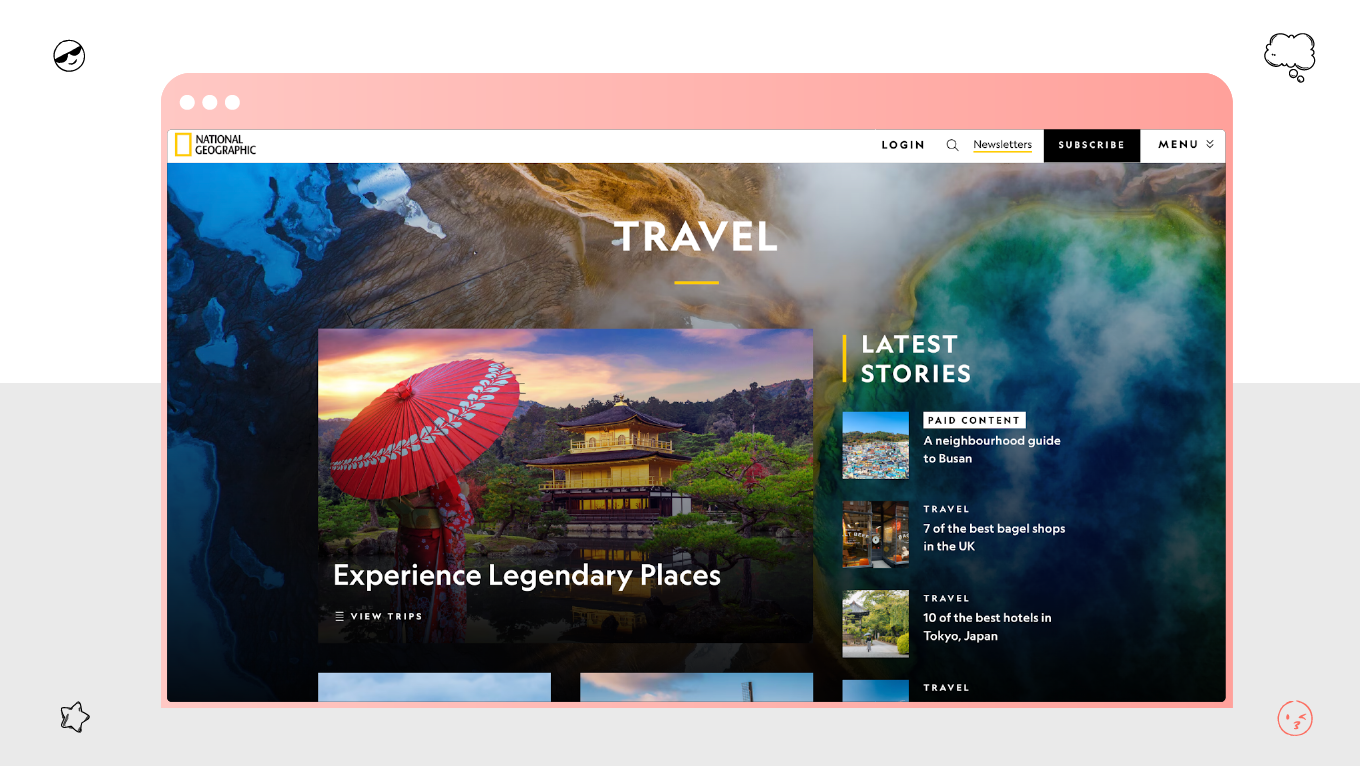
National Geographic: Storytelling, Visual Hierarchy, and Mission Alignment

National Geographic carries one of the most recognisable brand identities, and its digital platform succeeds precisely because it never treats that as a reason to coast. Every design decision is made in service of something larger than the interface itself: a mission that has remained consistent across more than a century of storytelling.

  • Intuitive navigation allows users to explore wildlife, science, culture, and conservation through clearly structured categories.

  • Visual hierarchy emphasizes photography and immersive storytelling, guiding attention without overwhelming the reader.

  • Editorial structure balances long-form narratives with curated collections and multimedia features.

  • Campaigns and content initiatives reinforce environmental advocacy and conservation goals.

  • Consistent brand identity across articles, videos, and interactive features deepens authority and recognition.

The result is an experience that earns something many digital platforms struggle to achieve: time. Users stay longer as the storytelling, structure, and mission give them a reason to keep going.

national geographic holistic design example

How to Apply Holistic Design Approach: Step-by-Step

Holistic design stops being a high-level theory and becomes practical the moment you treat it as an operating process. There is no need for a massive transformation program to get started. What you really demand is structured decision-making, clear ownership, and execution discipline.

Below is the exact framework we use alongside product and marketing teams. 

Step 1: Define Business Objectives and Success Metrics

Before any wireframes or visual concepts, clarify what success means in financial terms.

You should define: 

  • Revenue targets

  • Acceptable CAC thresholds

  • Conversion rate benchmarks

  • Retention goals

  • Strategic positioning

If you compete on authority, price, speed, or specialization, your website should reflect this choice.

Step 2: Map the Full Customer Journey

Redesigns fail when the thinking is too narrow. A more intuitive checkout flow means nothing if the landing page that precedes it sets the wrong expectation. A beautiful onboarding sequence loses its value if the acquisition campaign that feeds it attracts the wrong users entirely. Optimizing isolated touchpoints relocates them.

The more useful questions are: 

  • Where does traffic originate?

  • What expectations are created before users land?

  • What happens immediately after conversion? 

  • How does the experience evolve over time?

Our work begins with mapping that flow in full, understanding not just where users drop off, but why the journey was set up to lose them there in the first place. This is what separates a redesign that compounds value over time from one that produces a brief metric improvement and creates the next problem downstream.

Step 3: Align Brand, Messaging, and UX

Positioning is only as strong as its least consistent expression. For example, a brand that claims expertise but presents information in a cluttered structure sends a contradictory signal, one that users register instinctively. The gap between what a brand says it is and what the experience feels like is where trust erodes.

This is why your positioning shouldn’t live in a document. It has to be expressed through the information architecture clarity, tone confidence, interaction design logic, and visual language precision. Each is either reinforcing the brand's core claim or contradicting it. 

At Gapsy, brand logic, messaging architecture, and UX flows are treated as a single system. When they operate in alignment, the experience becomes easier, and trust, more than any individual design decision, is what drives conversion and retention that compounds over time.

Step 4: Design System and Scalable Architecture

Growth exposes whatever you failed to systematize. A product that scales quickly without the right structural foundation accumulates debt. New landing pages that can't inherit from a shared component library; campaign assets built from scratch each time because no reusable pattern exists; blog content that drifts visually because the content model was never clearly defined. Each of these feels manageable in isolation. Collectively, they create operational drag that slows teams down when momentum matters most.

The solution is better architecture. At this stage, we help companies create a component-based design system in which new pages, features, or campaigns start from a position of consistency. 

Step 5: Implement Measurement Framework

A holistic approach demands accountability. Before launch, define KPIs across acquisition, engagement, conversion, and retention. Implement event tracking, funnel analysis, and behavioral analytics. Ensure data flows into dashboards that leadership can interpret.

Treat measurement as a part of your journey. When tracking is embedded into the system from the very beginning, you gain the clarity to distinguish between what you assumed was working and what the data confirms is driving performance.

Step 6: Iterate Based on Behavioral Data

Launch is the beginning of refinement. You should analyze drop-offs, scroll depth, conversion paths, and post-conversion behavior regularly. Patterns in real user interaction reveal structural weaknesses that assumptions can’t detect.

For design teams, behavioural data is what drives refinement of flows, messaging, and layout. Disciplined iteration, applied consistently over time, transforms a website into an improving growth asset.

Why Choose Gapsy Studio as Your Design Partner

Many design agencies still start with how things look. We begin with how your business grows.

We founded Gapsy with the belief that design only earns its place when it moves the needle on what matters, whether that's a conversion rate, a retention rate, or a user's willingness to come back. 

Over a decade and 300+ projects later, this belief hasn't changed. The industries have varied, while the question we ask at the start of every engagement is always the same: what does your business need this to do?

Some of what that work has produced:

  • 11% higher conversions and 16% organic growth for Creatorset. 

  • 18% increase in engagement for Klever AI. 

  • 97/100 user satisfaction score for Labraix. 

  • 13 international awards, including recognition from Awwwards, FWA, and DesignRush. 

  • A 5/5 rating across 52 reviews on Clutch from clients who stayed long enough to have something worth saying. 

But what we're more proud of is the thinking behind the numbers: the willingness to ask questions early, to push back when the brief is solving the wrong problem, and to treat a pixel as a business decision. 

If your current website optimizes for isolated moments rather than the entire customer journey, the gap between where you are and where you could be is structural. And solvable. Let's map it together.

Conclusion

Holistic website design is a decision about how seriously you take growth. A disconnected platform creates a permanent compensation loop, more ad spend to overcome weak conversion, repeated redesigns that treat symptoms, and friction between teams. Traffic arrives, but profitability stays unpredictable.

When the website becomes part of your revenue architecture, that changes. Positioning aligns with messaging. Acquisition delivers conversion. Growth becomes more predictable because the structure behind it is intentional.

Strategy before visuals. Systems before pages. Performance before aesthetics. That’s what we advocate for at Gapsy. The result is a solution that works. Ready to close the gap between your traffic and your revenue? Let’s talk!

Rate this article

20 ratings
Average: 4.9 out of 5

If you like what we write, we recommend subscribing to our mailing list to always be aware of new publications.

Do you have any questions? We tried to answer most of them!