
A Complete Guide to Hybrid Crypto Exchange Development and Design

13minutes read
hybrid cryptocurrency exchange development

Look at the numbers from 2025: DEXs aren't just a niche anymore. Capturing nearly 22% of total volume and surging in the perpetuals market means the Trust-Liquidity Paradox has finally hit a breaking point. Traders want that snappy, Binance-style execution, but they’re done with the "black box" risk of handing over their assets. They want both CEX speed and their own keys.

Our fintech design studio sees founders stop trying to pick a side in the CEX vs. DEX war. Instead, they’re moving toward hybrid crypto exchange development. It’s a smart architectural play. You match orders off-chain so the platform is fast enough for professional scalpers, but you settle everything on-chain so the exchange never touches the money. From a business perspective, this effectively kills your custodial liability and drastically lowers insurance and legal overhead.

But here is the catch: if you build a hybrid exchange that feels like a clunky DeFi experiment, your users will leave before their first trade settles. In this guide, we’re skipping the fluff to look at the actual mechanics of building a market leader in 2026. We’ll show you how we design around the liquidity desert using aggregation and how to bake in heavy-duty tech like MPC and ZK-proofs without making the UI feel like a cockpit from the 90s.
Key Takeaways

  • The hybrid model solves the industry's core dilemma by decoupling high-speed off-chain matching from transparent on-chain settlement, offering CEX performance with DEX security.
  • White-label solutions are "technical debt" traps that fail at scale. Custom architecture is the only way to own your IP, optimize time-to-trade, and pivot with shifting regulations.
  • Security is useless if users don't feel it. Effective design uses visible trust indicators, MPC technology, and clear "Soft vs. Hard" finality feedback to bridge the gap.
  • Static interfaces are obsolete. Market leaders use modular, adaptive dashboards that scale from a simple retail "Swap" to a complex institutional terminal.
  • To capture liquidity and volume, you should integrate smart order routing (zero slippage), native cross-chain bridging, and institutional-grade APIs (FIX/WebSocket).

Reducing User Churn through Transparency: Our Insights from the Trackwallet Project

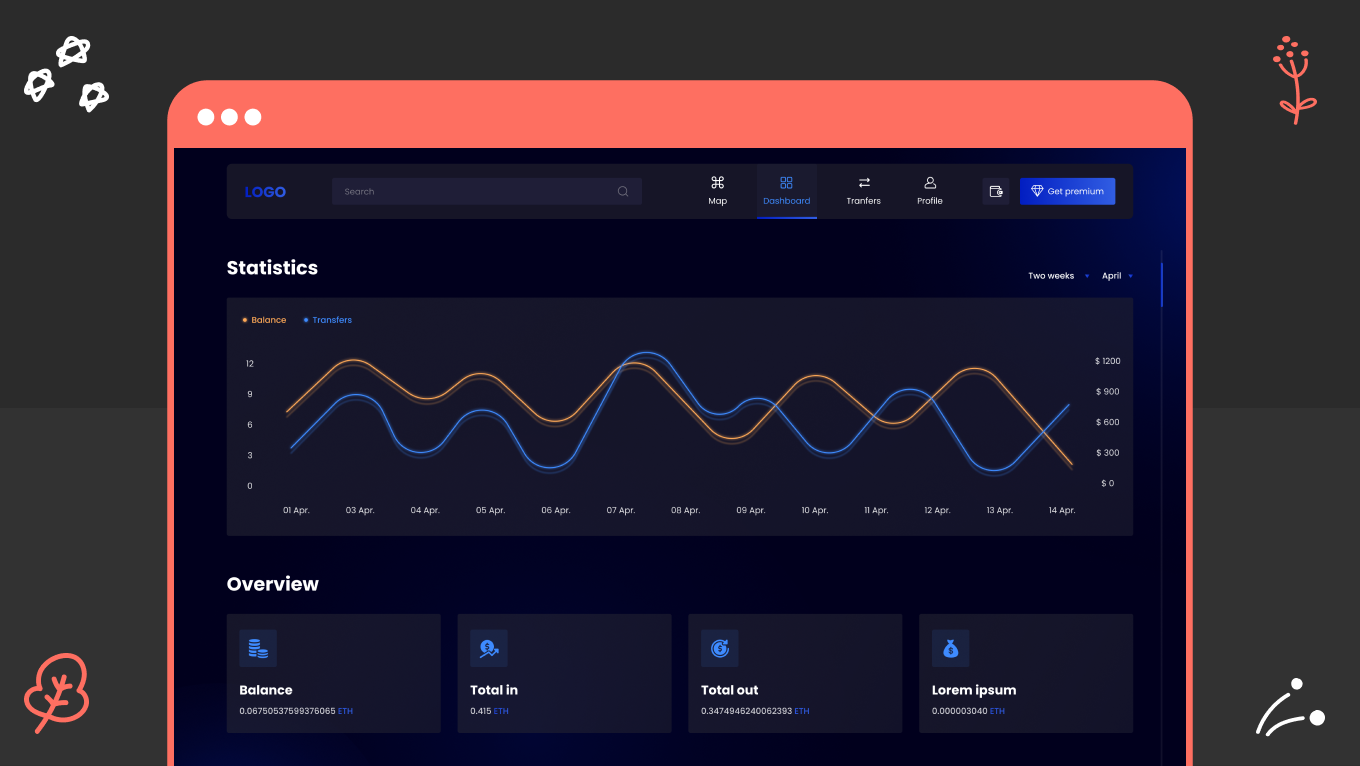
Building a high-performance exchange is about giving users the "visual evidence" they need to trust the system. To illustrate how we translate these complex hybrid requirements into a market-ready product, let’s look at a recent project: Trackwallet.

While Trackwallet functions as a standalone visualizer, data density, transaction transparency, and user-centricity challenges we solved in this project are exactly what a hybrid exchange needs to survive in 2026.

The Challenge: Deciphering the On-Chain "Black Box"

In the hybrid model, settlement happens on-chain, but blockchain data is notoriously difficult to read. For a business, this creates a major hurdle: if a user can't verify their transaction path easily, they default back to the "black box" anxiety of a CEX.

Our goal with Trackwallet was to turn raw hash data into a competitive advantage. We faced a fragmented landscape where users were forced to jump between clunky explorers. We needed to design a system that:

  • Identified connections within a complex crypto network.

  • Offered a command center dashboard for high-volume traders.

  • Simplified 5-layer deep transaction paths without overwhelming the user.

Our Strategy: Insight as a UX Priority

We applied the same design ethos we use for hybrid crypto exchange development:

  1. Informational hierarchy. We mapped transactions. By displaying wallets as distinct nodes on a 2D map, this project gave users an intuitive "bird’s eye view" of their funds.
  2. Seamless navigation. Our team created user paths that allow a trader to move from a high-level volume trend on the dashboard down to a specific timestamp and signature in two clicks.
  3. Trust through transparency. By tracing transactions up to five layers deep, we provided the ultimate tool for due diligence. This is a feature that, when integrated into a hybrid exchange, drastically increases institutional trust.

Business Impact

For our clients, these design choices were growth levers. Trackwallet’s design led to:

  • Enhanced user engagement. Users interact more frequently when they can see the logic of their movements.

  • A verifiable reputation. In an industry skeptical of hidden fees and social engineering, Trackwallet’s visual precision builds a level of trust that marketing copy alone cannot reach.

  • A unique market position. By offering a 5-layer deep tracing system, Trackwallet carved out a niche that general explorers couldn't touch.

Integrating this level of visualization into hybrid crypto exchange software is how you move from being "just another platform" to an essential tool for the modern trader.

The transition to hybrid architecture is a high-stakes pivot. Don't let clunky UX or technical debt stall your growth. Let’s audit your exchange blueprint and build a platform your users can trust.

Architecture Components of the Best Hybrid Crypto Exchange Platforms

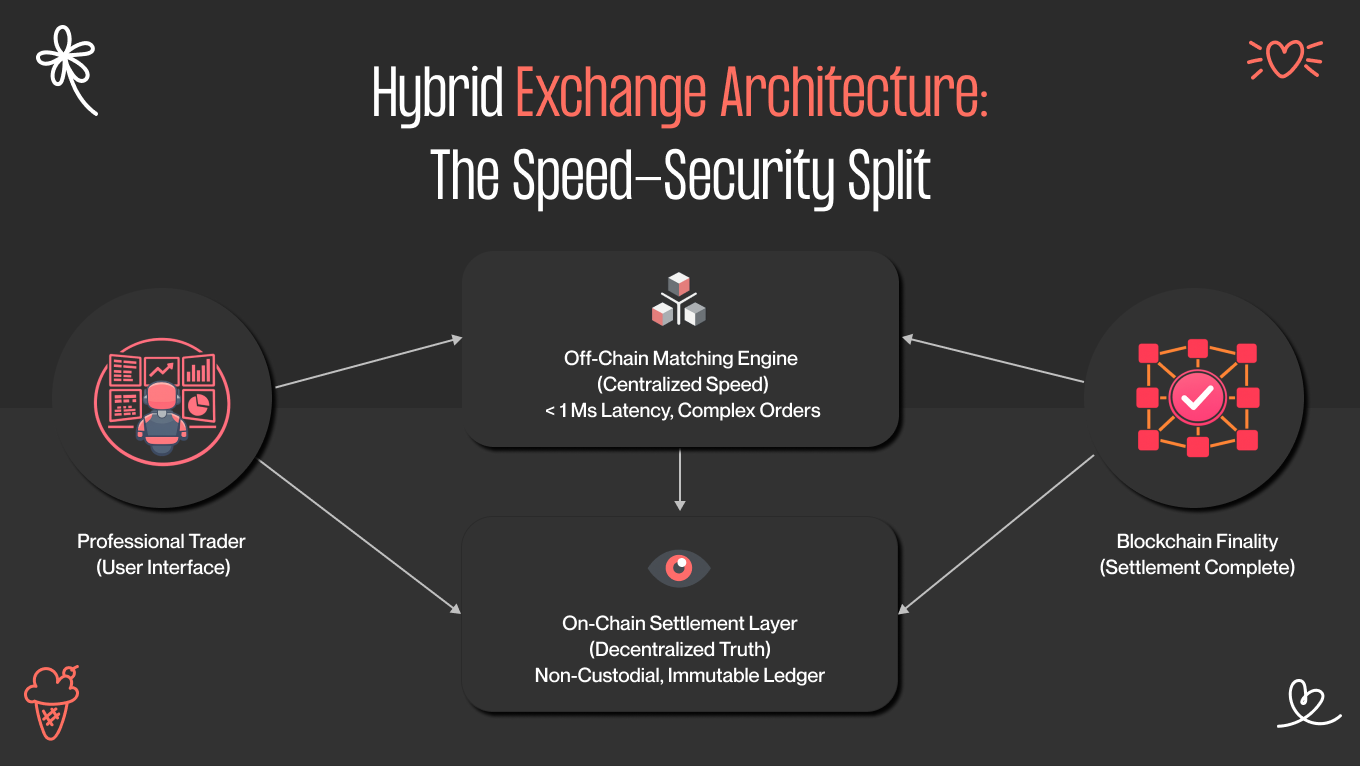
Engineering a market-leading hybrid exchange requires a deliberate structural split. You are building a system that lives in two environments simultaneously: the high-velocity world of centralized matching and the high-trust world of on-chain finality.

How to Achieve the Off-Chain/On-Chain Balance

The core challenge of hybrid crypto exchange development is psychological. You have to convince high-frequency traders that your platform is fast enough to compete, while simultaneously proving to your legal team and your users that you aren't a custodial "black box." We solve this by splitting the exchange’s brain from its vault.

Centralized Speed as the Engine 

In a professional trading environment, milliseconds equal millions. To compete with the best hybrid crypto exchange platforms, you should keep the matching engine off-chain.

By processing orders in a centralized environment, we achieve the sub-millisecond latency required for professional scalpers and market makers. This allows your platform to handle millions of transactions per second (TPS) and support advanced order types (like trailing stops and iceberg orders) that would be impossible or prohibitively expensive to run directly on a blockchain.

Decentralized Truth as the Vault 

While the decision to trade happens off-chain, the ownership of assets is anchored to the blockchain. This is the on-chain truth phase.

Using technologies like ZK-Rollups or MPC (Multi-Party Computation), we ensure that the exchange never takes custody of user private keys. Every matched trade is settled on-chain in batches, creating a transparent, immutable record. From a business standpoint, this architecture effectively kills your custodial liability. If the exchange's matching engine goes offline, the users’ funds remain safe in their own non-custodial smart contracts.

By engineering this split, we provide the performance of a CEX with the "sovereignty" of a DEX. 

Designing for Liquidity

Liquidity is the oxygen of any exchange. If a user tries to execute a large order and sees a 5% price impact, they’ll never return. Our hybrid crypto exchange development strategy focuses on liquidity aggregation to ensure deep markets from day 1.

  • Unified order books. Don’t just rely on your platform's native volume. Your architecture should aggregate liquidity from top-tier CEXs and DEXs, presenting a single, deep order book to the end-user.

  • UX visualization. We design slippage indicators and market depth maps that provide real-time feedback. By showing where the liquidity sits across multiple pools, design replaces anxiety with informed execution.

  • The whale interface. For institutional clients, we design custom OTC and block-trading modules that route large orders through fragmented pools intelligently, minimizing price impact while maintaining the non-custodial security they require.

Build or Buy Hybrid Crypto Exchange Software?

As product designers, we often see founders fall into the white-label trap."They buy a pre-packaged exchange script to save time, only to realize six months later that they’ve built a ceiling over their own growth.

Why does a design studio care about your backend? Because your architecture dictates your experience.

Why White-Label Fails at Scale

When relying on a rigid white-label template, you are often forced to compromise on the trader's journey. If you want to introduce a custom "One-Click Staking" feature or a seamless institutional audit flow, the answer from a white-label provider is frequently "No." You simply cannot optimize what you do not control. This lack of flexibility transforms from a minor annoyance into a critical business failure the moment you try to scale.

The consequences of this "technical debt" become painfully visible when you hit significant volume. Generic scripts are rarely engineered for high-frequency stress; they often crumble under the load of 1M+ users. A laggy execution interface destroys user trust faster than a hack ever could. You can’t design a market-leading experience on top of a broken engine.

Customization as a Moat

We advocate for custom hybrid crypto exchange development because it is the only way to construct a true defensive "moat" around your business. In a saturated market, your intellectual property is your leverage.

When you own the stack, you own the experience. This allows us to design bespoke workflows that target your specific niche rather than the "average user." 

For a platform targeting high-net-worth individuals, we can engineer a streamlined Whale Mode focused on OTC execution and privacy; for a retail-focused app, it’s possible to integrate gamified onboarding that resonates with Gen Z. 

Furthermore, owning your IP provides regulatory agility. When global frameworks like MiCA shift, a custom build allows you to pivot your compliance UI immediately. A white-label solution, by contrast, leaves you stranded, waiting for a vendor update that might never arrive.

The Speed of Intent

Ultimately, we measure design in clicks. The most critical metric for any exchange is time-to-trade, which is the velocity between a user’s intent ("I want to go long on ETH") and their execution.

White-label UIs are notoriously bloated with unnecessary steps designed to fit every possible use case, creating friction where there should be flow. A custom build allows us to ruthlessly strip away the fat, optimizing the interface for pure speed. By minimizing the distance between thought and action, we create the kind of professional-grade responsiveness that keeps serious traders on your platform.

Don't build a clone. Build a contender. Contact us to design a platform that your competitors can’t copy.

Essential Features of Hybrid Crypto Exchange Platform to Bring Speed, Security, and Strategy

Building a market-leading hybrid exchange requires a curated set of features designed to balance the high-velocity demands of professional trading with the non-negotiable need for self-custody. 

A successful hybrid platform uses its user interface (UI) as the critical bridge between centralized performance and decentralized security.

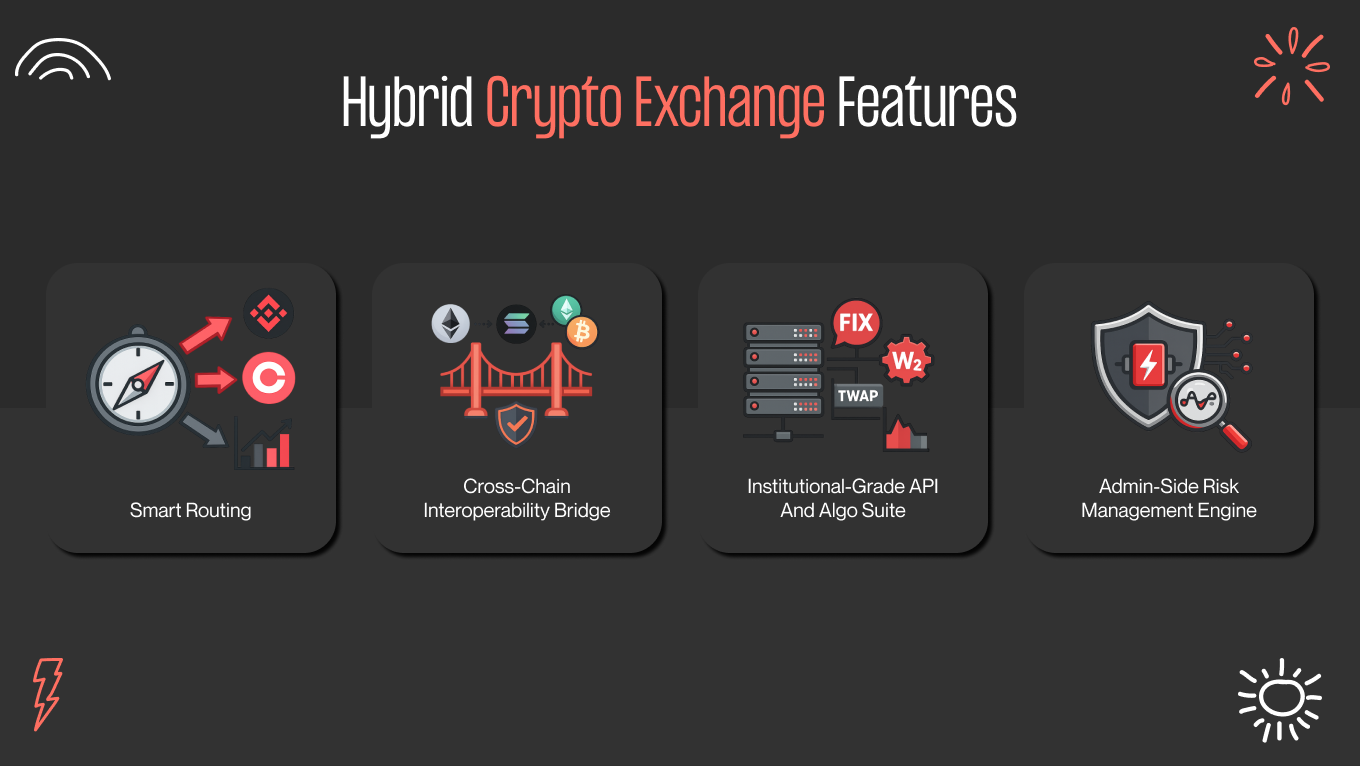
  • Smart routing—solves the "empty order book" problem by scanning external CEXs (Binance, Coinbase) and DEXs to route orders to the best price, ensuring zero slippage from Day 1.

  • Cross-chain interoperability bridge—a native, non-custodial architecture that eliminates "wrapping" headaches, allowing users to deposit ETH and settle trades in SOL or BTC without leaving your platform.

  • Institutional-grade API and algo suite—full FIX Protocol and WebSocket support with built-in algorithmic execution (TWAP, Iceberg), signalling to market makers that your infrastructure is robust enough for high-frequency bots.

  • Admin-side risk management engine—a real-time circuit breaker system that automatically detects and freezes wash trading or suspicious withdrawal patterns before they settle on-chain, protecting your business from liability.

The technology to build a hybrid exchange is complex, but the reason to build one is that users are tired of choosing between speed and safety. They want both. Our team designs the infrastructure that makes this possible. Discuss your project with us.

How Hybrid Crypto Exchange Development Mitigates Counterparty Risk

The statistics are a brutal wake-up call: over $2.55 billion lost across 344+ security incidents, including the staggering ~$1.5 billion compromise of ByBit. These numbers represent the structural failure of the purely centralized model. When storing billions in a single honey pot, you are mathematically guaranteed to attract the world's most sophisticated hackers.

In hybrid crypto exchange development, we treat counterparty risk as an architectural flaw to be designed out, not just a threat to be monitored.

Perceived vs. Technical Security in UX Design 

As engineers, we know that a secure backend is non-negotiable. But as designers, we understand that technical security is useless if the UI doesn't make the user feel safe.

In a hybrid environment, trust has to be visible. If a user is interacting with a non-custodial smart contract, the interface shouldn't look like a generic Web2 dashboard. We design specific trust indicators that actively communicate security status:

  • Real-time dashboards that visualize Proof of Solvency and on-chain verification in plain English, not raw hash data.

  • Replacing cryptic hex strings with clear, human-readable transaction summaries before signing.

  • Immediate visual confirmation when assets move from the "Trading" (off-chain) state to the "Settled" (on-chain) state.

The MPC Integration

The biggest barrier to self-custody has always been the dreaded 12-word seed phrase. Lose it, and your money is gone. This "UX cliff" is why millions stuck with CEXs despite the risks.

We bridge this gap using Multi-Party Computation (MPC). MPC allows us to split a user’s private key into multiple encrypted "shards" distributed across different devices (e.g., the user’s phone, the exchange’s server, and a third-party recovery service).

  • Users can log in with FaceID or an email link. It’s a seamless experience they are used to.

  • The exchange never possesses a complete key. Even if our servers are compromised (like in the 2025 CEX hacks), the attacker cannot assemble the full key to drain user funds.

This is the ultimate goal of hybrid design: providing the bulletproof sovereignty of a hardware wallet with the frictionless usability of a banking app.

Our Design-Led Approach to Hybrid Crypto Exchange Software

As a design studio, we engineer the layer where human psychology meets market volatility. In the hybrid exchange, where the speed of Web2 collides with the finality of Web3, design is the only interpreter your users have.

Here is how we approach the unique UX challenges of hybrid architectures:

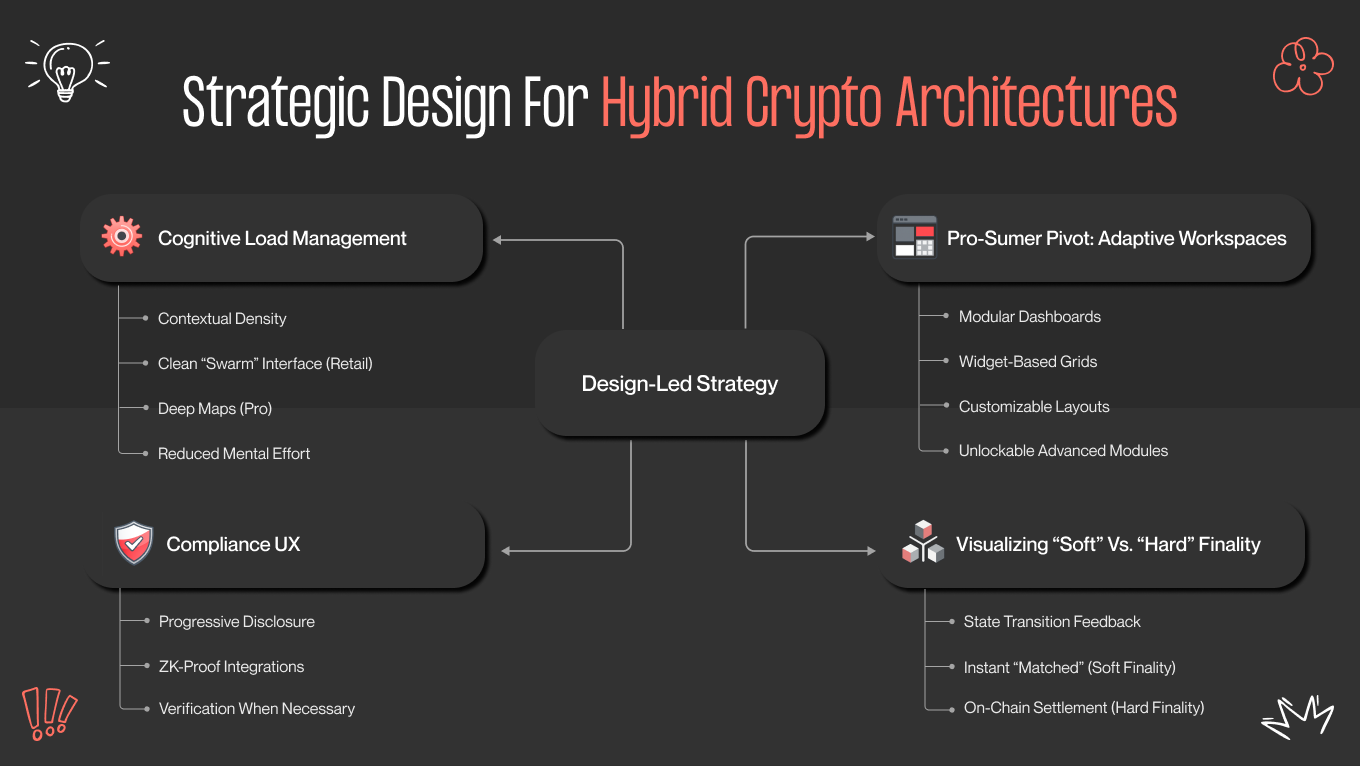
Cognitive Load Management

In a volatile market, information overload triggers analysis paralysis. Most exchanges make the mistake of vomiting data at the user (flashing tickers, depth charts, and order books), all simultaneously. This cognitive noise increases error rates and causes users to hesitate right when they need to act.

Our designers follow a philosophy of contextual density. We recognize that a retail user buying $50 of BTC needs a clean, calm "Swap" interface, while a pro trader needs depth maps and level-2 data. We separate these experiences strictly, ensuring the interface never demands more mental energy than the specific task requires.

Adaptive Workspaces

The gap between a retail user and an institutional whale is closing. The modern "pro-sumer" wants the simplicity of Coinbase combined with the raw power of a Bloomberg Terminal.

To solve this, we build modular dashboards. Instead of forcing a single, rigid layout, this implies designing widget-based grids that users can customize to their workflow. As their skills flow, they can start with a simple view and "unlock" advanced modules, like RSI indicators or iceberg order controls. 

The goal is to design the user your customer will become in 6 months, not just who they are today.

Compliance UX

Regulation is inevitable. However, KYC (Know Your Customer) doesn't have to be the step where your conversion rate dies.

We utilize progressive disclosure and ZK-proof integrations. Instead of hitting users with a massive form at signup, the system requests verification only when necessary, such as when crossing a specific withdrawal limit. 

By showing that data is verified but not stored centrally, we turn a bureaucratic step into a trust-building security feature.

Visualizing "Soft" vs. "Hard" Finality

The unique challenge of a hybrid exchange is that a trade happens twice: first in the matching engine (instant), and later on the blockchain (settled). This can confuse users who are used to immediate bank transfers.

We design specific state transition feedback to bridge this gap. When a user trades, they get an instant "Matched" confirmation (Soft Finality), allowing them to continue trading without pause. A subtle UI indicator then tracks the background process until the funds are cryptographically "Settled" (Hard Finality).

The Trust Anchor

The main selling point of a hybrid exchange is: "Even if we go down, your money is safe." But how do you prove that to a non-technical user?

We design a clear, accessible smart contract direct mode. If the centralized UI or engine goes offline, users can access a simplified, decentralized emergency interface to withdraw funds directly from the blockchain. We design this as a reassuring "vault key" that is always visible in the settings.

Algorithmic Humanization

Hybrid exchanges support complex order types that purely decentralized DEXs struggle with, such as Trailing Stops and OCOs (One-Cancels-the-Other). However, these tools are often hidden behind complex jargon.

We take this institutional logic and wrap it in a natural language UI. Instead of a complex form asking for a "Trigger Price" and "Delta," we use sentence-based inputs: "Sell my ETH if it drops by 5% from its peak."

We’re the Translators Between DeFi Degen and Institutional Suit

You don’t hire Gapsy Studio because you want a pretty dashboard. You hire us because you need a partner who understands why a 200ms delay in UI feedback can cause a panicked user to rage-quit your platform.

We aren't a traditional creative agency filled with people who just learned what a "smart contract" is last week. Our design studio is a collective of product architects, behavioral designers, and crypto-natives deeply obsessed with the friction between human psychology and immutable ledgers.

Our team was built specifically to bridge the gap in the hybrid space:

  • We speak "trader." Our strategists aren't just looking at user personas; they are active participants in the markets. They understand the visceral difference between degen yield farming and executing a six-figure OTC trade, and they design workspaces that respect those distinct mindsets.

  • We respect the code. Our lead designers have backgrounds ranging from front-end engineering to traditional fintech. They don't design impossible interfaces that break your backend; they design solutions that work with your technical constraints, not against them.

  • We prioritize trust over trends. We've seen enough hype cycles to know that flashy animations don't build loyalty; security and clarity do. Our focus is always on designing the transparent, reassuring signals that turn a skeptical first-time visitor into a long-term user.

You handle the liquidity and the smart contracts. Let us handle the friction, the trust signals, and the feeling of "safety" that turns a curious visitor into a high-volume trader.

Final Thoughts

For over a decade, the crypto industry forced users into a dangerous compromise: surrender your keys for the speed of a CEX, or suffer the sluggishness of a DEX for the safety of self-custody. 

In 2026, that trade-off is obsolete.

The hybrid exchange model is the inevitable evolution of the market. It represents the maturation of an industry that is finally ready to serve both the high-frequency day trader and the risk-averse institutional fund.

But remember: superior architecture does not guarantee adoption. You can have the fastest off-chain matching engine and the most secure ZK-proofs, but if the user interface feels clumsy, opaque, or overwhelming, you will lose to a competitor who prioritized experience.

We believe that trust is a design challenge. Your software defines your capabilities, but your design defines your relationship with the user. Don't just build a platform that works. Build one that wins.

Rate this article

20 ratings
Average: 4.9 out of 5

If you like what we write, we recommend subscribing to our mailing list to always be aware of new publications.

Do you have any questions? We tried to answer most of them!