
Website Redesign: How to Plan, Execute, and Drive Revenue

14minutes read
website-redesign

Your website is either your hardest-working salesperson or your biggest bottleneck. There is no middle ground. As users judge your brand’s credibility in 0.05 seconds, and with 252,000 new sites launching daily, stagnation is a revenue leak. If your site is slow, non-responsive, or outdated, you are actively sending qualified leads to your competitors.

We understand that changing your website can feel risky. There is a genuine concern about disrupting what is already working or losing hard-earned SEO rankings. However, in an AI-driven market, staying the same means falling behind. A website redesign is an investment in a platform that increases conversions and grows with your goals.

At Gapsy Studio, we’ve guided many brands change outdated sites into powerful, high-performing assets. In this guide, we share our step-by-step approach to a successful redesign: evaluating your current site, protecting your SEO, and creating a user experience that drives results.
Key Takeaways

  • A UX website redesign is a business-critical transformation and should be driven by data, performance metrics, and growth strategy.

  • The most successful redesigns begin with deep diagnostics before any design decisions are made.

  • Speed, accessibility, mobile-first UX, and scalability are baseline requirements for competitive digital products.

  • Long-term performance depends on systems and governance, performance budgets, modular design systems, and SEO-safe migration processes.

  • A redesign compounds value by improving conversion rates, user trust, retention, and overall revenue efficiency.

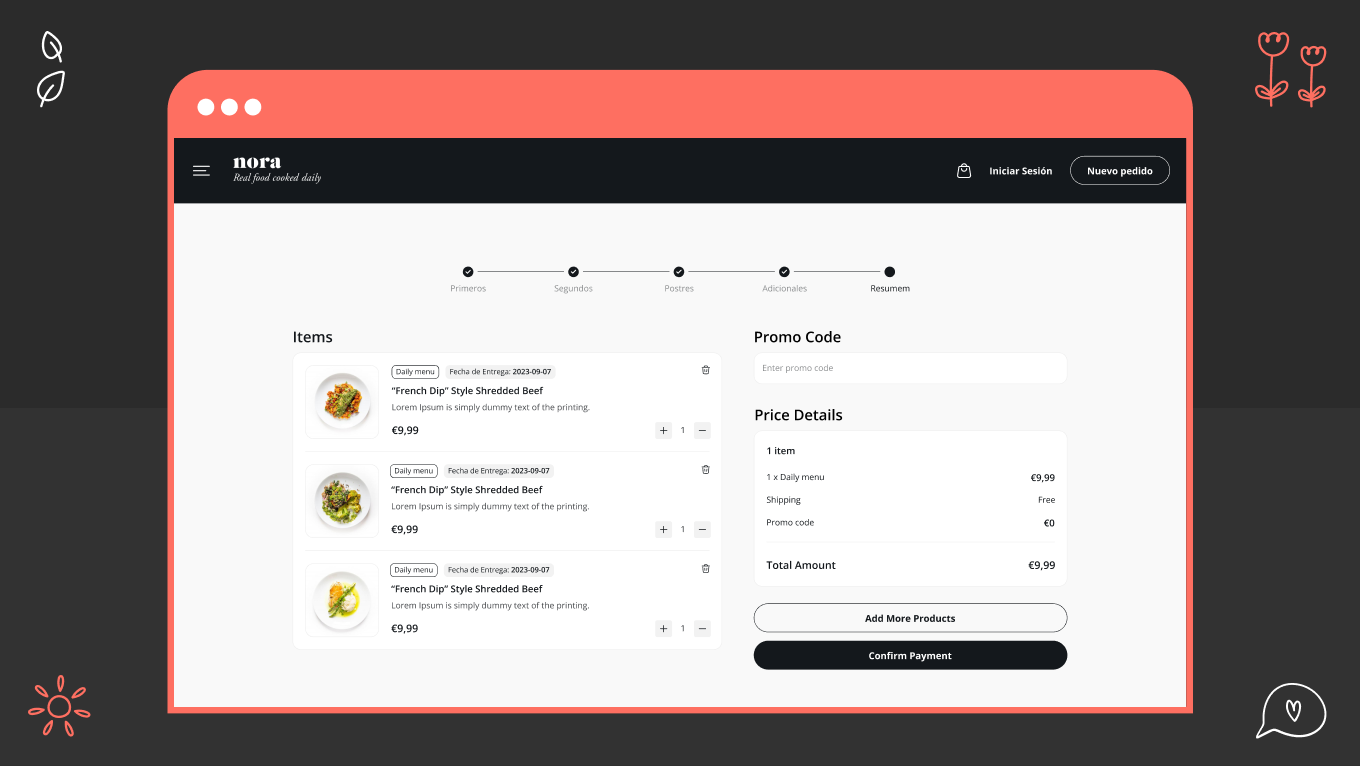
Our Website Redesign Example: The Nora Case Study

Theory is useful, but execution is what drives revenue. To illustrate the impact of a strategic redesign, let’s look at our work with Nora, a corporate nutrition platform that needed to align its digital presence with its operational growth.

The Challenge of Friction in the Funnel

After the initial consultation, we discovered that Nora’s value proposition (simplifying healthy meals for busy professionals) wasn’t translating well online. The digital experience created obstacles when users needed speed and clarity. 

Like many growing platforms, Nora faced a common challenge: creating visually appealing content while maintaining high performance. Our UX research showed that heavy visual assets slowed down the experience.

  • High-quality food photography is important for attracting interest, but unoptimized images cause long load times, risking a drop-off among corporate users ordering during meetings. 

  • Key information was hard to find. Delivery details and meal filters were not easily accessible, forcing users to search rather than take action. This increased mental effort and disrupted the ordering process just before the sale.

Our Solution to Blend Speed and Usability

The redesign aimed to remove unnecessary barriers and build the brand's trust. Instead of just giving it a new look, we created a system that works well in real-world situations.

  • Mobile-First Architecture. Since most orders are made on the go, we prioritized the smartphone experience. The interface works smoothly across all devices, making it easy to order quickly.

  • Technical Optimization. We used strong image compression, cleaned up code, and followed performance best practices to maintain high visual quality without slowing things down. The outcome is a site that feels luxurious but loads quickly.

  • Streamlined User Flows. We rebuilt navigation based on user intent. We made the main “Order” action more prominent, simplified menu paths, and clarified checkout steps, reducing decision fatigue.

The Website Redesign Outcome

The redesign quickly delivered immediate business value, improving both user behavior and internal efficiency.

  • User engagement increased by 25–30% post-launch, driven by faster load times and an intuitive interface.

  • Fewer support requests followed as users better understood delivery options and meal plans upfront, reducing operational strain.

  • A scalable foundation enabled Nora to confidently expand into new regions and target additional customer segments without reworking the platform.
nora gapsy project
nora — gapsy studio project

Give your website a breath of fresh air — let’s talk about reimagining your digital product.

7 Signs You Need to Redesign Your Website

Subjective opinions on the website’s aesthetics don’t justify a budget. Performance metrics do. If you’re still not sure whether to redesign your website, look at these seven diagnostic warning signs. If you check more than two boxes, chances are your website costs you more than a redesign. So, what to look for?

1. Your Conversion Rates Have Plateaued or Dropped

Traffic is meaningless if it doesn’t lead to conversion. When acquisition numbers stay the same but qualified leads or sales drop, the problem isn’t demand; it’s execution.

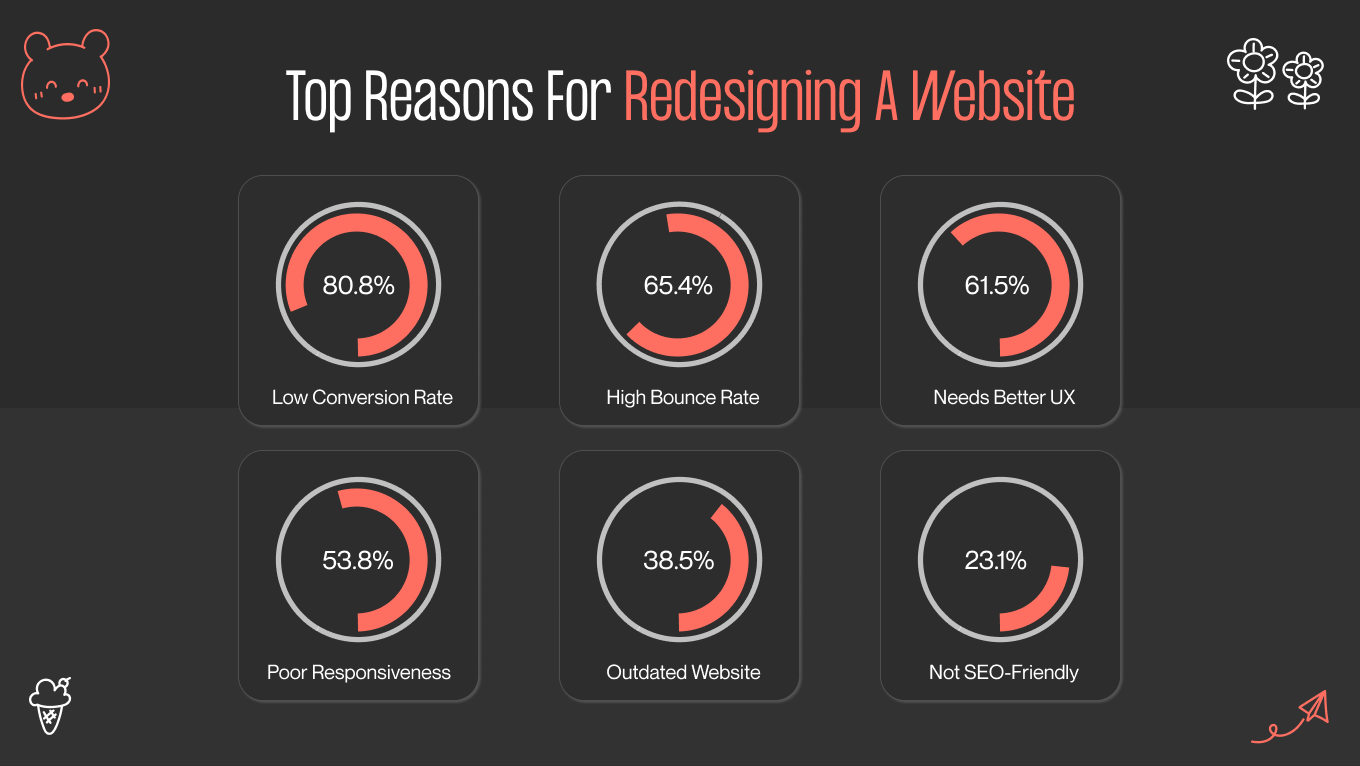
GoodFirms research indicates that over 80% of companies redesign their websites to solve conversion problems. This often reveals deeper issues: unclear calls-to-action (CTAs), overly complex forms, or a user journey that is too difficult to navigate.

A strategic redesign re-engineers the user flow to reduce abandonment and lower your Cost Per Acquisition (CPA), reducing drop-off and improving acquisition efficiency.

2. Your Mobile Bounce Rate Is Higher Than Desktop 

We have moved past the era of "mobile-friendly"; now, that's the era of "mobile-critical." With 64% of global traffic originating from mobile devices, a non-responsive site is a critical failure point. 

If your analytics reveal that mobile users are bouncing at a much higher rate than desktop users, you are effectively alienating the majority of your audience.

This is risky because research shows that 50% of users will immediately visit a competitor after a poor mobile experience. Beyond user sentiment, Google’s mobile-first indexing means a poor mobile site directly penalizes your search rankings, rendering you invisible to potential clients.

3. The "3-Second" Speed Barrier 

In 2026, performance is a product. User patience is virtually non-existent, with 88.5% of visitors citing slow load times as a primary reason for site abandonment.

Heavy code, large assets, and outdated server response times cause delays that users cannot tolerate. Even a one-second delay can reduce conversions by about 7%. If your pages are not usable within 3 seconds, most visitors will never see your value proposition.

4. Updating Content Requires a Developer 

Your marketing team should not need a developer to fix a typo or launch a landing page. If simple content updates require submitting IT tickets or navigating a hard-coded backend, your CMS is obsolete.

Modern redesigns focus on flexibility. They shift teams to systems that let marketers launch, test, and iterate on their own. Reducing technical roadblocks directly speeds up campaigns and improves responsiveness.

5. Your Bounce Rate Is Consistently Above 70%

Consistently high bounce rates indicate a disconnect between expectation and experience. Users arrive, scan briefly, and leave — often because they can’t quickly understand what you do or how to proceed.

61.5% of redesigns are driven by the need to fix poor User Experience (UX). High bounce rates suggest that your Information Architecture (IA) is confusing, your navigation is counter-intuitive, or your value proposition is buried under clutter.

6. You Are Embarrassed to Share Your URL 

This may sound subjective, but it has a quantifiable business impact. This isn’t just an emotional reaction — it’s a commercial one. Users make trust judgments in milliseconds. Design significantly affects perceived credibility. 

If your team hesitates to share your URL and instead uses slide decks or PDFs, your website is lacking confidence. A redesign bridges the gap between the quality of your work and its presentation online.

7. You’ve Rebranded or Scaled, But Your Site Hasn’t

Businesses change. They grow, shift, and expand. When your website does not reflect that change, it creates friction with potential clients who are ready to engage. A site designed for an earlier phase of your business can undermine a new brand direction or cause enterprise clients to doubt your maturity. Updating your online presence to align with your current positioning is crucial for building trust and clarity.

why redesigning a website?

Still not sure if your website needs a redesign? Contact us and we will evaluate your platform’s performance.

What to Do Before Redesigning Your Website

One of the biggest misconceptions about website redesign strategy is that it begins with visuals. In reality, everything is the other way around. Data is the driving force behind the successful digital renovation.

At Gapsy Studio, we operate on a "measure twice, cut once" philosophy. Your website is part of your business infrastructure. Changing it without a thorough check-up is like operating in the dark; you risk harming the very systems that drive traffic and revenue. That’s why we discuss design last. First, we look at how your site performs, how users interact with it, and where the system breaks down in real life, not just in theory.

Conduct a Comprehensive Website Audit

A standard audit looks at traffic. A strategic audit looks at intent and friction. We don't just ask "how many people visited?" but rather "why did they leave?"

Behavioral Forensics

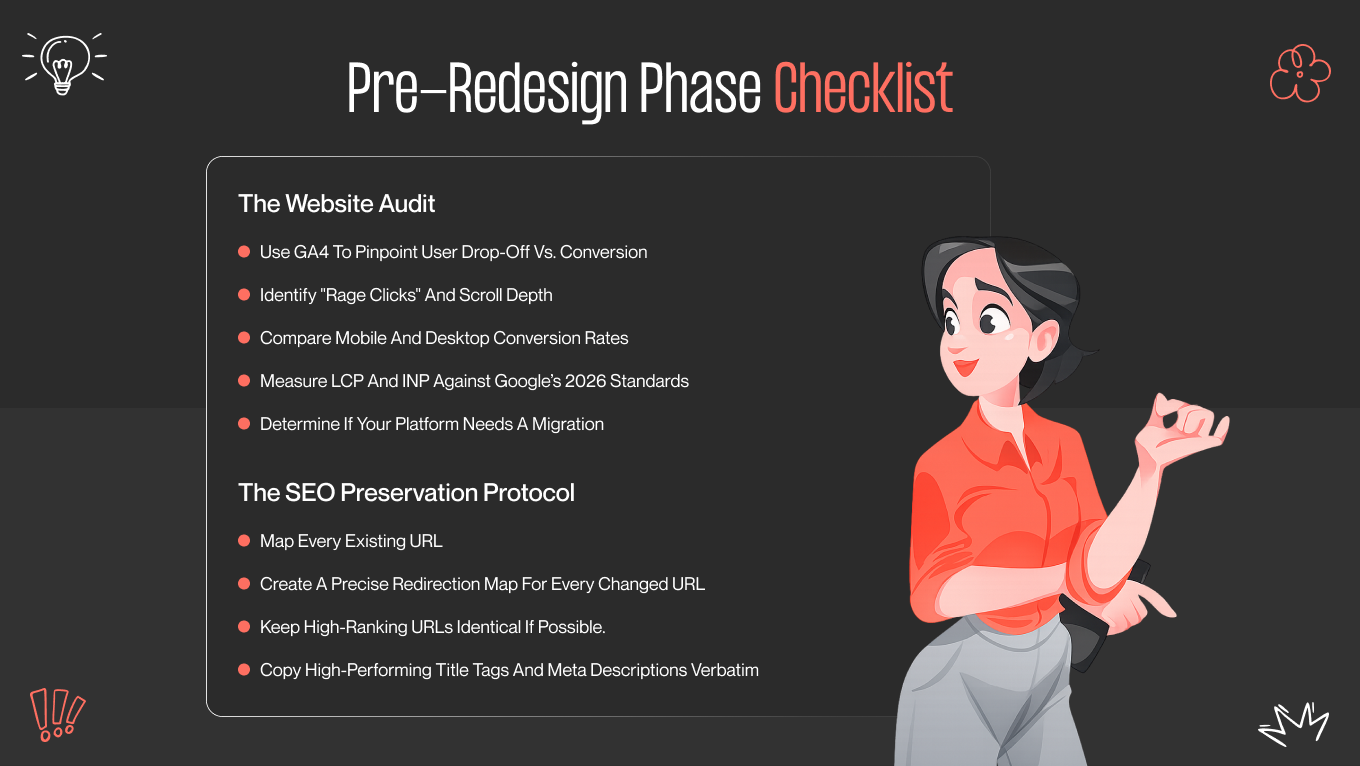
We use advanced analytics (GA4), heatmaps, and session-level insights to understand how users interact with your site and where they lose interest.

  • Bounce Rate vs. Exit Rate. Context matters. A high bounce rate on educational content is expected, but a high rate on a service or pricing page suggests a problem with messaging or structure. We analyze these rates by page type to identify the real issues.

  • Rage Clicks and Scroll Depth. When users repeatedly click on static elements or leave the page before seeing important content, such as pricing or CTAs, it creates a mismatch between expectations and experience. These signs help us improve layout, hierarchy, and interaction design.

  • The “Mobile Gap”. We compare mobile and desktop conversion rates directly. If mobile performance is more than 10% lower, it clearly indicates that user experience, rather than demand, is holding back revenue.

Technical Health Check

Design cannot make up for a weak foundation. We review the systems supporting your site to identify any hidden technical issues.

  • Site Speed and Core Web Vitals. We check metrics like Interaction to Next Paint (INP) and Largest Contentful Paint (LCP) to spot issues with loading delays and user interactions. In 2026, performance issues will no longer be just a user experience problem; they will also affect visibility.

  • CMS Viability. We evaluate if your current setup can handle growth. Often, a redesign is a good opportunity to shift from rigid or bloated systems to headless architectures or more scalable platforms that enable future changes.

How to Redesign Website Without Losing SEO

For C-level teams, the main worry during a redesign is clear: losing organic traffic overnight. This risk becomes real when design changes occur without considering existing data.

We view your current SEO performance as a financial asset. Domain authority, backlinks, and rankings reflect years of hard work. The goal isn’t to reset them; it’s to preserve that value moving forward.

The SEO Preservation Checklist

  • The Crawl and Inventory. Before development begins, we list all existing URLs. This includes low-visibility but high-performing pages that may not appear in the navigation but still drive traffic or conversions. We don’t overlook anything valuable.

  • The 301 Redirect Map. Every old URL should be mapped to its most relevant new counterpart. If a page like /services/consulting moves to /solutions/strategic-consulting This helps users and search engines navigate smoothly during the transition, preserving ranking history and authority.

  • Structure Preservation. If the current URL structure works well, we keep it. When changes are needed for UX improvements, we use clear, direct redirects without unnecessary chains or confusion.

  • Meta Data Migration. Pages that already rank well keep the elements that helped them achieve that position. We carefully transfer title tags and meta descriptions rather than rewrite them, protecting the keywords Google trusts.
pre-redesign phase checklist
steps for a pre-redesign phase

Nonetheless, a drop in traffic of 5-10% is common for 2-3 weeks post-launch as Google re-crawls the site. However, with a proper SEO migration strategy, traffic should not only recover but exceed previous benchmarks within 60 days.

2026 Website Redesign Standards

Visual styles will always evolve but standards remain steady. Some shifts have gone past being just trends; they are now basic expectations. Treating them as optional is dangerous. This is a website redesign checklist outlining the essential elements of a modern, future-proofed digital product.

AI-Enhanced Workflows

AI is now part of most modern design workflows, but how we use it matters. At Gapsy Studio, we don’t see AI as a creative substitute but rather as a way to improve efficiency.

Automation takes care of the repetitive, low-value tasks such as asset optimization, layout changes, code cleanup, and quick prototyping. By removing these obstacles, our senior designers and strategists can concentrate on work that really makes a difference. This includes brand positioning, behavioral design, and conversion logic. The benefits are obvious: faster launches, fewer wasted hours, and high-quality results without high production costs.

Sustainability and Green Code

Sustainability has become a technical challenge as consumers are increasingly eco-conscious. The internet has a measurable environmental impact, and inefficient websites play a part in it. Our view is straightforward: improved performance means greener performance.

“Green design" means preserving the planet as well as saving milliseconds. By optimizing code, compressing media, and using efficient hosting, you can cut website carbon emissions by up to 60%.

The ROI here is twofold: faster sites load faster, rank higher, and convert better. Being environmentally responsible happens naturally when we build things the right way.

Accessibility (A11y)

Meeting W3C (WCAG 2.2) compliance is now a legal and ethical baseline, yet many businesses still view accessibility as a constraint. We view it as a growth hack. 

By designing for the visually or motor impaired, you immediately expand your Total Addressable Market (TAM) by 30%. Designing for inclusivity means your site ranks higher on Google and opens your brand to millions of users (including the aging population) that your competitors are actively ignoring.

Dark Mode and Modular Layouts

With 82% of users now preferring dark mode, dynamic theming support is mandatory. This is about respecting user autonomy and preserving battery life. 

We combine this with modular, Bento-style layout systems that work well across breakpoints. Modular architecture lets content and features grow without major changes, making updates quicker and safer. Instead of redesigning pages each time priorities shift, the system handles growth smoothly.

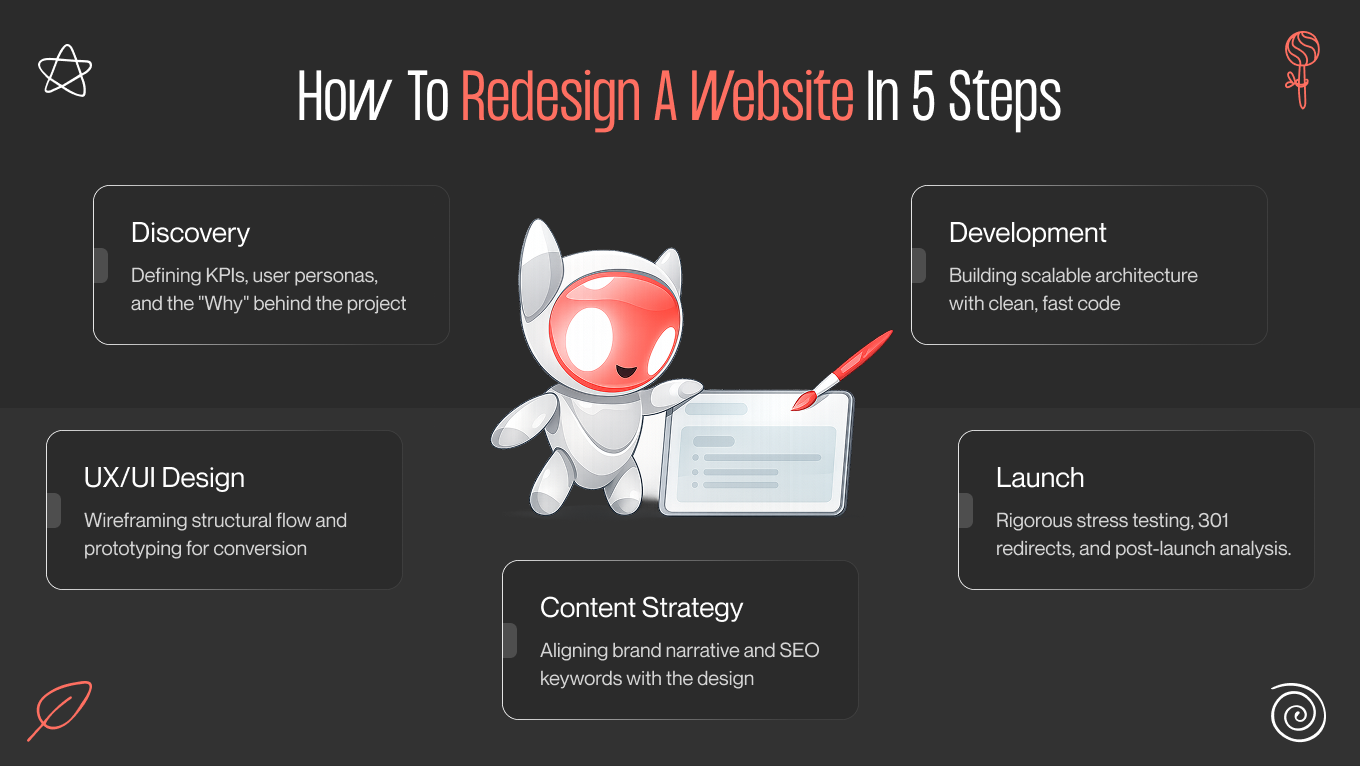
The 5-Step Website Redesign Process

A successful redesign is a cycle of strategic refinement. At Gapsy Studio, we have moved away from the "waterfall" methods of the past to an agile approach. This means our team strives to engineer a digital ecosystem.

website redesign process

So, how to redesign a website? Here is how we execute.

Step 1: Discovery and Strategy

Most digital projects fail because execution starts before understanding. Real strategy begins with diagnosis, which tests assumptions against data and business reality. Instead of just listing wants, this phase clarifies what the business really needs to grow sustainably.

  • Map objectives to actions. Business goals matter only if they translate into observable behavior. Whether the aim is to get higher-quality B2B leads or boost repeat purchases, each goal connects to a specific action the interface needs to trigger. If a design element doesn’t support that action, it won’t be used.

  • Psychographics over demographics. Demographics tell us who users are, while psychographics reveal what drives them. We examine pain points, decision blockers, and emotional triggers to identify what causes hesitation and what encourages commitment.

  • The KPI roadmap. Success metrics such as AOV growth, lead quality, retention, or reducing bounce rates become essential reference points. These KPIs keep every design discussion focused on results, removing subjective debates and personal preferences later in the process.

Step 2: UX/UI Design and Prototyping

UI/UX design is practical logic. This phase focuses on reducing friction rather than adding style. Before we discuss aesthetics, we must create the site’s structure so users can navigate it intuitively and without mental overload.

  • Blueprints before paint. Navigation, content hierarchy, and interaction patterns must function in grayscale before we start visual design. If the layout doesn’t work at this level, adding color won’t solve the problem.

  • Less noise and more signals. We intentionally eliminate visual clutter and unnecessary elements that distract from the main focus. Minimalism here serves a practical purpose, ensuring users always understand what to do next and why it’s important.

  • Systems instead of just pages. Instead of creating static screens, we develop a modular Atomic Design System. Reusable components like buttons, cards, and typography scales ensure consistency, reduce technical debt, and allow the product to grow without losing visual integrity.

Step 3: Content Strategy and Narrative

"Lorem Ipsum" kills good design. Without real content, layout choices become guesses. A content-first approach ensures the interface enhances the message rather than limiting it.

Design centers on actual headlines, value propositions, and CTAs. This ensures that visual hierarchy supports the story, guiding users from awareness to trust to action with clarity and focus.

Step 4: Development

This is where strategy becomes the foundation. The focus shifts to creating a fast, reliable system with clear, readable code that works well for both users and search engines. Every technical choice considers future growth. 

  • Future-ready tech. Whether the solution includes a headless CMS, a React-based front end, or a hybrid architecture, the stack is chosen to support future integrations, internationalization, and product expansion, not just current needs. 

  • Security by design. Encryption, secure authentication processes, firewalls, and data protection protocols are incorporated at the foundational level. Security is not added later; it is integrated into the system before launch.

Step 5: Testing, Launch, and Post-Launch Analysis

Launch day is not the finish line; it is the beginning for data collection. The transition from development to A/B testing to live production requires rigorous "stress tests" across devices, browsers, and network speeds to ensure stability under pressure.

Here’s how you can do this: 

  • Simulate high-traffic loads to guarantee the site won't crash during the next major marketing campaign.

  • Roll out to a small segment of users first to detect edge-case bugs before the full public reveal.

  • Monitor analytics daily for the first month. This helps identify immediate improvements in conversion pathways and enables micro-adjustments in real time.

Your website is an online reflection of your brand’s values. Redesign with Gapsy Studio — let’s discuss all the details.

Investment & ROI: What Does a Website Redesign Cost?

A strategic B2B website redesign aligns user experience, performance, and content architecture to support higher-quality leads and sustained revenue growth. Among all the website redesign questions we receive, the most common one is, "How much?" The most honest answer is, "It depends on the scope of your ambition."

In 2026, the global market for professional agency work typically ranges from $5,000 for a small business website redesign to $75,000+ for larger companies (depending on the scale). To a CFO, that variance can be confusing. However, the gap between the low end and the high end is about the difference between a cosmetic "reskin" and a strategic revenue engine.

Template vs. Custom Website Redesign Strategy

Why pay for a bespoke agency approach when a $200 template exists? The answer lies in risk mitigation and scalability.

Let’s compare custom strategy and ready-made templates: 

Feature

The budget approach (Template)

The strategic approach (Agency)

Primary focus

Provides a generic layout and color scheme. Focuses on "looking new" rather than performing better.

Engineers specific user flows based on behavioral data to maximize conversion and revenue.

SEO impact

Often results in a ~40% drop in organic traffic due to broken links, missing metadata, and ignored URL history.

Includes rigorous 301 redirect mapping and authority migration to protect and eventually boost your rankings.

Scalability

Relies on bloated plugins and heavy themes that degrade speed over time and break under high traffic.

Custom-engineered on clean code to handle high traffic loads and seamless CRM/ERP integrations.

The outcome

A website that looks different but performs the same (or worse).

A digital asset that acts as a scalable revenue engine.

Remember that the most expensive website design is the one you have to redo because the first one didn't convert.

Calculating the ROI of Redesign

A redesign should never be viewed as a sunk cost; it is a capital expenditure with an expected return. To measure success, move beyond "it looks better" and focus on Payback Period and Conversion Lift.

The Formula: (New Monthly Revenue - Old Monthly Revenue) ÷ Total Cost of Redesign = ROI Speed

Imagine your current site generates $50,000/month with a 1% conversion rate.

  • You invest $40,000 in a strategic redesign.

  • The new UX improves the conversion rate to just 1.5% (a conservative lift).

  • Your monthly revenue jumps to $75,000 (an extra $25k/month).

In this case, the redesign pays for itself in less than 2 months. Every month thereafter is pure profit. When viewed through this lens, the initial price tag becomes secondary to the upside in performance.

5 Website Redesign Best Practices from Our Team

"Best practices" are the minimum requirement. They help you avoid failure, but they don’t guarantee success. To create a digital product that remains competitive in 2026 and beyond, execution must go beyond the basics. Here are five key principles we include in every redesign to ensure performance, scalability, and long-term relevance.

The "Performance Budget" Approach 

Many websites start quickly but slow down as scripts, trackers, and large files accumulate. We avoid this by treating performance as a limited resource, not something to think about later. A Performance Budget sets clear limits on page size, script size, and resources that block rendering. 

For instance, we cap JavaScript sizes on critical pages. If a new feature goes over the budget, we optimize or refactor it before it goes live. This method promotes discipline across teams and ensures that speed is not sacrificed for convenience. The outcome is a site that stays responsive months after launch, not just during the initial release.

Cognitive Load Management

We design for attention. Every interface competes with distractions, and too much information can quickly drive users away. By applying principles of behavioral psychology, such as Jakob’s Law, Hick’s Law, and the Peak-End Rule, we intentionally make things easier to understand.

Layouts follow how people naturally scan information, visual hierarchy highlights the most important elements, and choices are kept to what users can act on right away. When users don’t have to think too hard, they take action. Reducing cognitive load increases completion rates and improves conversions.

Predictive Performance

Speed scores (LCP) are important, but perceived performance is critical. We implement predictive pre-fetching technology. By analyzing cursor movement and hover intent, the site begins loading the destination page before the user clicks the link. 

To the user, the transition feels instantaneous. This "perceived speed" creates a premium psychological association with your brand: you are fast, efficient, and reliable.

The "Living" Design System

Many redesigns slowly fall apart as new pages are added without supervision. Visual consistency erodes, and the product loses credibility. We prevent this by building “living” design systems, which are fully coded component libraries integrated directly into the CMS.

Content teams don’t improvise layouts; they assemble pages using predefined, performance-tested blocks. This management ensures visual integrity, accessibility, and responsiveness stay intact over time. The site looks intentional and coherent on day 500, not just at launch.

"Trust-First" Data Architecture

In a climate of increasing skepticism, trust boosts conversions. We create interfaces that convey safety and transparency without using legal jargon. Forms only ask for what is necessary, which lowers friction and anxiety. Privacy controls are clear and easy to understand, not hidden.

During critical moments, such as checkout or data submission, we provide reassurance with clear security signals and feedback. By integrating privacy into the user experience, meeting regulations becomes a benefit rather than a limitation. This architecture turns compliance (GDPR/CCPA) from a legal headache into a customer trust-building feature.

Need to Redesign Your Website? You’re in Good Hands

Our team at Gapsy Studio views a UX website redesign process as a fundamental business transformation. Our team combines strategy, design, and engineering with a common belief: good design is about solving real problems and creating measurable results.

With over 300 projects worldwide, helping both early-stage startups and established companies handle digital changes. This guide was created because we often see strong brands held back by outdated digital systems. Our goal is to be long-term partners, focused on performance metrics, user loyalty, and building platforms that enable ongoing growth.

Gapsy Studio is Your Reliable Partner

Our team is here to help you enhance your online presence.

Final Takeaway

A static website is a depreciating asset. With user expectations evolving and technology advancing rapidly, clinging to a legacy design is a cap on your growth potential. 

A successful redesign requires moving beyond subjective aesthetics to embrace a strategy rooted in data, performance, and scalability. It is about shifting your mindset from "fixing a webpage" to engineering a competitive advantage.

Your digital presence should be your company's hardest-working employee. By prioritizing SEO preservation, mobile-first architecture, and conversion efficiency, you transform your site from a digital brochure into a measurable revenue engine. The cost of stagnation is high, but the opportunity for reinvention is limitless. If you are ready to align your digital infrastructure with your business ambition, the time to start planning is now. Gapsy’s here to take your website to the next level — let’s start a conversation.

Rate this article

21 ratings
Average: 4.9 out of 5

If you like what we write, we recommend subscribing to our mailing list to always be aware of new publications.

Do you have any questions? We tried to answer most of them!